


To learn more, visit Johnhancock.com
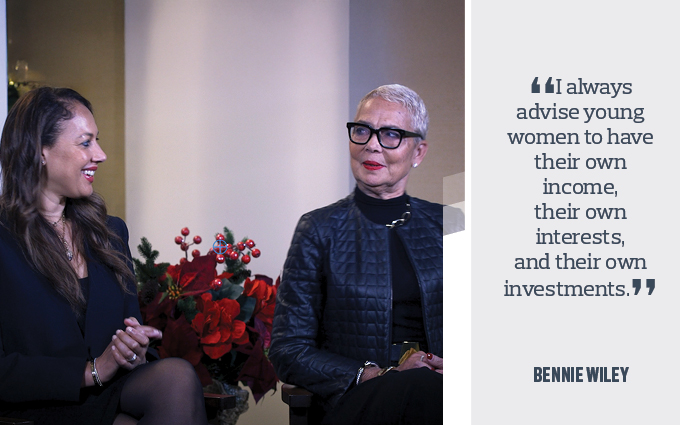
A great many “truisms” are frequently ascribed to mothers and daughters, and most would agree that there’s no stronger bond, forged by shared life experience, mutual respect, and – let’s be real – often passionate generational differences. In the case of Benaree “Bennie” Pratt Wiley and B.J. Wiley Williams, mother and daughter share a relationship that transcends the personal and the professional.
Both women have traveled their respective paths—one marked by decades of barrier-breaking leadership in boardrooms and civic institutions, the other driven by entrepreneurial innovation in the wellness economy—all the while mirroring one another’s ideals, interests, and achievements.
“BJ and I are the first African American mother–daughter graduates of Harvard Business School – we’re very proud of that,” Bennie Wiley is quick to offer. She’s equally proud of the duo’s shared commitment to helping other African Americans advance economically and prepare for the future.
For 15 years, Bennie Wiley led The Partnership, Inc., transforming it into one of the most influential engines for attracting, retaining, and developing professionals of color in the Greater Boston region. She continues to drive economic impact through a broad portfolio of corporate board service, including BNY Mellon Mutual Funds and CBIZ Inc., as well as civic engagement with organizations like the Black Economic Alliance.
Representing a younger generation, B.J. Wiley Williams is leaving her own imprint as founder and CEO of the healthcare startup, SoHookd. “We’re a turnkey wellness platform that helps employers support employee well-being and engagement,” says BJ, who adds that she sees herself as “part of a legacy focused on expanding access.” Indeed, BJ views her work as a continuation of the values that raised her, emulating her mother’s commitment to preparedness and fiscal discipline.
When asked about financial preparedness, Bennie believes in understanding terms and aligning goals: “When I think of retirement, I think of planning to have the resources to live whatever lifestyle you envision once you’re no longer working or earning income. When I think of preparedness, I think of planning for the unknown. There may be illnesses, opportunities—there are many twists and turns in life you don’t expect. It’s always good to prepare as best you can for those unexpected events.”
BJ immediately builds on that framework: “What I like about the word ‘preparedness’ is that it’s not only about the future—it can be about the ‘now.’ My husband and I are always talking about risk–reward, where we invest, and how we invest. Yes, we’re preparing for the future, but we’re also preparing so we can take the kinds of investment risks we want to take today.”
These issues are pointedly relevant in both women’s lives right now. It’s been less than a year since the passing of Bennie’s husband (and BJ’s father), Fletcher Wiley, at age 82. An attorney, civic leader, and a principal figure in Boston’s business community, “Flash” Wiley was very much Bennie’s co-chair of family finance, putting future security ahead of unchecked spending on material desires. In many families, the death of a loved one can expose years of unpreparedness and unleash devastating economic consequences. Not the Wileys.
As BJ explains: “My parents always understood survivorship, joint accounts, trustees—everything that could delay transfers when someone passes away. My parents were very thoughtful so that if anything happened to one of them, things would be seamless for the other.”
Speaking of her partnership with her late husband, Bennie says the couple was always intentional about money strategy and decision-making, underscoring the distinction between income and wealth. “We decided to be investors because we believed creating wealth was important. Not every investment was successful, but all were thoughtful, and enough worked out.”
One critical investment strategy for the couple was deferred income, such as insurance, which she describes as vital for building financial security. The approach extended to the couple’s board service.
“When Fletcher and I first joined corporate boards, which we did relatively early in our careers, we deferred that income as a way of planning for future resources,” she said, going on to explain the mechanics: “When you put what you earn into a vested account instead of taking the money upfront, that money has the opportunity to grow. A lot of executives do this.”
Of course, income deferment as a wealth creation strategy isn’t reserved for corporate execs. For Bennie and BJ and their families, it’s part of a multi-tiered approach to making money you earn work and grow in the long term.
“One of the best ways people—Black people and everyone else —can create wealth for themselves is through entrepreneurship,” BJ says. “A major part of the journey has been investing in our businesses, and as we earn income, setting money aside for retirement—planning not just for today but for tomorrow.”
Bennie agrees, adding that the benefits go far beyond personal success, impacting the larger community. “Entrepreneurship is critical – not only being an entrepreneur but also investing in other entrepreneurs and serving as a resource so they can succeed, and our community can succeed. Building that ecosystem is essential.”
As for Bennie Wiley, she continues to build her corner of that ecosystem, embracing the future after the loss of her life partner. While being part of a union that shared a determination to prepare for the future helped her land in a position of strength and stability, Bennie also credits the steps she took to secure her own financial independence.
Marriage or any long-term partnership isn’t necessarily security , especially for women.
“I feel thankful that I have my own life—my own income, interests, and investments,” she says. “Even though my husband and I made decisions together, having independence makes things much easier now. I advise young women to always have their own lives—not separate, but independent enough that they’re always secure.”
Having made the case for independence, Bennie believes family members working in sync is essential to maintaining that foundation. “I’ve leaned on my children throughout my husband’s illness and since his passing. I can’t imagine how difficult this would be without them. Together, we make a great team.”
For BJ, the philosophy comes full circle in a personal mantra: “Preparation is power. I think that’s true not just for financial planning but almost anything in life.” Together, Bennie Wiley and B.J. Wiley Williams model an intentional, strategic, collaborative approach to wealth creation that spans generations. Says BJ: “If you’re prepared, if you know your North Star, and if you work hard, the possibilities are endless.”