New Study: 79 Percent of Black Business Owners Have Experienced Racism From a Customer
According to a new survey, Black entrepreneurs still experience racism despite Blacks business owners potentially adding $190 billion to the economy.
According to Intuit, which surveyed 2,000 business owners in the United States, Black business owners still face racism. However, the survey found room for hope.
The study reported that 84 percent of Black business owners said that their business improved their financial position while 79 percent of Black business owners said they have experienced racism from a customer; 82 percent said they code switch when dealing with vendors and customers to avoid negative stereotypes; and 86 percent of Black business owners said they are judged more harshly than non-Black business owners.
Fifty-seven percent of Black business owners claimed they were denied business loans compared to 37 percent non-white business owners.
According to SCORE, a partner of the U.S. Small Business Administration, Black ownership is on the rise.
“As new small business applications continue at a record-setting pace, Black business owners are thriving, but face unique challenges no matter what their business stage. SCORE is here to provide the tools to meet and overcome these challenges on the road to success,” said SCORE CEO Bridget Weston.
“Without my mentor and SCORE, I would not have been able to get the funding I needed to grow,” said Lenora Ebule, SCORE Memphis client and founder of Bailan Spice. “I started with one store with one product and I have gone to an entire range of nine products in more than 30 stores, including Kroger. Working with SCORE has helped me tremendously and I believe it would help any business.”
In more Black entrepreneurship news, aBlack-owned title insurance company, National Standard Abstract, recently closed over $2 billion in transactions. The masterminds behind this inspiring company are the father and son Osei Rubie and Nadir Rubie.
Lawmakers Sport “1870 Pins” During SOTU Address, Marking 153 Years Since First Unarmed Black Killing
Tuesday night’s State of the Union addressed many important issues facing Americans today. Lawmakers on both sides of the political aisle present made their own statements.
News broke last week of Republicans wearing AR-15 pins on their lapels as a protest against a weapons ban. During Tuesday’s speech, pins that stood for something more significant made an appearance. According to The Hill, large black pins with “1870” on them, representing the year Henry Truman, an unarmed Black man, was killed by police, were seen.
Bloomberg reported the cards were distributed by Rep. Bonnie Watson Coleman (D-NJ) and were accompanied by a card that read, “153 years later, nothing has changed,” as a reference to the recent murder of Tyre Nichols, another unarmed Black man, who was murdered by police in Memphis and others before him.
“We are tired of mourning and demand change,” the cards continued. Coleman posted a video via Twitter, stating how she felt about police reform. “I mourn each and every life that has been stolen from us, but I have grown tired of mourning,” Coleman said. “Mourning alone will bring us no closer to justice.”
Today, my @TheBlackCaucus colleagues and I are standing united against police brutality.
In 1870, police killed an unarmed Black man. Last year, the number of police killings reached a record high.
Bloomberg reported that 30 pins were passed out. During the speech, the pins were seen worn by Ilhan Omar (D-MN), Ayanna Presley (D-MA), and more.
Police reform was one of the hot topics during Tuesday’s State of the Union address. Tyre Nichols’ parents, RowVaughn and Rodney Wells, were present and met with a standing ovation as President Joe Biden spoke of their courage among tragedy.
BLACK ENTERPRISE reported other parents of victims of police brutality attended the speech, including Michael Brown Sr., the father of Michael Brown, Jr., and Philonise Floyd, the brother of George Floyd, whose death sparked national outrage and protests. Gwen Carr, mother of Eric Garner, who was killed after a New York cop placed him in a banned chokehold, was also present as Biden called for a ban on brutal chokeholds.
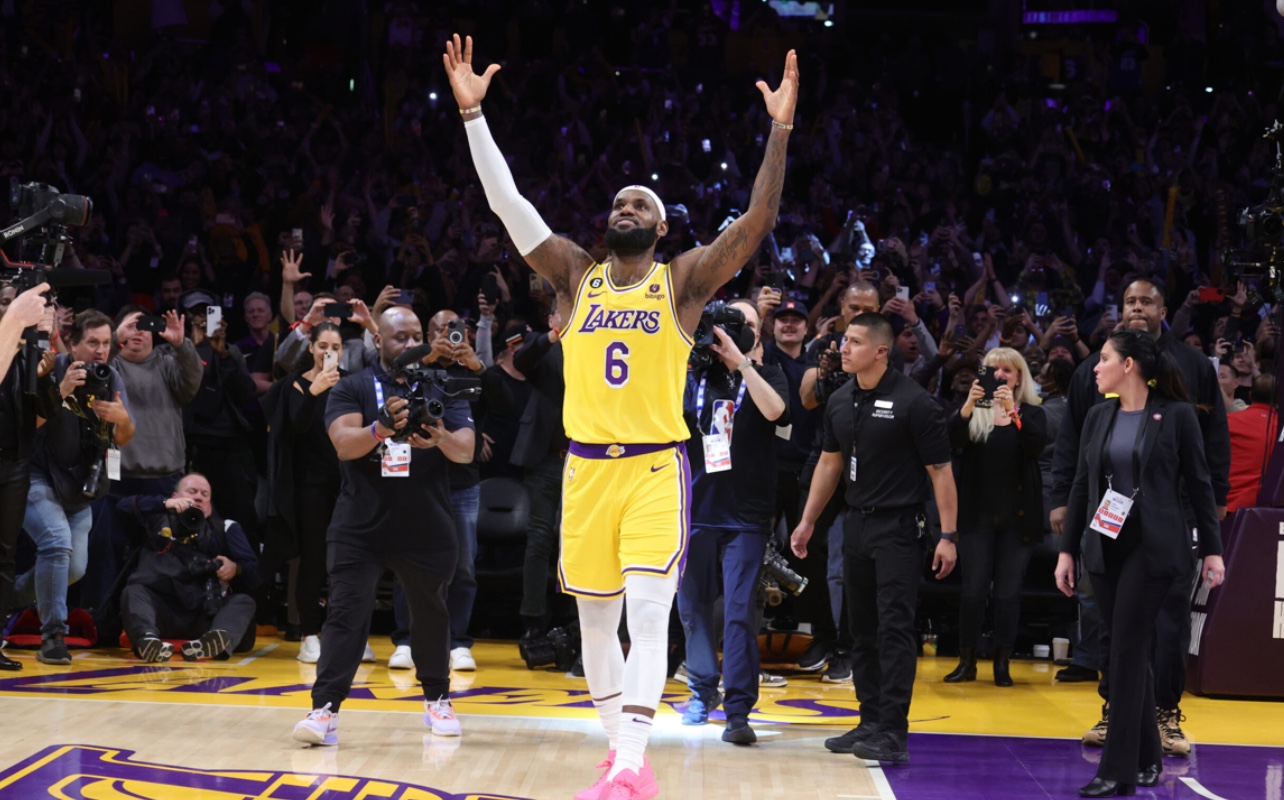
LeBron James became the NBA’s all-time leading scorer Tuesday in the Los Angeles Lakers’ game against the visiting Oklahoma City Thunder, surpassing the record held by six-time NBA MVP and Lakers legend Kareem Abdul-Jabbar for 39 years.
Needing 36 points to break the mark entering the game, James reached the record with a fadeaway jumper from the left elbow with 10.9 seconds left in the third quarter, cutting the Thunder’s lead to 104-99 and sending a supercharged crowd at Los Angeles crowd into a frenzy.
James stretched his arms in celebration, and officials paused the game for minutes to honor him on the court, where his mother, wife and children met and embraced him.
Congrats @KingJames …legendary stuff right there #38388
NBA Commissioner Adam Silver congratulated him, and Abdul-Jabbar–in attendance and clapping as James neared the record–handed him a game ball at center court.
“Everybody that’s ever been a part of this run with me the last 20-plus years, I just want to say I thank you so much, because I wouldn’t be me without y’all.”
James’ record-breaking feat is even more impressive given he’s widely considered a pass-first player in the league, recently claiming the fourth spot in the NBA’s all-time assist list.
In other news, James expressed disappointment with the Lakers for not acquiring former teammate Kyrie Irving in a trade. Irving was traded from the Brooklyn Nets to the Dallas Mavericks on Sunday.
James and Irving played for the Cleveland Cavaliers between 2014 and 2017, reaching the NBA Finals in all three of the seasons and winning the championship in 2016.
The documents discussed repeated misconduct by the officers, starting just after Nichols was pulled over for a traffic stop, through an arrest carried out with excessive force, and continuing through the many minutes when Nichols lay on the street in need of medical help.
Sending the photograph to contacts in his phone, including at least one outside the police department, violated policies about keeping information confidential, according to the documents. But police officials said it was also part of a pattern of mocking, abusive, and “blatantly unprofessional” behavior by the officers, including shouting profanities at Nichols, laughing after the beating, and “bragging” about their involvement.
The revelations came from internal affairs documents that the Memphis Police Department sent to a state agency, in which the department asked for the five officers—who have been charged with second-degree murder in Nichols’s death—to be decertified, meaning they could no longer work as police officers anywhere in the state.
In the documents, police officials described how the officers worked together as they severely beat Nichols, appeared to relish the assault afterward, and then made a series of omissions and false claims in their reports about what happened.
Demetrius Haley, the officer who sent the photographs and forced Nichols out of his car, also never told Nichols why he had been stopped or was under arrest. After Nichols ran away from the officers, several of them caught up with him a few minutes later and unleashed a series of punches and kicks while he was being restrained. And when one officer met with Nichols’s mother afterward, the officer “refused to provide an accurate account” of what had happened, the police officials said.
In other Memphis Police Department news, the Department of Justice will help review the Memphis Police Department following the fatal beating of Tyre Nichols, city officials said.
Memphis Mayor Jim Stricklandannounced Friday that the DOJ’s Office of Community Oriented Policing Services, along with the International Association of Police Chiefs, will conduct an “independent, external review” that will include assessing the department’s special units and use-of-force policies “to honor Tyre and help make sure this type of tragedy does not happen again.”
Godfather of Black Radio Percy E. Sutton Remains a Model For Multi-Generational Wealth
Percy Ellis Sutton, the late media mogul, entrepreneur, WWII fighter, and pioneering civil rights champion, is celebrated today for teaching the model for multi-generational wealth.
“Every time a Black politician walks in a legislature hallway, that’s Percy Sutton,” Rev. Al Sharpton said during Sutton’s eulogy in 2009. “Every time a black radio station plays black music, that’s Percy Sutton. Every time talk radio registers voters and mobilizes those that fight for justice, that’s Percy Sutton. He took the megaphones out of our hands and gave us a radio station…he made us important.”
Born in 1920, Sutton grew up the youngest of 15 children on a farm in San Antonio, Texas, where his introductions to activism and Black entrepreneurship paved the way for his life’s work.
His mother and father, Lillian andSamuel Johnson Sutton, were early civil rights activists who farmed, sold real estate and owned a mattress factory, a funeral home, and a skating rink—all while Samuel worked full-time as a principal at the all-Black Phyllis Wheatley High School and Lillian an educator. Their home now serves the community as a nonprofit called the Hope House Ministries.
Samuel J. Sutton, Lillian Sutton, and their family outside their home, 430 N. Cherry Street, San Antonio, Texas, in 1917. (Photo courtesy of UTSA Libraries Digital Collection)
“My father was involved in a variety of businesses, and invested his money in others. Not all of his investments were successful. He used to often say that he got involved in enterprises in which he had the money and his partner had the experience, and by the time he left the venture, his partner would have the money and he would have the experience,” Sutton told BLACK ENTERPRISE in 2016.
He continued: “But our family was never without money–even during the Depression, when he had to sell some of his holdings. He made sure that his family would have access to opportunities, even though we didn’t have social access in the segregated South. Another one of his practices was to give money to Black organizations that helped those he called ‘people with broken wings.’ Many of his principles–diversification, giving back to the community, showing employees and associates respect–I held in my personal, political, and business life.”
In his father’s strides toward equality, young Sutton helped educate others about racism. He experienced his first encounter with police brutality at age 13. He was beaten by an officer while passing out NAACP pamphlets in an all-white neighborhood.
Percy Sutton (File photo)
A civil rights activist in practice
A graduate of Prairie View A&M, Tuskegee Institute, and Hampton University, Sutton enlisted in the armed forces during World War II, serving with the legendary Tuskegee Airmen. After the war ended, he left with his combat stars to pursue law. He enrolled at Columbia Law School and later graduated Brooklyn Law School.
Sutton served in the Air Force, becoming the first Black Judge Advocate General (JAG). In 1953, he established a Harlem-based law firm in partnership with his brother, Oliver Sutton, and George Covington. He brought his vigor as an attorney for Malcolm X, and, after his death, his family for several decades.
In 1964, Sutton won a New York State Assembly seat, and in 1966 he replaced Manhattan Borough President Constance Baker Motley when she was appointed as a federal judge. Following his second reelection, he became the longest-serving Manhattan borough president and highest-ranking Black elected official for more than a decade. He also made history as the first Black man to run for mayor of New York City in 1977.
In the 1970s, Sutton was a member of a group of Black politicians from Harlem dubbed the “Gang of Four.”
A media mogul in the making
This April 1989BLACK ENTERPRISE cover shows Percy Sutton, the “Godfather of Urban Radio,” in front of Harlem’s legendary Apollo Theatre, which he acquired, renovated and revitalized as part of a nationally-syndicated Showtime at the Apollo television show.
As a descendant of entrepreneurs, Sutton, also known as “The Chairman,” purchased a mom-and-pop radio station in New York City in 1972 for $1.9 million and transformed Inner City Broadcasting Corp. into a multimillion-dollar broadcasting and media giant. His model of R&B, talk radio, and community service would be replicated nationwide.
Inner City owned several radio stations across the country, including WLIB-AM and WBLS-FM. At one point, WBLS was the number-one radio station in the country. Inner City became a mainstay on the BE 100s for more than two decades, providing a myriad of opportunities for African Americans in the entertainment industry.
In 1981, the company resurrected Harlem’s 125th street by saving the famed Apollo Theater, and went on to to produce the hit television show, It’s Showtime at the Apollo. Sutton continued to develop new media ventures as well as begin the process of handing the reins of his business empire to the next generation.
At the time of Sutton’s death, then-President Barack Obama recognized him as a public servant who made the rise of countless young African Americans possible.
“I knew the horror stories of the dissolution of family businesses and the erosion of family wealth because of poor succession and estate planning. I didn’t want that to happen to my family. I decided that i was going to take a decade to train the next generation and pass on my management philosophy,” Sutton explained.
Sutton died December 26, 2009. He was 89. The beloved neighborhood park in East Harlem was named in his honor in 2021.
Award-Winning Social Impact Firm, Parkes Philanthropy, Unveils Inaugural Impact Collective, The Giving Black Fund
“Legacy isn’t just about honoring the past, it’s about being impactful in the present and creating a better future. This Black History Month, we wanted to create a philanthropic venture by and for our community,” said Brandon Parkes, CEO/Founder of Parkes Philanthropy.
Philanthropy has long been embedded in the legacy of African Americans. But despite Black households giving 25% more of their income annually than white households, Black communities are often forgotten in conversations about donors and giving.
This Black History Month, award-winning social impact firm Parkes Philanthropy has launched a giving circle: The Giving Black Fund. This new impact investment collective of Black professionals will leverage their collective influence and venture philanthropy to amplify impact.
A giving circle is a form of philanthropy that brings together individuals with a shared interest to combine their contributions and collaborate to distribute funds. Recognizing that the lives of Black lesbian, gay, bisexual, and transgender (LGBT) people are often excluded in conversations about Black History Month, The Giving Black Fund’s first round of grants will focus on LGBTQ, BIPOC-led, and/or serving organizations.
“We wanted to create a space for Black professionals to give back regularly and intentionally, while connecting with a like- minded community,” Parkes Philanthropy explains on their website, thegivingblackfund.com
The Giving Black Fund is actively seeking nominations for its first round of grants, slated to be distributed in March 2023. In addition to the quarterly grants, Parkes Philanthropy will offer other support and connections to eligible organizations, to expand their impact. Nominate a nonprofit here.
LISC and Uber Eats Announce Black Restaurant Fund to Expand Access to Growth Capital And Fuel Underserved Businesses and Communities
The Local Initiatives Support Corporation (LISC) and Uber Eats [NYSE: UBER] are teaming up to launch a new investment program that will provide growth capital to Black restaurant owners and help break down some of the systemic financial barriers that often limit their opportunities.
The Black Restaurant Fund, announced at Uber and Eat Okra’s Black Business Resource Launch Party in Atlanta, will provide financing with a twist: unlike traditional loan products, the investments do not have fixed repayment terms. Instead, they are patient, flexible investments that only require repayment after owners achieve targeted revenue growth.
“Black-owned restaurants have historically been locked out of economic opportunity, which limits their ability to grow and thrive,” said Julia Paige, Uber’s director of social impact, said in a release. “Uber and LISC created the Black Restaurant Fund to help close the resource gap by connecting Black food entrepreneurs to flexible capital to fuel growth and expansion while seeding wealth creation in Black communities.”
According to the National Restaurant Association, the restaurant industry has a higher rate of minority business ownership than the overall private sector in every state. But, at the same time, minority-owned businesses are more likely to have been denied credit, less likely to receive the full credit amount requested, and more likely to be discouraged from applying for credit, according to the U.S. Small Business Administration.
As a result, they tend to grow more slowly, generate lower profits, hire fewer employees, and create less wealth than otherwise might be the case.
The Black Restaurant Fund, which will be administered by LISC, directly addresses this capital gap by focusing on restaurants in economically disadvantaged communities that have employees, are partners of Uber Eats, and generate revenues from $250,000 to $3 million—meaning they are in a position to effectively deploy growth capital. LISC and Uber expect the initiative will help fuel 35 businesses over the next three years.
“This program is making an investment in a healthy, equitable future for Black restaurant owners and their employees as well as the communities where they operate,” said George Ashton, managing director of LISC Strategic Investments, which is overseeing the initiative.
“We take a different approach to underwriting than many investors do because we can look beyond traditional metrics to consider the real-world potential of these enterprises,” he explained. “It means we can build collaborations and investment products that support their plans for sustainable growth—like this new program with Uber—while at the same time helping owners build a financial track record that can help open doors to conventional investors in the future.”
Uber has been a valuable LISC partner in recent years, collaborating on programs that provided vital financial and technical assistance to more than 1,000 restaurants during the pandemic—mostly owned by entrepreneurs of color. Uber also worked with LISC to advance health aims in underserved communities, ensuring residents had better access to accurate medical information and vaccines.
Magic Johnson, Samuel L. Jackson, and Latanya Richardson Jackson Lead Pre-seed Funding For Statement Films
Statement Films—the women-led, data-driven entertainment startup—has secured an initial three quarters of a million dollars of funding from an array of titans across Hollywood, sports, and business, including Earvin “Magic” Johnson, Samuel L. Jackson, LaTanya Richardson Jackson.
Founded by writer, producer, and political analyst, Areej Noor, Statement Films sources, develops, and presents a pipeline of African-women-led IP to international buyers, bridging the gap between African and Diaspora women filmmakers and the global market.
It showcases the growing collaboration and stewardship between Black America and Africa. A Somali-American, Noor was born in Washington, D.C. to a prominent global women’s rights activist turned political strategist. The stories of powerful women from around the world were abundant in Noor’s childhood, inspiring her to build an inclusive global community of influential African women creatives.
Areej Noor said, “I grew up exposed to incredibly creative and powerful stories of African women, but I felt they were still underserved by Western media and the entertainment elite — that is why I founded Statement Films,” says Noor. “Having the support of Hollywood, sports, and business titans gives us the momentum to establish new and equitable pathways for the explosive female talent coming from the continent.”
For the pre-seed round, Statement Films and Noor raised an initial three quarters of a million, with contributions from NBA Hall of Famer and business titan Johnson; legendary Hollywood actor and producer Samuel L. Jackson; and Tony-nominated actor, director, and producer LaTanya Richardson Jackson; as well as business leaders Robyn & Tony Coles and Vicki & John Palmer.
Samuel L. Jackson, Oscar recipient, actor and producer said, “I am incredibly excited to be a part of the journey with Statement Films. The company is doing such important work to fill a long overdue gap in the industry. We can look forward with optimism to the future of African women in film.”
LaTanya Richardson Jackson, Tony-nominated actor, producer, and director said, “As a female creative, this is something I am particularly passionate about and I look forward to seeing the opportunities and progress that will unfold for African women through the incredible work of Areej and her team at Statement Films.”
Increased connectivity is fueling the growth of the African Creator Economy and entertainment ecosystem. And data show that, while fairly new to international consumption, African content is steadily succeeding in the U.S. and abroad.
With the recent investment, Statement Films is scaling the current offering into a media and insights business that increases the visibility of the African Creative Class while its production arm remains focused on building a pipeline for female filmmakers on the continent and in the diaspora. For more information, and to keep up to date with company news, visit Statement Films here: https://www.statement-films.com
Eagles fans were amazed by running back Boston Scott, who sang “FourFiveSeconds” as he revealed his pick. “WHICH ONE SANG FOUR FIVE SECONDS? 😂😂😂😂😂 I need his name. I’m a new fan of his. That made me HOLLLAAA,” a fan commented under the video on TikTok.
The Eagles page responded sharing Scott is a “man of many talents.”
Other players tried hitting a note or two for “What’s My Name,” and “Umbrella,” singing “Oh, na na, what’s my name?” and “You can stand under my umbrella (ella, ella, eh eh).”
“That’s probably the only song they know and they sounded terrible,” one of the players said about their teammates’ vocals.
As previously reported by BLACK ENTERPRISE, Rihanna was confirmed as the Super Bowl’s halftime show performer last September. The Fenty Beauty CEO confirmed the news on her Instagram page with an announcement from Jay-Z‘s Roc Nation following.
“We are thrilled to welcome Rihanna to the Apple Music Super Bowl Halftime Show stage. Rihanna is a once-in-a-generation artist who has been a cultural force throughout her career,” the NFL head of music Seth Dudowsky said at the time.
The Philadelphia Eagles will face the Kansas City Chiefs this Sunday in Glendale, Arizona. This will mark the Eagles’ second time in six seasons to play in the Super Bowl. The Chiefs will appear in their third Super Bowl in four seasons.
Young Teen Sues School District After Officer Reportedly Knelt on Her Neck for Over 20 Seconds
Another officer has been caught on surveillance footage using his knee to restrain a civilian, this time in Wisconsin.
A middle schooler has sued the Kenosha Unified School District, City of Kenosha, and a Kenosha police officer after she was reportedly restrained in a chokehold by an officer who was off-duty.
According to the Milwaukee Journal Sentinel, the federal lawsuit was filed on behalf of the 12-year-old girl after the incident happened last year at Lincoln Middle School. In the 14-page complaint, the girl’s attorney, Drew DeVinney, claimed officer Shawn Guetschow “acted with malice or in reckless disregard” toward the middle schooler.
Footage of the March 4, 2022 shows Guetschow breaking up a fight between the 12-year-old and another student. Guetschow worked as a part-time security guard in addition to his police duties. The young girl is shown restrained on the ground as Guetschow holds his knee on her neck for more than 20 seconds, using “unreasonable and excessive” force, according to her attorney.
The scuffle broke out after the student approached the girl inside Lincoln Middle School’s cafeteria.
Jerrel Perez, the girl’s father, is named as the plaintiff in the lawsuit since the girl is considered a minor.
“(Perez’s daughter) has (been) treated for nearly a year for the physical and emotional injuries that she sustained. Although she is not healed from her trauma, she is ready to stand up for herself,” DeVinney said in a statement.
The attorney said his clients are demanding a jury trial in the civil case. The Kenosha County District Attorney’s Office declined charges against Guetschow but charged the young girl. That case, DeVinney said, is closed.
Guetschow resigned days after the incident. In his resignation letter, he said the district did not support him. The Kenosha Police Department said Tuesday he is still an active officer.