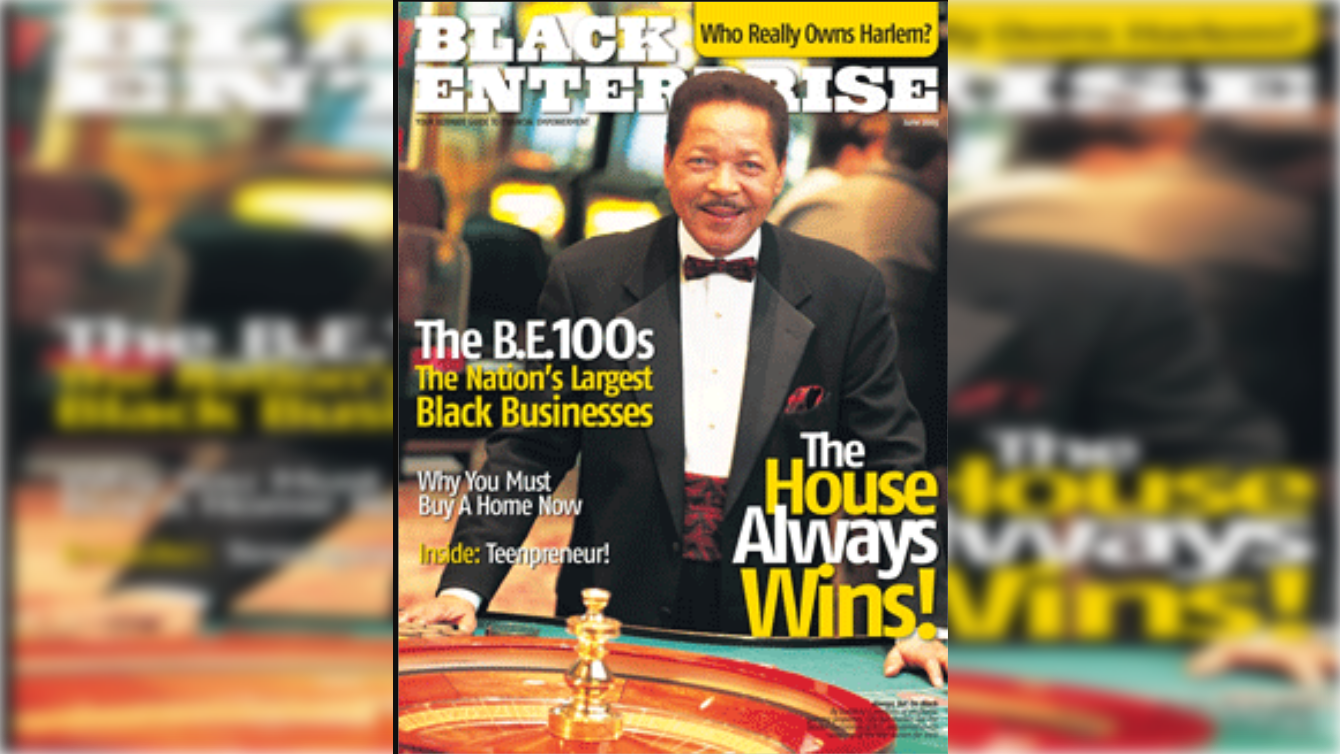
Bet on Black: Don Barden Made History as the First-Ever Black Las Vegas Casino Operator
Don Barden entered uncharted territory for black entrepreneurs by developing the largest black cable television operator and managing the only black-owned gaming conglomerate with properties in Las Vegas.
In 2002, with the acquisition of three Fitzgeralds casinos for $149 million, Barden became the first African American to wholly own a casino in the nation’s gambling capital.
Rising from meager beginnings to become a self-made multimillionaire African American entrepreneur, the late Don Barden was a trailblazer in America’s gaming industry.
A mentor to generations of black professionals, Barden earned Black Enterprise Company of the Year honors in two industries: In 1992 for Barden Communications Inc. and in 2003 for The Barden Cos. Inc.
Barden made history when one of his companies acquired three Fitzgeralds casinos for $149 million, making him the first black to own casino operations in Las Vegas. The transaction placed his gaming enterprise in the industry’s largest U.S. market and at the same time, broke barriers within the sector.
Barden added to his empire—he had already owned casinos in Gary, Indiana; Tunica, Mississippi; and Black Hawk, Colorado—by purchasing the Fitzgeralds properties from bankruptcy court. In fact, Barden used $14 million of his own money and raised $150 million from 40 institutional investors to seal the deal and upgrade operations.
The daring entrepreneur’s big gamble paid off. It bumped revenues of Barden Cos. Inc., placing it among the top 25 of BE Industrial/Service Companies in the early 2000s. Observers hailed Barden’s move as a major victory in bringing much-needed diversity to the industry. “It has the same ramification [for the Las Vegas gaming industry] that Jackie Robinson had to baseball,” Gene Collins, president of the Las Vegas chapter of the NAACP told the Las Vegas Sun at the time.” It opens all sorts of opportunities for African Americans because someone has to be first.”
First African American to Build an Urban-Based Cable TV Company
Making history was nothing new for Barden. In addition to being the first African American to own a casino corporation outright, he beat the odds by controlling multimillion-dollar companies in other industries that locked out blacks from ownership participation. As such, he would become the first black businessman to build a cable TV system for urban markets as well as a major player in commercial estate development over the course of his 40-year career.
He shared his deal-making philosophy in the BLACK ENTERPRISE book, Lessons From The Top: “I have learned to look for businesses that make money while I sleep. I like to acquire any business that doesn’t require an exorbitant amount of time and capital to turn it around. Yet, I want to be able to expand the core businesses. I have been able to do that with real estate, cable, and gaming. If you find viable businesses with solid management, you are not drained by the day-to-day operations. You can scope out other opportunities.”
The ninth of 13 children raised in Inkster, Michigan, he attended Central State University in Ohio with the goal of pursuing a legal career. But he ultimately turned to entrepreneurship. His first venture was a record store that he opened in Lorain, Ohio, at the age of 21 with $500 in savings. From there, he launched several businesses, including a real estate development firm, a nightclub, and a weekly newspaper, The Lorain County Times, in Lorain. He was also Lorain’s first elected black city council member.
(Barden featured in Black Enterprise magazine, May 1998)
By 1981, Barden bought an interest in a cable television station in Lorain and formed Barden Communications Inc. He expanded his cable system to include communities in his hometown of Inkster and the Detroit metro area, growing gross revenues from $600,000 to $91.2 million in a decade. By 1992, BCI earned the No. 5 position on the BE INDUSTRIAL/SERVICE 100 and BE 100s Company of the Year honors—for the first time. By 1994, he sold the company to Comcast Cable in 1994 for more than $100 million.
Two years later, he ventured into the casino gaming industry when he acquired and operated the Majestic Star Casino, a riverboat casino in Gary, Indiana. After an unsuccessful bid to buy a casino in Detroit, he acquired the Fitzgeralds properties. In 2003, BLACK ENTERPRISE named Barden Cos. as Company of the Year—the only entrepreneur to receive such recognition in two different industries within a 10-year span.
But not all of Barden’s ventures were proven winners. In 2009, the Majestic Star Casino was forced to file for bankruptcy protection.
Such setbacks, however, did not keep BLACK ENTERPRISE from heralding his myriad accomplishments.
As part of its 40th-anniversary celebration in 2010—a year before Barden’s untimely death due to complications from lung cancer—Barden was ranked No. 21 on the roster of “Titans: The 40 Most Powerful African Americans in Business.”
That same year, he also received the A.G. Gaston Lifetime Achievement Award, BE‘s top honor for business excellence. Barden left a legacy for being one of the most honored and respected black business leaders of his generation, and mentor to several generations of black professionals and entrepreneurs.
Sunny Hostin Responds to Accusations That her Son Got Into Harvard Because She Bought a Building
The topic of nepotism and celebrity in New York Magazine sparked a lot of conversation and controversy. On an episode of The View several weeks ago, the subject came about, and a conversation evolved around Sunny Hostin’s son, Gabriel, being admitted to Ivy League school, Harvard University.
According to Decider, people have speculated that Gabriel got into the school as a ‘nepo baby.’ His entrance was made possible because, according to rumors, his mother, Sunny, allegedly bought a building at Harvard.
Hostin has flat-out denied the accusations being made.
“Any parent is going to try to make sure that their children have a better life than they had,” the talk show host stated. “I know I tried very hard so that my children had a better life, and I was very surprised when people said, “Oh, Gabriel got into Harvard because Sunny bought a building.’
“Look, I’m from the Bronx projects. I don’t have money to buy buildings at Harvard, OK? So he earned that on his own, and yes, I would be upset if people took that away from him. But we taught him, we can open up a door for you, but you’ve gotta walk through, and you’ve gotta work hard, and you’ve gotta be there first and be there last, and work as hard as you can.”
Whoopi Goldberg agreed with the misunderstanding of how some people believe that children of celebrities and/or people with a privileged status have an advantage. But, she also stated that two things can be true at the same time.
She said, “Don’t assume that people didn’t work and bust their behind. ’Cause their parents might have said to them, ‘I’m not gonna help you. You need to get this done by yourself. … Ninety percent of the people I find are working their butts off because they just want to have a good life like their parents did.”
Meet Wall Street’s First Black Millionaire Who Turned Opportunity to Fortune
After his iconic status reached its height in the mid-19th century, Jeremiah G. Hamilton left behind a blazing trail as Wall Street’s first and only Black millionaire.
In celebration of Black History Month, we are recounting Hamilton’s life and work to acknowledge his existence and prominence among the many Black millionaires who have resisted historic oppression.
Today, vague historical records (there are no surviving photos of Hamilton) bring light to the scattered fragments of the story about an elusive stockbroker and financier, saddled with the moniker “Prince of Darkness.” He was as aggressive and ruthless as most antebellum businessmen, and yet he earned a disdainful reputation for seizing opportunities that were insurmountable for Blacks in the then-segregated New York City.
Image: The Picture of New-York, and Stranger’s Guide to the Commercial Metropolis of the United States (1825) / Wikimedia Creative Commons
Leveraging his wits, the adept, skilled and innovative Wall Street manipulator steered clear of obstacles and carried on architecting his life and fortune.
By the time of his passing in 1875, Hamilton earned a newspaper reputation for being the richest Black man in the country — as one outlet dictated it, the mystery man collected “a colossal fortune of nearly two millions ($2,000,000) dollars.”
Hamilton amassed in excess of a quarter of a billion dollars in today’s currency, but not without the strife from rumors of counterfeiting and scams against insurance companies. By the 1830s, he was well on the path to building a legacy and enterprise that could sustain generations to come.
In addition, Don Cheadle will serve as executive producer alongside Hollywood heavyweight Steven Soderbergh and Carlos Foglia, to bring Hamilton to life in the forthcoming HBO Max mini-series tentatively titled The Other Hamilton, BLACK ENTERPRISE previously reported. The anticipated retelling is based on White’s book.
The beginning of a criminal enterprise
Born in 1807, Hamilton was recorded to have hailed from the West Indies with parents who were born in Port-au-Prince, Haiti, according to theAfrican American Registry. Along the way, he had intimated to different people at different times that he came from Richmond, VA or somewhere in the Caribbean, perhaps Haiti or Cuba or even Puerto Rico.
He was in Haiti when he first appeared on historical record in 1828. In that year, the 20-year-old man attracted attention after arriving secretly at Port-au-Prince Harbor aboard the brig Ann Eliza Jane.
Hamilton slipped in and out of the city to run a cargo of counterfeit Haitian coin to Port-au-Prince for a group of New York merchants. When Haitian authorities caught wind of the ploy, Hamilton allegedly escaped with a $300 bounty and death sentence on his head, as well as $5,000 worth of the counterfeit coin.
In a story published by Freedom’s Journal, the first Black-owned and -operated newspaper, the editor blasted Hamilton for disgracing the world’s first and only Black republic.
Joining New York’s millionaire’s club
Though newspapers condemned him, Hamilton worked in and around Wall Street for 40 years. His focus shifted to the world where white Americans associated African Americans with slavery and poverty.
In 1711, an official slave market opened by the East River on Wall Street between Pearl and Water Streets, where ships would dock with the same enslaved people whose labor made the city’s economy run.
Image: The National Archives / Wikimedia Creative Commons
Some 100 years later, just a few years before the abolishing of slavery in New York, Hamilton learned the game of Wall Street and quickly acquired a reputation for over-insuring vessels and then arranging for them to be destroyed. The marine-insurance industry was lucrative for him – until he was blackballed.
During the mid-1830s, White revealed in an opinion piece on Gotham’s Only Black Millionaire that Hamilton, who was renting an office space on Wall Street, made large profits off of what is now known as the Great Fire of 1835, which destroyed half a billion dollars’ worth of property, nearly taking down a city built on the back of enslaved labor.
Hamilton received a $5 million pay-out, in today’s dollars.
Within months, the multi-millionaire impressively found his groove in a real estate boom in the city. He invested in 47 lots of land in present-day Astoria, as well as property in Poughkeepsie, a 400-foot-long wharf along the Hudson River, and a mansion.
Notably, the determined businessman even owned stock in railways that denied access to the Black community.
In pursuit of his millions, Hamilton turned to more creative and relentless endeavors while he continued to be the subject of discrimination and pubic shaming.
From running a “pool” in the stock market with white businessmen to confronting his enemies and outsmarting racial attacks, he gained the notoriety of being referred to as “one of the most remarkable men of his race” and the only “man who ever fought the Commodore” (after suing the tycoon’s Accessory Transit Company.)
Hamilton was married to a white woman, Eliza Morris, that lasted 40 years until his death. They shared 10 children.
Free At Last? Tech CEO Apologizes After Quoting Dr. Martin Luther King Jr. in Termination Email
It’s not always about what you say, it’s the tone in which you say it.
On Jan. 24, former employees of a tech startup raised an eyebrow after Dr. Martin Luther King Jr. was quoted in an email saying they would be laid off, CNN reported.
Jennifer Tejada, CEO of PagerDuty, felt an encouraging tone would be fitting after telling her staff she would be cutting 7% of her workforce, saying the company is a “leader.”
“I am reminded in moments like this, of something Martin Luther King said, that ‘the ultimate measure of a leader is not where they stand in the moments of comfort and convenience, but where they stand in times of challenge and controversy,’” she wrote.
Her soon-to-be out-of-work employees were not moved by the words once stated by the civil rights leader.
Tejada immediately apologized for the words used in the email, saying they were “inappropriate and insensitive,” CNN reports.
“I should have been more upfront about the layoffs in the email, more thoughtful about my tone, and more concise,” Tejada wrote. “I am sorry.”
Many employers feel that a layoff email is a faster way of terminating someone, however, The Wall Street Journalreported a number of employees who may have been laid off this way feel the method is “cold and unkind.”
With the backlash, Tejada now knows her communication method wasn’t the best way to go about it.
“The way I communicated layoffs distracted from our number one priority: showing care for the employees we laid off, and demonstrating the grace, respect, and appreciation they and all of you deserve,” the CEO wrote to her staff, according to The Wall Street Journal.
“There are a number of things I would do differently if I could.”
PagerDuty is one of many companies cutting back on staff in the tech world. As the economy slows down, CNN reported several companies, like Amazon, announced they would be letting go of more than 18,000 employees. Microsoft is set to terminate 10,000 staff members.
How Traffic, Sales & Profit Founders Lamar & Ronnie Tyler are Creating ‘New Black History’ Through Entrepreneurship
Lamar and Ronnie Tyler have done the work so Black entrepreneurs can pull up to the winner’s table ahead of the game.
As founders of Tyler New Media and Traffic Sales and Profit (TSP), the two-time Inc. 5000 power couple are change agents who are breaking chains by educating Black entrepreneurs on how to create well-engineered systems and strategies to increase their profits and build their burgeoning brands.
A passion fuels the Tylers to change the economic landscape of the Black community by aiding entrepreneurs who want to secure the bag with a blueprint to Black wealth. Together, they are essentially creating “New Black History” by closing the wealth gap through entrepreneurship.
Lamar and Ronnie Tyler (Image credit Blachwood LLC)
“I tell my team all the time, we are literally in the business of making and generating wealth for people through businesses,” Lamar told BLACK ENTERPRISE.
Through their work, the Atlanta power duo is disrupting and dismantling systemic barriers Black communities face by helping entrepreneurs enhance their odds of financial wellness.
Traffic Sales and Profit has helped more than 20,000 Black-owned businesses earn collectively $100 million in revenue annually, year over year.
TSP is a supportive ecosystem for purpose-driven African American business owners locked out of opportunities to start or grow their businesses because of economic disadvantages, lack of access, capital, know-how, or for basically being Black. And yes, that’s still a thing.
“According to a McKinsey report, “participants in focus groups said that they feel that their race—and sometimes age and gender—makes loan officers hesitant to lend to them.”
Biases still exist, especially in the banking industry, and racial funding gaps are fundamental.
According to NerdWallet, “while 82.1% of white business owners are approved by online lenders, both Black and Hispanic business owners still trail in approval rates, coming in at 67.2% and 71.5%, respectively.”
“Research shows that white-owned startups have an average of $18,500 in outside equity at the founding, compared to just $500 for Black-owned startups.” the report continues.
And when it comes to funding African American-led small businesses, the McKinsey report contends that Black entrepreneurs are denied small business loans every year or credit refused at an alarming rate. In comparison, their white counterparts are more likely to receive full funding for their enterprises.
Meanwhile, Black women are the fastest-growing entrepreneurs in the United States. Yet, somehow in 2023 are still “the most disrespected… unprotected and most neglected person in America,” as Malcolm X stated back in 1962.
And data shows that 8 out of 10 Black-owned businesses fail within the first 18 months of opening due to lack of information, which further lends credence to the fact that Black business owners need support to scale and grow.
The McKinsey report also makes clear: “Business networks can support Black entrepreneurs, but Black entrepreneurs are less likely to know and hear about relevant networks that can help support and promote their businesses.”
Where one door closes, the Tylers step into the room and open up a floodgate of opportunities for Black entrepreneurs.
In Lamar’s words, “We Are the ones we’ve been waiting for!”
So with a network of over 42,000 members, the TSP community boasts owners of everything from brick-and-mortar stores to e-commerce brands to service and product-based businesses.
TSP Mastermind
Through their extensive network, the TSP group led by the Tylers have banded together to disband racist business culture by creating a community. Got a business question? Community members are encouraged to ask away and, in return, will most definitely receive an avalanche of responses from other members more than happy to have their brains picked.
“To build a real sustainable business, you need a team, you need other people, you need systems, you need processes,” Lamar said.
And the result? In 2020 during the pandemic, the TSP Mastermind, which teaches Black entrepreneurs the blueprint for adding zeros and commas to their bottom line, collectively generated over $49 million in revenue, with their most high-performing numbers being earned during COVID months, Lamar said.
“We’re not waiting for a change in policy, a change in government, nor a change in society to save us,” Lamar quipped.
Especially when 1,100 private U.S. corporations that pledged an estimated total of $200 billion to Black equity efforts after George Floyd’smurder in 2020 are still mostly unfulfilled, according to a 2020 McKinsey & Company report.
Lamar and Ronnie have built a table where Black entrepreneurs are invited to have a seat, break bread and build wealth.
And the sense of community and uniqueness of the TSP group extends to the TSP conference.
A Conference Like No Other
(Image: Tyler New Media)
If you’ve never been to one, get ready to Milly-rock on this particular block because this is the community “barbecue” you’d want to be invited to.
Imagine this: the TSP conference is alive with dozens of entrepreneurs jamming to Frankie Beverly & Maze or swag surfing in the hotel conference corridors while networking and building business relationships.
Yes, entrepreneurs are learning about funding resources, social media strategies, passive income, and investments, and yes, it’s a business conference — sans the stuffy suits.
(Image: Tyler New Media)
It’s a new business environment, bustling with energy and where the likes of Janice Bryant Howroyd, the first African American woman to operate a company that generated more than $1 billion in annual revenue, graced the stage at one conference in Atlanta, sharing her secrets to economic success.
Yet, even with all these heavy hitters in the room, the Tylers still have to fight the idea that Black folks must show up a certain way to be recognized or respected.
Case in point: during one particular TSP conference, a group of Black entrepreneurs in the Mastermind group with a collective worth of $100 million decided to hit Beyonce’s “Cuff It” challenge and rocked the viral dance that ultimately made their video go viral.
In return, they were met with a slew of online hate, from people calling it a “pyramid scheme” to one commenter saying, “It would be nice if they were all sitting still so they could actually be taken seriously.”
It’s the nature of the beast that Lamar and Ronnie deal with when trying to convince the masses that they are not doing anything nefarious. And historically, it’s been what Black folks have had to battle after being brought kicking and screaming to this land in 1619 and told how to look, walk, talk, and assimilate to be “accepted” into European culture.
But Lamar and Ronnie are not trying to fit in. Their platform and their profitable paper trail prove they stand out.
The Tylers leverage the most influential entrepreneurs in the country – if not the world – to grace their stage and speak at their TSP conferences, thus giving Black entrepreneurs not only a seat at the table but also a ticket on the midnight train to economic progress in Atlanta — the unofficial Black mecca, and the late Martin Luther King Jr.’s home base.
Why Atlanta? Black-owned businesses accounted for about 28% of all businesses in Washington, DC, the highest ratio in the nation. But pulling up second is the state of Georgia, where 20% of businesses are Black-owned, BlackBusiness.comreports.
It’s undeniable. Lamar and Ronnie are the pied pipers of helping Black people get their paper.
Gabby Goodwin, CEO of Confidence and Inventor of GaBBY Bows, joined Traffic, Sales and Profit in 2015 and earned six figures by sixth grade thanks to Lamar and Ronnie.
“People may know me as the #sixfiguresbysixthgrade kidpreneur, but there is no six figures without Mr. Lamar and Mrs. Ronnie,” 16-year-old Goodwin exclusively told BLACK ENTERPRISE.
“Mr. Lamar took me and my mom on as one of his first and few one-on-one business coaching clients when I was just eight years old. My company’s growth and my personal growth as an entrepreneur are results of their guidance and mentoring over the past eight years,” she said.
Gabby Goodwin, her mom Roz and dad Mike, along with Ronnie and Lamar (Courtesy Roz Goodwin)
The Tylers are the real deal, but naysayers—especially those in the non-Black community—can’t digest that two Black entrepreneurs have had monumental success, generating measurable wealth for people while circulating the Black dollar.
“We impact people, to impact people,” Lamar Said.
Lamar and Ronnie Tyler (Image credit Blachwood LLC)
And Lamar and Ronnie are doing it by providing parallels between the old and new ways of doing business.
Change of Guard
In the last 50 years, Black business icons like Reginald Lewis, who launched the first Black-owned business to surpass $1 billion in revenue, and Earl G. Graves Sr., who showcased the best of Black business excellence through the creation of BLACK ENTERPRISE, set the standard for African American entrepreneurs holding fast to dreams of making Black history through building innovative businesses while generating Black wealth.
What’s been proven by Lewis and Graves Sr. and other Black business visionaries like Robert L. Johnson, who created the most Black millionaires in U.S. history as the founder of BET Holdings when he sold to Viacom, is that there is a viable Black consumer market and a coalition of Black entrepreneurs tapping into it.
But back in the day when Johnson got the idea to start BET, he literally took one idea from a man who was creating a channel for elderly people and replaced everything with the word Black. That was the gist of it and how BET came to be. No market research and no connected network. Just Black entrepreneurs crossing their fingers and hoping for the best.
Today, the Black consumer market is worth trillions. Black entrepreneurs are seizing the moment, building support systems and business cohorts, and coordinating efforts resulting in equitable outcomes.
The gatekeepers are gone. But the guidance from this dynamic couple proves they are their brothers and sisters’ keepers.
Just ask Angela Hawkins, founder and owner of Bamblu, a luxury bedding company and a dedicated member of TSP.
“Lamar and Ronnie created an environment where I could go from concept to launch with a new business idea in just four months feeling fully supported,” Hawkins told BLACK ENTERPRISE.
Lamar Tyler and Anglea Hawkins, founder of Bamblu (Courtesy)
She continued, “And just one and a half years later, go through a complete rebrand that allowed me to successfully trademark the new brand, Bamblu, that resonated so well in the market, we were picked up by a major retailer and experienced a 458% revenue lift in that next year.
“That’s not possible within two years of launching a business without support, systems, and access to the right knowledge,” she admits. “That is what Lamar & Ronnie have built with traffic, sales and profit.”
Traffic, Sales and Profit — Helping Black Entrepreneurs Build Brands
The Tylers are unstoppable because Black generational wealth is at stake.
As architects of a new emerging Black history, their business team drips in what Lamar would say, “anxious energy.”
Their enterprise is instrumental in supporting, training, investing, and advancing 48 seven-figure companies and five eight-figure companies that have come through their game-changing educational programs.
In another successful case, Dacia Woods, co-owner of Ladies & Luggage Travel Group, has been singing the praises of Traffic, Sales, and Profit, saying that after officially joining TSP Mastermind in June 2021, her company ended the year at about $300K in sales and has since crossed the million-dollar mark.
“The lives we changed just because somebody’s working for a Black person and then saying, ‘You know what? They did it; I can do it. Or if they did it, my kids can do it.’ And their kids are seeing their mom and dad work for amazing Black entrepreneurs. I just get excited just thinking about them,” Lamar admits.
Kim Lewis, CEO of Chicago-based beauty brand CurlMix, says, “Lamar and Ronnie made us millionaires.”
“Before them, we spent five years spinning our wheels, making no money. In fact, we lost $100,000 of our own money before joining the TSP community. Their guidance helped us grow our business to $10M in 4 years. They’ve been incredible mentors, teachers, and friends, and we are forever grateful to them,” Lewis explained.
Kim Lewis Curl Mix (Courtesy)
By the end of 2023, the Tylers are on a mission to develop, nurture and serve 500 seven-figure Black businesses, 50 eight-figure Black businesses, and five nine-figure Black businesses.
“Now that’s Black history,” Lamar said.
CurlMix CEO Kim Lewis, her husband Tim with Lamar and Ronnie Tyler (Courtesy)
Changemakers on the move
As an IT professional, Lamar always had it in his mind that he wanted to be an entrepreneur. The roadmap wasn’t always clear, but he was a visionary who went from kid-level side hustles and cutting people’s grass for money to creating new Black history.
“But while I had these IT careers, I was always in the back of my mind trying different entrepreneurial ventures, trying to figure it out or trying to get a hold of something that would propel that piece of me.”
In his early years, Lamar memorialized in his mind the legendary presence of BLACK ENTERPRISE magazine, which sharpened his lens to the world of Black entrepreneurship and wealth.
“I know there are millions of people probably just like me that never imagined that they could own a company that was a certain size.”
“And looking at those covers and reading the articles inside of it is what really gave me a lens into what was possible for me through entrepreneurship and not just hustle because I always just find… It’s a difference between hustle and entrepreneurship, and a lot of times, people get the lines blurred. But really building a sustainable, lasting business enterprise.”
Lamar and Ronnie Tyler (Image credit Blachwood LLC)
A graduate of Spelman College, Ronnie recalls instances of Black wealth in the student parking lot. As Mercedes-Benz cars came rolling in and out, she was aware her peers—daughters of lawyers and celebrity parents—were wealthy.
Before transitioning into a fully-fledged entrepreneur, Ronnie only worked for one company coming out of college, and that was IBM. She served as a project manager for over 17 years and managed large software development projects with budgets of over $30 million or more. After leaving to commit to her business full-time, it was a no-brainer that she would become the chief operations officer who serves as the secret sauce in planning and casting visions.
“Anytime that we’ve up-leveled in our business, right directly before us going to the next level, there was some type of risk; there was some type of major investment, something that just almost stopped my heart that we did in order to get to that next level each and every time. And each time, it gets bigger to get to the next level,” Ronnie said.
The secrets to building a successful romantic relationship echo the fundamentals of a great partnership in business—trust, communication, and accountability. Marriage takes work, and the business falls short if one partner drops the ball at home. It has been instrumental for the couple to leverage each other’s strengths and weaknesses to grow stronger in matrimony and enterprise building. And being parents of four children certainly adds flavor and a level of challenges into the mix.
“I’m all the way at the edge of risk, whereas Ronnie is pretty close to the edge of being conservative. And so a lot of times she said, Hey, I’ve stretched her out past where she would’ve gone. I say, well, she’s pulled me into a safe space further than what I would’ve risked if that risk was too much,” Lamar said.
“And so our years at Black and Married with Kids definitely laid the foundation for us to have a good marriage and to be intentional about our marriage, and that helps us be good business partners,” Ronnie added.
“If your spouse is not on board and they don’t understand, the best thing you can do is stay committed, stay consistent, and show them some results,” Ronnie added.
Building sweat equity
Tyler New Media started as an online blog, leveraging the power of social media, but it was no easy feat for the Tylers.
Adopting the C.R.U.S.H. mentality, can’t rest until something happens, the couple operated on very little time while raising four little children and serving demanding jobs. The couple still managed to write and edit all the original articles, build websites, and do any other tasks during hours that would typically require rest.
Lamar and Ronnie Tyler (Image credit Blachwood LLC)
“A lot of times, it’s a lot of conversations about self-care, which is valid and about you need your sleep, you need this, but sometimes everything can’t fit. And just being transparent, everything can’t fit,” Lamar said.
“So at that point in life for us, it was either I’m going to build a business, or I’m going to go to sleep.”
He continued, “But for that season, we had to do what we had to do to get to the next level. So we didn’t have a lot of money to build, we didn’t have startup funds, we used our paychecks, and money we could squeeze off our paychecks is what initially built it. We built a lot of sweat equity.”
Changing the narrative of Black entrepreneurship
The core of the Tylers’ passion is building community through education and helping to exploit the opportunities that currently exist.
“When we started our business, our mission was to uplift and support and equip African American couples and their relationships and families,” Ronnie said.
“From there, we moved into entrepreneurship. And so, our focus with Traffic Sales and Profit is to build businesses. And that’s one of our missions, Black businesses, and entrepreneurs. Because why when those businesses grow, they hire people that look just like us, and that’s supporting the community, bringing money back into the community,” Ronnie continued.
With the fast-growing expansion of Tyler New Media, the founders embarked on a journey of reinvention. They built an inspirational community in Traffic Sales and Profit (TSP), which has helped thousands of Black entrepreneurs build six, seven, and eight-figure businesses.
“It’s very important for you to plan and to cast that vision,” Ronnie said. “Part of that is your yearly planning, your quarterly planning, and putting plans in place for your launches.”
“I always tell any entrepreneur, if you want to set yourself apart, especially the service-based businesses, you learn how to plan. You learn how to get your systems and processes together, and I guarantee you will set your business apart from anybody else in the marketplace.”
In executing their vision, the Tylers understood the value of connecting with consultants, coaches, and mentors while they walked on a path of unlearning and knowledge. They learned that generating, preserving, and wealth-building was just as important as learning how to build a business. But it wasn’t without trial and error.
“One of the things I realized the hard way myself was that making money was different from building wealth,” Lamar said.
Lamar Tyler (Image credit Blachwood LLC)
“Because I used to think, ‘Hey, we make a lot of money. We’ll be wealthy.’ And I found out that is not the case.
“As we are doing it, again, we’re able to model it for other people in our community, share the stories with them,” he added.
“I had the philosophy I think most people have, which is I’m waiting for somebody to pick me. I’m waiting for somebody to see how hard of a worker I am, how much effort I put in, all these different things,” Lamar said.
“I realized that you go out and buy a mentor, and you can pay for that access, the information, the knowledge, and not wait for anything. When we got that, and we shifted, we started getting in those rooms and paying to be a mastermind, paying to have coaches. And we haven’t stopped since,” Lamar continued.
Ronnie added, “We are going to take whatever action we need to take to put ourselves into those spaces, whether it’s paying forward, paying for access via their programs, or just trying to be in the room, the conferences, or what have you. But we are intentional about that.”
An HBCU Homecoming for Black businesses
In a true homecoming fashion, Tyler New Media’s Traffic Sales and Profit (TSP) hosts two signature public conferences a year where they reunite the greatest minds in business and wealth to teach, train, inspire, and celebrate. In January 2023, the Tylers again invited entrepreneurs to get three full days of coaching at the TSP LIVE conference in four key areas: People (team-building and staffing), Projects (project management and organization), Products (product and service creation and sales) and Profit (cash flow and revenue).
“It is like a HBCU family reunion,” Ronnie said.
(Image: Tyler New Media)
According to the Tylers, the special sauce isn’t just about how to sell a product but how to overcome the systemic issues Black people face as a community.
“We really want to make people feel like this is for them,” Ronnie said.
“So not only are we giving them the best business input and knowledge, we’re focusing on how to do sales and marketing, but we’re also focusing on how to build a sustainable, strong business.”
(Image: Tyler New Media)
“We’re focusing on the challenges we face specifically as a people. And then we’re adding that cultural flavor to it, the music, things of that nature,” she continued.
Lamar’s favorite part at each event is the awards show, where they honor their clients for hitting six or seven figures.
“The point of doing that is that once people see it, they can’t unsee it,” Lamar explained. “For a lot of people, we continuously hear over and over again is that they never even thought about the fact that they could build a seven-figure business until they saw somebody on that stage.”
“It is taking that blueprint and just transitioning to a different model and a different format and giving those people the vision that they can see it, and they can be it,” Lamar said.
Freddie Taylor, founder of Urban Intellectuals, and his wife, Krystal, founder of Fitness Is Not a Game, are two people who benefitted from TSP and can now see the vision that Lamar speaks of.
“Being in the Mastermind with Lamar and Ronnie has been special because they’ve shown us how to go from hustling on the internet to building a real business with structure, systems, and processes, including contractors; we employ over 20 people, and I know this is just the foundation,” Freddie told BLACK ENTERPRISE.
“The explosion is about to happen. The community they’ve built is a reflection of their union in business and marriage. It is a place my wife and I are able to mix and mingle with other married, focused entrepreneurs that are trustworthy and brilliant. It is an amazing space more people should know about,” he shared.
Tyler New Media’s headquarters, a Nod to Black history
Last year, the power couple opened their new two-level headquarters in the Duluth area of Atlanta, where they run day-to-day company operations. They have made a state-of-the-art learning and educational center available for entrepreneurs and small business owners to rent for their own high-level events.
The Rosewood Training Center, a nod to the historic and thriving Black community that was burned down in 1923 by a white mob, offers intensive training that is both Black-owned and utilizes the highest level of technology and service, and more.
Lamar and Ronnie Tyler (Image credit Blachwood LLC)
For the Tylers, their clients raised the possibility of ownership: a husband and wife who bought a building right down the street from the Tylers’ old office.
“They told us to come by, and we came by, and they said, ‘We own this.’” And I was like, ‘What do you mean you own it? I don’t get it.’ And they were like, ‘We own it. We own it. We pay the mortgage. We own it like our house.’”
The clients informed the Tylers that lots were available in the same development. Lamar said he realized it was more cost-effective to pay a mortgage in the development than for the lease he was paying. It just clicked that he and his wife would own the building.
Lamar and Ronnie Tyler (Image credit Blachwood LLC)
“Since we’ve owned the building, we began telling all of our clients what the process was, the pitfalls we ran into, and the problems we ran into,” Lamar said.
The Tylers were rejected from banks they had used for years and forced to borrow money from smaller regional community banks.
“So just from having that conversation with our community, then guess what, five or six more of our clients now own their own buildings that they operate out of. But it’s literally so many things that we can achieve, but we just need to see it first,” Lamar said.
Circulating the Black dollar
Transformed by Black-owned Nikki Klugh Design Group, Tyler New Media’s headquarters has fostered a community and environment “where everything we need is in a room.”
“As soon as you walk in the door, you’re seeing art that inspires you. Art that makes you feel proud to be an African American. And also just images of people that have paved the way for us. And so it’s a big deal for people when they come to our business, our building, because it inspires them. And that’s exactly what we wanted to do when we designed the space,” Ronnie said.
From hiring a Black-owned AV and automation company to a Black-owned security company, the Tylers intentionally champion Black talent, Black excellence, and the circulation of the Black dollar.
“I always say Black unemployment is so high because Black businesses don’t employ people. And most people hire people that look like them. They hire people from their own backgrounds, from their own communities,” Lamar said.
“But the problem is, nine out of 10 Black businesses are solo entrepreneurs. So we need our companies to grow and scale so that we can provide more opportunity for our own people.”
So far, the growing pains are glorious for the Black entrepreneurs in the Tylers’ orbit.
For The Love of Chicken: Former School Official Accused of Embezzling $1 Million Worth of Wings
People will do anything for money – or for food.
A former food services director is accused of embezzling over $1 million worth of chicken wings, CBS News reports.
Vera Liddell, who used to work for the Harvey School District 52 in Illinois, allegedly placed hundreds of unauthorized orders of food during the height of the COVID-19 pandemic. Some of those orders included 11,000 cases of frozen chicken wings. The State Attorney’s office says the schools were closed and classes were being held virtually.
However, the school district still provided meal pickup services.
According to NBC 5, the orders were placed through the district’s main food services supplier, Gordon Food Services, from July 2020 to February 2022. Prosecutors say the purchases were made separately from official orders made by the school district.
An audit of all the district’s departments was performed by the school district’s business manager and discovered the food service department exceeded the annual budget by $300,000, with only half the school year left.
Invoices were later found signed by Liddell for “massive quantities” of chicken wings, which isn’t typically served to students since they aren’t boneless. Prosecutors in the case say surveillance footage shows Liddell at Gordon Food Services to pick up the food orders. Liddell signed an electronic keypad to acknowledge she received the chicken wings and the school district was later billed for them. and leaving with them in a district cargo van.
The former school official put them in a district cargo van but the food was never brought back to the school or the students, as told by prosecutors to CBS News.
A statement, secured by CBS News, was issued by District 152 Interim Supt. Lela Bridges regarding the case but couldn’t comment further because of the ongoing investigation. “We are fully cooperating with the authorities regarding this matter.”
Starr Andrews Becomes First Black Woman to Win Medal at US Figure Skating Championships Since 1988
She came out on top in a sport where Black women rarely step foot on the medal podium.
After skating in the national championship program last week, figure skater Starr Andrews became the first Black woman in over three decades to win a medal at the US Figure Skating Championships in San Jose, California.
According to Local News Today, the 21-year-old finished fourth overall after completing the two-day competition with a score of 188.24 and a free-skate score of 119.27.
“To be the next African American woman to stand on a podium is amazing,” Andrews said, according to The Washington Post.
“It will never be an easy path [in skating]’ Andrews said. “There are ups and downs, and … you have to make the best of it. This is how you become a great athlete, and [it] also helps you in normal life.”
Andrews was proud of the improvement in the recent performance even with some minor hiccups.
“I can’t even put into words how much it all means to me. I just want to say thank you from the bottom of my heart for everyone who believed in me. Even though I made two huge mistakes in my long I am so glad from how much I improved over the last year. I hope to keep improving and showing my star power,” Andrews wrote on Instagram.
Andrews shared the medal podium with champion Isabeau Levito, runner-up Bradie Tennell, and bronze medalist Amber Glenn.
Following her free skate, Andrews was selected to represent America as the first proxy for the women’s team who will participate in the World Figure Skating Championships in Saitama, Japan, scheduled for March.
As previously reported by BLACK ENTERPRISE, Andrews became the first U.S. Black figure skater to win an International Skating Union (ISU) Grand Prix medal in the series history that dates back to 1995. She scored the win on Oct. 29 at Skate Canada in Mississauga, Ontario.
Georgia High School Student Allegedly Breaks Teacher’s Leg During Classroom Confrontation
After footage circulated on social media showing a high school student fighting her teacher, an investigation in underway, and the teenager is facing criminal charges.
According to WSB-TV, the confrontation happened between a ninth grader and her teacher inside a classroom at Heritage High School on Jan. 27.
The viral video showed the argument that escalated into the teen attacking her teacher. The teen is seen approaching the teacher shouting and cursing as she continuously told her she isn’t going to talk to her in any kind of way. The teacher responded, demanding the student to back out of her face.
As the teacher attempted to call for assistance, the female student knocked the cell phone out of her hands.
Public School teacher does her best to keep her composure while being assaulted by a Student… pic.twitter.com/mYpyhezBQG
The teacher walked outside of the classroom and the student followed, trying to slam the door closed behind her, but the teacher turned around and blocked the door before it shut.
While she tried to hold the triggered student back, the teen started kicking and becoming physical, warning that she can start “swinging” at any moment.
Another teacher from across the hall came to try to de-escalate the situation, but it took a turn for the worse as the teen did exactly what she said she would do: start swinging. Shortly into the scuffle, both the student and teacher fell to the ground in the school’s hallway before they are finally separated.
“She’s a pretty good teacher, but how she talks, she talks with aggression,” said a student who witnessed the fight. “How she talks to kids is not a proper way to talk to them.”
Classmates said the student was taken to the Juvenile Detention Center following the incident.
According to Rockdale County School District officials, the student has been suspended from school, and confirmed she will be facing criminal charges.
A statement was released by the school system addressing the incident.
“Rockdale County Public Schools is investigating an incident where a student allegedly attacked a teacher during class today. RCPS does not tolerate student violence towards any staff members. Students who harm other students or staff will be disciplined according to our Student Discipline Code of Conduct and will be appropriately charged by law enforcement. We will adhere to personnel and student privacy laws in this matter,” the statement read.
Say What? Smokey Robinson Aims to Set the Mood with New Album ‘GASMS’
The soul-singing icon Smokey Robinson is serving nothing but “GASMS” with his first EP release in nearly a decade.
On Friday, the Motown legend announced the release date for his nine-track album, GASMS, coming April 28, Billboardreported. The new EP features new songs written and produced by Robinson.
It’s the first album release for the former vice-president of Motown Records since his 2013 album, Smokey & Friends, which featured fellow musical icons like Elton John, John Legend, Steven Tyler, and Mary J. Blige. Upon announcing the new album, the “Tears of a Clown” crooner released the album’s first single, “If We Don’t Have Each Other.”
“I chose this song as the first single of my new album because it’s different musically and has a slide dance feeling to it…which is different from what I’ve ever done before,” Robinson said. “It also has a current rhythm of today that I love, and I hope everyone else does too.”
After announcing his new album title, it didn’t take social media too long to start sounding off with reactions to Robinson’s new EP.
“D’FU*K,” one Twitter user wrote along with a laughing emoji.
Another user praised the upcoming EP and its tracklist of sultry song titles. With songs like “I Wanna Know Your Body” and “I Fit In There,” the 82-year-old “Cruisin” singer apparently wants the streets to know he’s still got it.
“Smokey Robinson got a new album called “Gasms” I’m about to download this sh*t. Look at the track list 😂😂😂,” they wrote.
Smokey Robinson got a new album called “Gasms” I’m about to download this shit. Look at the track list 😂😂😂 pic.twitter.com/bga1nO0yDt
“Smokey Robinson titled the album ‘Gasms’ so you know its about to be a bunch of freaky old ni**a lyrics,” another user quipped.
With over 4,000 written songs under his belt, Smokey Robinson is an acclaimed singer, songwriter, producer, and music executive. He was inducted into the Rock and Roll Hall of Fame in 1987 and awarded the 2016 Library of Congress Gershwin Prize for his lifetime contributions to popular music.
Last year, Robinson was added to the Black Music & Entertainment Walk of Fame.
This year, Robinson and Motown founder Berry Gordy will be honored as 2023 MusicCares Persons of the Year.
Feds: Black Doctor Faces Prison After Circulating Unsanitary Equipment on Surgical Patients
Seems like patients are going to have to start monitoring their doctors to make sure they’re using clean materials.
Anita Louise Jackson, an ear, nose, and throat doctor in Raleigh, North Carolina, is facing a maximum 20-year prison sentence after being found guilty of allegedly reusing unsanitary surgical equipment on multiple patients.
According to 6 ABC, the U.S. Attorney’s Office said Jackson was charged after authorities found she was circulating 36 Entellus XprESS devices to perform more than 1,400 balloon sinuplasty procedures, while the devices were only permitted by the FDA for use on one patient.
“This doctor put profit ahead of patients, luring in Medicare patients with free ‘sinus spas’ and risking infection to those patients by reusing the same single-use surgical devices on them again and again,” said Michael Easley, U.S. Attorney for the Eastern District of North Carolina.
Jackson operated offices in Raleigh, Lumberton, and Rockingham.
“If we allow doctors to bilk Medicare to pad their profits by performing unsupported medical procedures — each and every American taxpayer eats the cost,” Easley added. “Jackson’s blatant disregard for her patients’ health has led to her conviction on multiple federal charges.”
Federal prosecutors also found that Jackson was using her practices to bill medicare over $46 million for the surgeries. Jackson allegedly netted over $4.79 million from Medicare for the balloon sinuplasty procedures alone.
“The FDA continues in its commitment to aggressively pursue those who deviate from required standards of use for medical devices,” said Special Agent in Charge Justin C. Fielder at the FDA Office of Criminal Investigations Miami Field Office. “We will remain vigilant in our efforts to protect consumers from potentially dangerous products.”
“It is disturbing when fraudsters exploit vulnerable Medicare enrollees and defraud federal health care programs for personal gain,” said Special Agent in Charge Tamala E. Miles of the U.S. Department of Health and Human Services Office of Inspector General.
Jackson is facing a 20-year maximum prison sentence after a three-week-long federal jury trial convicted her on 20 counts: 10 for paying illegal remunerations, five for conspiracy and false statements, three for adulteration with the intent to defraud or mislead, and two for aggravated identity theft.
The jury ordered Jackson to pay $250,000 in fines and forfeit $4,794,039.31.