Naomi Asaka, Coco Gauff, US open

As Naomi Osaka And Coco Gauff Prep For Rematch, Black Women Take Center Court At US Open

Black women players continuing to take the main stage at the US Open.


With the US Open captivating New York and the global sports world, one thing everyone seems to be serving up is Black Girl Magic.

As former US Open champs and sisterly rivals Naomi Osaka and Coco Gauff prepare to face each other yet again on Sept. 1, Black women have taken center court at the tennis competition. The moment also comes as the US Open paid tribute to Althea Gibson, one of the first Black women to break the color barriers in tennis.

A two-week celebration, marked “75 Years of Breaking Barriers,” highlighted Gibson’s enduring legacy for Black women tennis players. The honor included a performance by the marching band of Gibson’s alma mater, Florida A&M University, as well as short films narrated by Venus Williams.

Following in Gibson’s footsteps, major Black women tennis players have entered the tournament, including Gauff, Osaka, Williams, and Taylor Townsend. Rightfully so, they are reclaiming their crowns as legends and formidable opponents, while stopping any misogynoir in its tracks.

Townsend made headlines after checking opponent Jelena Ostapenko, who made offensive comments toward her after being defeated. Her fellow Black players also stuck up for her, with Osaka noting at a press conference that Ostapenko’s comments were “one of the worst” remarks you could say to a Black player.

The solidarity among Black female athletes continued, with the tournament catching a sweet moment between Gauff and all-time gymnast Simone Biles. The two champions hyped each other up as fans of one another, with Biles telling Gauff that she has been “popping off” with her multiple wins.

Black women have dominated the sport for decades, with original competitors like Gibson and the Williams sisters paving the way. The eldest Williams, Venus, kept the momentum going as she competed while serving her own looks. While Williams competed in the doubles category, she came out swinging with a custom ERL fit with an accompanying fur racket bag.

Unapologetically Black, stylish, and serving, the ultimate Black girl tennis showcase will take place Sept. 1 between Gauff and Osaka. The Round 4 match-up will see both women competing against one another since their 2019 appearance at the US Open. However, despite being on opposing sides, the two remain in support of one another as they both fight for the singles title.

RELATED CONTENT: Taylor Townsend Tells Jelena Ostapenko To ‘Learn How To Take A Loss’ After Being Told She ‘Has No Class’

Lord Sear, Hip Hop, radio, DJ

DJ Enuff Fired Amid Funkmaster Flex’s Slot Shuffle; Rappers Flock To Hot 97 In Support

Fat Joe and DJ Khaled headed to 'the building' in disbelief over the news.


With DJ Enuff out at Hot 97, and Funkmaster Flex announcing his new time slot, rappers headed to the station in disbelief about his firing.

The legendary DJ helped turn tables and blast hip-hop through the airwaves of Hot 97. The DJ, whose real name is Ephrem Louis Lopez, Sr., made a post thanking his fans for “27 unforgettable years” as he approached his last day on Aug. 29.

“Today is my last day on Hot 97, but the music, memories, culture will keep living on,” shared the radio personality. “From early mornings to mid-days to afternoons & late-nights every moment behind them turntables has been a blessing. To all the listeners, the callers, the artist, the fans, you made it all matter. This chapter may be closing, but the journey continues. Make sure you tap in with me for my next adventure. With all my heart, thank you for riding with me.”

However, fans and A-list supporters alike were shocked at the news that his slot would scrapped as Funkmaster gained a new five-hour slot with the station. As the switch-up made headlines, Fat Joe and DJ Khaled pulled up to the Hot 97 station.

Fat Joe told TMZ reporters on the scene that his phone was in a frenzy following the “sad” news.

“It’s actually sad. I don’t know the politics of it, but the man been on here since 98.7 KISS. He been on Hot 97 for 27 years.”

He added, “They called me up last night…Camilo called me and said, ‘Yo, DJ, Enuff is on the radio at 12 it is his last day.’ So we just came through to support. I really don’t know politics behind anything that happened.”

Fat Joe also mentioned Funkmaster Flex’s own announcement of the “end of an era” for his current slot at Hot 97. The original host of the station’s rap program will keep spinning, but fans will also miss the man who once deejayed for the Notorious B.I.G.

Fat Joe and DJ Enuff go back decades, as both became household names in the hip-hop and rap music culture. Khaled was also in the building as they tipped off a phenomenal run from the iconic DJ.

Nessa Nitty, New York DJ and wife of Colin Kaepernick, will now spin as the lead-up to Flex, holding it down from 1 p.m. to 5 p.m. The new schedule left no room for DJ Enuff to take part in the programming.

While the changes mark a new era for Hot97, hip-hop enthusiasts remember the “OG” lineup that made New York radio a hub for rap.

RELATED CONTENT: Funkmaster Flex Announces Major Change At Hot 97

LSU, law school dean

First Black Law School Dean At LSU Steps Down, Claims She Is Being Discriminated Against

Alena Allen claims she was a victim of gender and racial discrimination over the end of her leadership tenure.


The first Black Law School Dean at Louisiana State University has announced that she will step down from the role against her wishes.

Alena Allen made history in 2023 as the first Black person and woman to lead the LSU Paul M. Hebert Law Center. The Louisiana Illuminator reported that Allen will continue teaching at the Baton Rouge school as a full-time faculty member. The University announced the end of her leadership tenure in an internal email sent Aug. 29.

However, Allen claims that she was a victim of racial and gender discrimination that forced her to leave her position. According to NOLA, Allen’s attorney asserted that she did not agree to resign despite LSU leadership announcing the decision. Now, she may pursue legal action over alleged whistleblower retaliation.

She says she was prompted to leave after questioning “irregularities” in the LSU law school’s finances. However, when she tried to address the budget gaps, which occurred before her appointment, Allen believed LSU leaders shifted the blame onto her. Allen’s attorney further claims that the LSU Board of Supervisors “engaged in systematic discrimination and retaliatory conduct” against the education leader.

“I am the first woman and the first person of color to serve as the permanent dean of the Paul M. Hebert Law Center. That fact is not incidental—it is central to what follows,” Allen wrote in a response to auditors. “I find it deeply troubling, and frankly difficult to ignore, that I appear to be held to a standard far more exacting than that applied to my white, overwhelmingly male predecessors. It was they who oversaw and entrenched the very practices I have since questioned and begun to reform.”

After Allen requested an investigation into the racial and gender discrimination, she met with LSU leaders to a shocking development. At the meeting, they told her that the Law School would go in a “different direction” without her leadership.

The news comes as several Black administrators at LSU previously announced their departures, including the University’s first Black president, William Tate. Tate left his position on June 30 to become the president of Rutgers University.

Allen will lead the Law School until the end of the spring 2026 semester. In the meantime, Interim LSU Provost Troy Blanchard shared that a national search for her replacement will take place.

RELATED CONTENT: Shaq Wants To Invest In New LSU Arena To Support Alma Mater And Baton Rouge

Texas Tween , Carnegie Hall

Bay Area Rapper LaRussell Makes Millions Letting Fans Name Their Price

LaRussell's trajectory could resemble the paths of artists Houston artist Lil Flip, Chicago's Chance The Rapper, and Mississippi's Big K.R.I.T., who all utilized the independent route to gain the attention of major labels.


Rising Bay Area rap artist LaRussell is a throwback to the days of independent artists selling their own pressed CDs out the back of their trunks, he utilizes community support to both circumvent and supplement a lack of a major label deal, much like the independent Houston artists who once claimed their lack of a major label deal was both a badge of honor and evidence of their ability to get it out the mud before eventually cashing out and signing a record distribution deal.

Although, unlike those artists, he does not hide the fact that he wants the relative security that comes with a major label deal with bravado, his creativity, like that of the artists who came before him, was born of the same necessity: To get where he wants to go, he still has to make money.

To that end, the rapper and his team have crafted a strategy that fits well with his aims, concert tickets, physical media and other items are offered to the public on a sliding scale in auction style bids that start as low as $1 and increases from that point as much as consumers want to pay, similar in concept to popular pay what you want hosting sites for mixtapes.

In addition, potential collaborators can submit bids directly to him; however, LaRussell reserves the right to reject any bid that is less than his standard fee of $500 for a verse. As NBC News noted, his policy is to spend no more than 15 minutes composing his verse, so the rapid-fire approach can add up quickly, depending on how fast the tracks come together.

“You cultivate a completely different experience,” LaRussell told the outlet ahead of a recent performance. “I have every age there (at his shows) from 1 to 100. Granny not coming out at 10 p.m., and you don’t want the little homies out at 10 p.m. I wasn’t independent because I didn’t want to sign and I didn’t like the labels. I was independent because I didn’t have no other option.”

LaRussell saw what the late Nipsey Hussle was able to achieve using his own model, wherein the rapper charged $100 for 1,000 copies of his album in 2013, pocketing approximately $100,000 more or less overnight. However, he wasn’t necessarily comfortable asking folks to come off $100 for an album, so he made some adjustments to Nipsey’s strategy.

“I didn’t know a bunch of people who had $100 to spend on an album, so I was like, ‘I’m going to let them pay me anything,’ because I got zero dollars. So if they give me $1, I am up. It really helped me build the base and establish the infrastructure.”

More recently, he launched his own version of Nipsey’s initiative where instead of charging $100 for an album or a mixtape, LaRussell decided to give his fans a more intimate look at his show, which includes a cozy show at a smaller venue, unlimited access to future backyard shows, a tour of his childhood home, and other perks, which he dubbed the “Backyard Show Experience.”

As a result, LaRussell nearly duplicated Nipsey’s feat, selling 67 of those tickets, resulting in a $67,000 influx of cash in addition to his standard fees for a show.

What’s more, since he is still independent, he doesn’t have to wrangle and wrest control of his masters or other publishing rights from a major label, an arrangement that infamously infuriated the late Prince so much that he changed his legal name to a symbol and released an album under the moniker “The Artist Formerly Known As Prince.”

Although he recognizes the freedom in his path, LaRussell is also cognizant of the risks that come with doing things with no real safety net.

“There’s a different roller coaster when you’re independent because you’re constantly taking risks for a reward that you see in your head that may not be something that looks completely tangible yet, but you have to just go with what you feel,” the rapper told the outlet.

LaRussell’s likely trajectory could resemble the paths of Houston artist Lil Flip as well as more recent acts like Chicago’s Chance The Rapper and Mississippi’s Big K.R.I.T., who all utilized the independent route to gain the attention of major labels.

Some, like K.R.I.T., who has addressed the problems of major label meddling, have since gone from being on a roster at a major label back to independence, where the art is the focus and not fulfilling a set number of albums to satisfy a record deal.

As Lexington, Kentucky’s Devine Carama, a regional performer who has been an independent artist for the past 20 years, pointed out to the outlet, what K.R.I.T. ultimately figured out on his path could be the North Star for an artist like LaRussell.

The key, Carama told NBC News, is to focus on building a fanbase “that loves and supports you — not just your music, but you.”

He continued, “I don’t see how it’s possible to be a hip-hop artist and not be connected to the community that you come from and somehow using the culture to give back.”

RELATED CONTENT: LaRussell Is Revolutionizing The Music Industry With His ‘Pay What You Want’ Approach

farmer's market,DC

Black And Forth Farmers Market Places Spotlight On D.C. Black-Owned Businesses

Angel Gregorio, owner of The Spice Suite, conceived the open-air marketplace after buying the property that became Black and Forth.


As reports circulate about Washington, D.C., Mayor Muriel Bowser’s Trump-friendly response to the federal government’s presence in the city, a nearby strip mall continues to serve as a hub for Black businesses and residents.

According to D.C. News Now, a farmer’s market blooms on the second and fourth Sunday of each month at the city’s Black and Forth strip mall, serving as a host to vendors, Mid-Atlantic farmers, and food artisans.

Angel Gregorio, who also owns The Spice Suite, told the outlet that she came up with the idea for the open-air marketplace after her experience buying the commercial property that she turned into Black and Forth.

“I noticed the lack of representation of Black farmers at the markets locally, so I decided to create a free space for Black farmers to show up and sell their produce, invest in their community and kind of have a bi-weekly block party,” Gregorio said.

She continued, “It’s so many things that we do well and that we do for the community. So many things that we do is free that it’s also difficult for the community not to show up for us because we are pouring so much into the community.”

As BLACK ENTERPRISE previously reported, Gregorio purchased a 7,500-square-foot lot in 2023, which she christened Black and Forth, and houses her aforementioned business as well as multiple other shops.

The name, as Gregorio told Dcist, is derived from her own term for dealing with various Black-owned businesses in the city.

“It was just this catchy, cool name that I created for how I describe my process of going back-and-forth with Black business owners,” Gregorio told the outlet. “And now it is the name of a shopping center—a strip mall —that I own in D.C. So I feel good about that and I’m grateful to be in the space.”

She continued, “We have a lot of conversation about affordable housing, but we don’t talk enough about making commercial space affordable for Black women. And so since no one is talking about it, I’m just going to do it and let people talk about it.”

Her purchase of the lot, which was facilitated at least in part by a program instituted by Mayor Bowser which was aimed at increasing the amount of Black women business owners in the city, came about following reports from several Black farmers that in 2020, one of Washington D.C.’s largest farmers markets and its parent company, Freshfarm denied Black farmers and food artisans spots at Dupont Circle, its most profitable farmer’s market.

Instead of resigning to dealing with the microaggressions of Freshfarm, a year after this scandal rocked the city’s Black farm-to-table community, Gregorio reportedly became the initial recipient of a $750,000 grant from D.C.’s Commercial Property Acquisition Fund, the brainchild of City Councilman Kenyan McDuffie.

According to McDuffie, that grant was intended to be the first building block for equity and inclusion in the city’s financial system as it relates to Black entrepreneurs.

“We’re going to keep making these sorts of investments, so we can do the sorts of transformational things that allow our Black and brown entrepreneurs not only to be great business people [but] to build wealth that they can pass on for generations to come,” he said at the ribbon cutting for Gregorio’s strip mall in 2023.

Gregorio agreed, noting at the ceremony that she wanted Black and Forth to serve as a model for what is possible in D.C.

“The goal of this space is to build community. I want this to become the model. I want to be able to consult for free and talk to other people on how to do this in your city, in your quadrant, so this becomes the standard of how we care for each other and how we show up for community.”

RELATED CONTENT: ‘Spice Girl’, Popular Owner of D.C.’s Spice Suite Buys the Block — Owns $1M Strip Mall for Black-owned Businesses

Tony! Toni! Toné!, D'Wayne Wiggins, Children, Estate

Wichita Civil Rights Activist Sues City For $1.8B, Claims Humiliation And Retaliation Over Reparations Push

Mary Dean, a civil rights activist and a resident of Wichita, Kansas, is suing the city over their decision to disband its Diversity, Inclusion, and Civil Rights Board.


Mary Dean, a civil rights activist and a resident of Wichita, Kansas, is suing the city over its decision to disband its Diversity, Inclusion, and Civil Rights Board, as well as what the lawsuit describes as a public humiliation stemming from her unceremonious removal from a city council meeting where she advocated for a reparations ordinance.

According to The Wichita Eagle, Dean has pushed the city to adopt an ordinance on reparations for years, but her efforts were thwarted when the board was suspended earlier this year amid concerns about any ordinance it might implement with respect to race and gender.

According to the federal lawsuit, “Ms. Dean was publicly humiliated in front of City officials and members of the public, silenced from exercising her constitutional right to petition her government. As a result, Ms. Dean has suffered emotional distress, reputational harm, and loss of two years of her life’s work advocating for racial equality in Wichita.”

Furthermore, Dean’s lawsuit names Wichita Mayor Lily Wu, City Manager Robert Layton, City Attorney Jennifer Magana, and other city council members who voted to suspend the board.

Dean is also alleging in her lawsuit that the city violated her civil rights as well as the Fourteenth Amendment due to the city council’s decision not to consider the ordinance she has championed.

“By ordering her removal from chambers, Defendants deprived her of liberty without due process of law and silenced her right to petition the government,” the suit states.

In an interview with the outlet, Dean, who is suing the city and the named defendants for $1,842,482,472, a figure she declined to provide specifics on, implored Black people in Wichita to stand up and take action.

“I just wish and pray that Black people in Wichita would stand up for themselves and become more empowered and engaged in the issues that have impacted them for decades in this city,” Dean said.

According to KWCH, in July, after the city voted to suspend the board, Layton said the move was spurred by the federal government’s crackdown on diversity, equity, and inclusion initiatives, which could cost the city approximately $100 million if the federal government decides to pull funding.

“There is the possibility that a portion of that [$100 million] could be suspended or put in advance, and then that would force us to respond to any complaints or claims filed by the federal government,” Layton said in a city council meeting that month.

In addition, according to Board Chair Tabitha Lehman, all of the board’s work at the time was under review by the city’s legal department.

“I would say that that was part of our discussion as a board, acknowledging that that’s the position the City is in. That was why things needed to be under legal review, because of these grant funds being on the line.”

As KAKE also reported in July, the city council decision reflects similar choices being considered across the country, but as the 4-3 council vote underscored, not everyone was on board with the decision to scrap the Diversity, Inclusion, and Civil Rights Board.

Councilmember Brandon Johnson opened his statement to the outlet with a textbook definition of fascism, criticism of the federal government, and concern for constitutional violations.

“Without elaborating, whether you agree with my inference or not, you undoubtedly know exactly what and whom I’m referring to. That alone speaks volumes. The executive branch of the United States government continues to push the boundaries of settled law and the Constitution, infringing upon our God given rights simply because the current occupant disagrees,” Johnson said.

He continued, contextualizing what’s at stake for the residents of the city if that $100 million in funding is lost.

“We’ve got $100 million at risk. If Wichita doesn’t have $100 million, we’re going to have a lot of holes in what we provide all the way from transportation to housing to roads.”

As this situation and others like it continues to make clear, the Trump administration’s war on diversity, equity, and inclusion programs have painted rural and smaller towns into a corner, which Jill Habig, the founder and CEO of the Public Rights Project, asserted in her comments regarding a federal lawsuit joined by at least 60 local governments which alleges that the grant conditions issued by the Trump administration constitute an unlawful abuse of power.

“Communities shouldn’t have to lose critical services because of the Trump administration’s political agenda. These federal funding conditions aim to strip billions of dollars from local governments working to help people thrive. Public Rights Project is proud to represent a growing coalition of cities and counties across the country that are fighting back against this unlawful abuse of power,” Habig said in a press release.

RELATED CONTENT: Report: Blacks Could Face Elevated Risks If Trump’s Anti-Equity Agenda Persists

OJ Da Juiceman, Medical Emergency, Police Custody

Florida Pastors Arrested After Allegedly Trying To Prevent Erasure Of Black History Matters Mural

A pair of Florida men are in the news after police in St. Petersburg, Florida, alleged that the pair attempted to block transportation crews from painting over a “Black History Matters” mural.


A pair of Florida pastors is in the news for making what the late Rep. John Lewis used to call “good trouble” after police in St. Petersburg, Florida, alleged that the pair attempted to block Florida Department of Transportation crews from painting over a “Black History Matters” mural.

According to Fox 13 Tampa Bay, Rev. Andrew Oliver, 45, and Rev. Benedict Atherton-Zeman, 59, brought a stop to an attempt to paint over a street mural by walking past police officers and sitting down in the middle of the street, directly on top of the mural set to be painted over.

Oliver is the pastor at Allendale United Methodist Church; Atherton-Zeman is the pastor of the Unitarian Universalist Church of St. Petersburg.

Per the police account of the situation, the two men were attempting to block FDOT machinery. The St. Petersburg police officers who spoke to the outlet indicated that the two men were repeatedly warned to move, but they declined to acquiesce to the demands of the police, so they were arrested and later booked on charges of pedestrian(s) obstructing or hindering traffic, and obstruction.

The two-man peaceful protest stems from Florida’s Gov. Ron DeSantis signing Senate Bill 1662 into law in June. Purportedly, the bill aims to keep transportation facilities (which apparently has been expanded to include roads) clear of any kind of political ideology.

However, the city had requested that the state make an exception for several murals including a Pride mural, a mural on the campus of the University of South Florida, and the aforementioned Black History Matters mural outside of the Woodson African American History Museum, which it defended by providing crash data that proved that not all street murals posed the danger that the state said they did.

Despite this effort, the request was denied by the FDOT, and although city officials disagreed with the decision from the state entity, in an Aug. 25 press conference, St. Petersburg Mayor Ken Welch urged residents to be strategic and not reactionary regarding the decision from the State of Florida.

As the outlet reported, St. Petersburg’s leaders did not want to risk losing critical funding from the state, similar to how the Trump administration has sought to punish local governments that don’t adhere to its anti-diversity, equity, and inclusion stance by withholding critical funding.

“These murals are more than paint on pavement. They are expressions of our community identity and values. As the mayor of our city, I will not risk these essential investments in a fight I don’t believe we can win,” Welch said in the press conference. “That would be irresponsible leadership and detrimental to our city in the long run. But make no mistake, this is not the end of the story. Our response will be strategic, not reactionary.”

According to CBS 12, in keeping with Mayor Welch’s response, leaders of other cities, including Delray Beach’s Vice-Mayor Rob Long, have called attention to the fact that the removal of these murals is not about public safety, but DeSantis and the Republican Party’s war on culture and inclusion, which often targets Black Americans and LGBTQ+ individuals.

“Let’s be honest. We all know that this is not about traffic safety, this is political,” Long said. “It’s a part of same culture war climate where symbols of inclusion are targeted precisely because they represent acceptance. It’s about erasing the visibility of the LGBTQIA+ people.”

RELATED CONTENT: Heads Up: Seven Southern States Team Up To Create Anti-DEI College Accreditor Format To Please Trump

AAFCA TV Honors, Sterling K. Brown

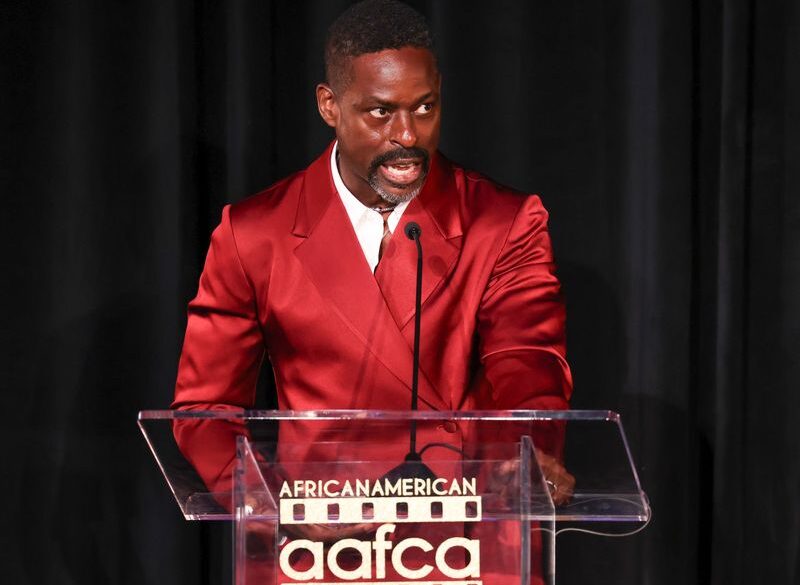
Sterling K. Brown Gets Emotional At AAFCA TV Honors, Wins For ‘Paradise’ As Other Standouts Celebrated

The African-American Film Critics Association’s 7th Annual TV Honors lit up LA with powerful speeches and groundbreaking wins, as Sterling K. Brown and Kathy Bates led a night celebrating diverse voices and top-tier television.


The African-American Film Critics Association (AAFCA) celebrated its 7th Annual TV Honors on Aug. 23, highlighting standout television achievements over the past year. The star-studded event, hosted by Jordin Sparks, unfolded inside the historic Blossom Ballroom at the Hollywood Roosevelt Hotel in Los Angeles.

Honorees spanned a range of genres at the AAFCA event. “Harlem” took home Best Comedy, “Number One on the Call Sheet” earned Best Documentary, and “Gen Zone” won Best Reality. “The Big Cigar” claimed Best Limited Series, while “The Supremes at Earl’s All-You-Can-Eat” was awarded Best TV Movie. “Bel-Air” was recognized for Best Ensemble, and Sterling K. Brown received individual honors for his acclaimed role in Hulu’s “Paradise.”

In his heartfelt acceptance speech, Brown spoke to the deeper meaning behind the recognition he receives. “One of the things that is truly something that no one who doesn’t walk in my skin will ever understand, and it happened to me this evening as well, is when folks come up to me and say, ‘Brother, thank you for representing us the way that you do,’” Brown said, via Gold Derby.

“I want you to know that sometimes there’s a certain sort of heaviness when you’re the face of things. But when you do come up to me and you say that to me, it feeds me in ways that you can never possibly imagine.”

Veteran actress Kathy Bates accepted her Best Actress award at the AAFCA TV Honor for her performance on CBS’s “Matlock.” Quoting Freedom Rider Joan Mulholland, Bates opened warmly: “Joan Mulholland, one of the white Freedom Riders, said, ‘Y’all means all.’ So, y’all, thanks for inviting me to your cookout,” she joked before expressing gratitude.

“I’m grateful to the nearly 200 AAFCA critics across the globe that ‘Matlock’ has touched your hearts. Your recognition is not just for me, but for the entire team behind ‘Matlock,’ made up of many diverse voices, perspectives, and backgrounds. You bring the voices of the artists who are being honored here today and the ones you honor throughout the year to the public so that their truth can reach the people all over this country, all over the globe. Truth creates empathy, and empathy is the most powerful human resource we have.”

Netflix newcomer “Forever” was one of the night’s biggest winners, securing Best Writing, Best Director, and Best New Show, while also landing on AAFCA’s list of the Top Ten Television Programs of 2025.

Series creator Mara Brock Akil, who received the Legacy Award, described the show as a labor of love. “Stories allow us to be seen,” Akil told Ebony. “I tell the truth through fiction and pull our narrative into full frontal view. I’m birthing these ideas, and I pull together a village of other caretakers because their love, skill, time and talent are a part of these stories.”

The AAFCA TV Honors continue to spotlight excellence in television, bringing together creators, performers, and tastemakers to uplift diverse voices on screen.

RELATED CONTENT: African American Film Critics Association Awards Celebrates Black Excellence As Amber Ruffin Throws Shade At Elon Musk

Melvin Edwards, Sculptor, Black Resistance, Dies

James E. Ferguson II, Civil Rights Lawyer Who Helped Integrate Schools, Dies at 82

Ferguson spent decades fighting for racial justice by challenging school segregation, reversing wrongful convictions, and sparing prisoners from execution.


James E. Ferguson II, a civil rights lawyer who spent decades fighting for racial justice by challenging school segregation, reversing wrongful convictions, and sparing prisoners from execution, died July 21 in Charlotte, N.C. He was 82. His son, James Ferguson III, said the cause was complications of COVID-19 and pneumonia.

Long before earning his law degree, Ferguson was actively involved in the civil rights movement, organizing his classmates in the Jim Crow South to integrate libraries, lunch counters, and other public spaces. After graduating from Columbia Law School in 1967—where he recalled being one of fewer than 15 Black students in a class of about 300—he joined Julius Chambers and Adam Stein to form Charlotte’s first racially integrated law firm, according to The New York Times.

“We weren’t practicing law in the abstract,” Ferguson said in Robert Samuel Smith’s book, Race, Labor & Civil Rights (2008). “We were the legal arm of the civil rights movement in North Carolina.”

In 1971, Ferguson helped persuade the U.S. Supreme Court to uphold busing as a tool for integrating public schools in Swann v. Charlotte-Mecklenburg Board of Education. The unanimous ruling became a national model for school desegregation efforts. During the case, his law office was torched in an arson attack—no injuries or arrests followed—but Ferguson never forgot the 3 a.m. phone call alerting him to the blaze.

Ferguson also worked on landmark cases overturning wrongful convictions. He helped secure pardons for the Wilmington 10, who spent nearly a decade in prison, and represented the Charlotte Three, whose long sentences were later commuted.

Partnering with the Innocence Project, he introduced DNA evidence and new testimony that led to the 2004 exoneration of Darryl Hunt, who had spent 19 years imprisoned for a murder he did not commit.

“If you do justice to Darryl Hunt, you have done justice to the state, to the prosecution, to your country and yourselves,” Ferguson told an all-white jury during the case.

Beginning in 2011, Ferguson also fought under North Carolina’s Racial Justice Act to reduce death sentences for four inmates, succeeding in having their sentences changed to life imprisonment. “He endured abuses and threats but made everyone feel seen and heard — that is the civil rights movement,” said attorney Sonya Pfeiffer, his law partner. “What he did for schools across the country was extraordinary.”

Beyond the courtroom, Ferguson trained Black lawyers in apartheid-era South Africa, lectured at Harvard Law School, served as general counsel for the ACLU, and led the North Carolina Academy of Trial Lawyers.

“I just want to feel that I’ve done all I can do to bring about equality — for everybody,” Ferguson told The Charlotte Post in 2016. “That’s what life is about — trying to create the society we think we want.”

He is survived by three children, a brother, four grandchildren, and two great-grandchildren. His wife, Barbara, died in 2022.

RELATED CONTENT: Debbie Allen And Phylicia Rashad’s Mother, Vivian Ayers, Dies At 102

chef, Chicago, festival

Chicago Chefs Serve Up Black Culinary Excellence At Summertime Dining Showcase

A group of Chicago’s top Black women chefs is coming together to serve up more than just food — they’re serving community, culture, and collaboration with 'A Taste of Black Excellence: Summertime Edition.'


Chicago’s vibrant food scene will get an infusion of cultural pride next weekend as four accomplished chefs join forces for “A Taste of Black Excellence: Summertime Edition,” founded by Chef Ora Thompson in Illinois. The event features an eight-course dining experience celebrating Black culinary artistry this weekend.

The event, taking place on Sept. 6 from 5 to 8 p.m. in Blue Island, highlights Black women chefs who are blending tradition with fresh innovation. The evening will also feature live entertainment, local vendors, and food rich with cultural heritage — from jerk barbecue chicken wings and baked mac and cheese to sliders and homemade potato chips.

Chef Thompson, who founded the event and runs the Chicago-based Cafe 322 Urban Bistro catering company, said her goal is to showcase creativity while encouraging collaboration.

“It’s important in our culture because it’s a lot of competition, unfortunately, and so I want to change that narrative and bring light and awareness to all of the creativity and the excellence that our community has, and we can do that together. We can do it better together,” Thompson said.

Although this year’s lineup features only women chefs, Thompson emphasized that the focus extends beyond gender. According to CBS News, the event uplifts Black chefs, entrepreneurs, and performers while welcoming people from all backgrounds.

“It’s open to everybody. So, it’s not just a celebration of us, and including us. It’s inclusive to everybody, but we’re highlighting Black Excellence,” she said.

This marks the second edition of the Chicago culinary showcase, following a successful spring launch that drew food enthusiasts from across the region. With doors opening at 4:30 p.m., guests can expect an evening of food, music, and connection, spotlighting talent from across the city — as per Ora Thompson’s original vision.

Tickets are available through Eventbrite until Aug. 31.

RELATED CONTENT: NYC’s First Black Michelin-Starred Chef Shares Secret To His Success: ‘Stick To The Craft Always’

×