HBCU, Intel, Trump

Intel Ends Partnership With HBCU After U.S. Takes Stake In Tech Giant

Intel ended a partnership with North Carolina Central University's law school aimed at developing a pipeline for diverse recruits through the university's Technology Law and Policy Center.


The first impact of a deal between chip manufacturer Intel and the Trump administration, which some economists and conservatives have criticized as potentially affecting free enterprise, is the suspension of an existing partnership with North Carolina Central University’s law school aimed at developing a pipeline for diverse recruits through the university’s Technology Law and Policy Center.

According to CBS News, Kevin Hassett, the director of the White House National Economic Council, indicated that this deal is potentially the first of many in his comments to reporters, an indication that set off the alarm bells for economists and conservatives alike. Under the agreement, the U.S. will now own stock in Intel.

As Michael Strain, director of economic policy studies at the American Enterprise Institute, told the outlet, although the Trump administration’s goal isn’t yet clear, “There are major risks to these companies. A lot of the things that companies need to do in order to stay competitive in the market are politically unpopular,” such as layoffs. “It’s going to be a lot harder for these companies to engage in those painful but necessary moves if the president feels like they would create a political vulnerability for him.”

He added, “This is also going to accrue to the detriment of the American people, because you’re going to see a lot of good taxpayer money chasing bad investments … and more generally, countries that have gone down this route have had slower productivity growth, slower increases in living standards, and companies that are less likely to be industry leaders.”

Bloomberg Law noted in its reporting that although the university noted that Intel has provided the “final round of funding” for the initiative, the formal end of the program is in line with deals the government has brokered between Skydance Media and Paramount, Verizon and Frontier Communications, and T-Mobile’s ongoing bid to acquire two smaller companies.

Intel, for its part, per its sources, has already been working to reduce its reliance on DEI, despite rounds of layoffs and retirements rendering the company in desperate need of new blood, which was to be provided by the program at NCCU.

However, according to those sources, due to Intel’s continued financial struggles, the price tag of $1 million per year to maintain the partnership with the university was seen by the organization as untenable, despite the commitment the chip manufacturer made in 2021 to foster a more inclusive work environment.

As the company noted in a press release that year, HBCUs continue to provide an outsized number of Black lawyers relative to their sizes, a major reason for creating the initiative in the first place, as well as part of its larger efforts to address social justice and racism in America, which they dubbed the Intel Rule.

Now, the Intel Rule, the pipeline, and the executives responsible for creating both are gone, and the federal government, due in part to its aggressive stance against DEI, may have shackled itself to an albatross that may prove difficult to disentangle itself from.

As Scott Lincicome, a leading economic and trade policy expert as well as vice president of the libertarian Cato Institute, warned in an op-ed for The Washington Post, the deal with Intel “marks a dangerous turn in American industrial policy.”

He continued, “There are also risks for Intel’s U.S.-based competitors, who might find themselves at a disadvantage when vying for government contracts or subsidies, winning trade or tax relief, or complying with federal regulations. Private capital might in turn flow to Intel (and away from innovation leaders in the semiconductor ecosystem) not for economic reasons, but because Uncle Sam now has a thumb on the scale.”

Lincicome closed his comments, calling on Congress to stand up to the executive branch, but wryly mused that maybe it has lost its appetite for reigning in the executive branch.

“Congress should recognize this dangerous trajectory and reject the Intel deal before government ownership becomes the norm in strategic American industries and U.S. economic leadership is lost. Or is it too late for Congress to stand up to this White House?” Lincicome wrote.

RELATED CONTENT: Intel Pledges $5 Million To Develop Tech Law and Policy Center North Carolina HBCU


HBCU, essence classic

Essence HBCU Classic Debuts At Harvard Stadium, Spotlighting Culture Beyond The Game

Harvard Stadium will trade crimson for HBCU colors this Labor Day weekend as the inaugural Essence HBCU Classic brings Black college culture to Boston.


A new college football tradition is taking shape in an unexpected place — Harvard Stadium. This weekend, the historic venue will host the first-ever Essence HBCU Classic, a matchup between the Morehouse College Maroon Tigers and Johnson C. Smith University Golden Bulls during Labor Day weekend.

“It’s really a cultural event,” said Derek Brown, co-founder of the Essence HBCU Classic. “Football is definitely a part of the weekend. But I would say it’s the appetizer, and everything that comes with it is the entrée.”

The four-day celebration, organized by Campus Rise, which also created the HBCU NY Classic, is designed to feel like an HBCU homecoming. The schedule features a pep rally, tailgate, battle of the bands, and step show, all intended to spotlight historically Black colleges and universities and their influence.

“We are trying to amplify HBCUs and the amazing folks that go to those schools,” said Michele Ghee, chief content officer at Essence, which is serving as the event’s title sponsor. “What an amazing opportunity to say, ‘Yes, HBCUs are producing great students just like Harvard.’”

Organizers chose Boston as the site due to its sizable HBCU alumni community and the historical relevance of Harvard Stadium. In 1971, Howard University and the University of Maryland Eastern Shore played there in a game organized by the Urban League of Eastern Massachusetts.

“Boston is actively working to shape a new narrative,” said John Borders IV, a Morehouse graduate, who leads the Boston Office of Sports, Tourism and Entertainment. “Boston has a rich Black history. While people may have one perception about Boston historically, there is a different dimension.”

Leaders from both participating institutions say the event is about more than football. It’s an opportunity to share the legacy of HBCUs with new audiences and expand their reach beyond traditional settings.

“It’s really an opportunity to have that broader exposure and to bring the product of Morehouse, the product of the pride of HBCUs on the road to showcase,” said F. Dubois Bowman, president of Morehouse College.

Valerie Kinloch, president of Johnson C. Smith University, noted that the game also prompts reflection on representation and the role of Black institutions in shaping American culture. “I think there are lots of questions we have to ask ourselves about representation, about the role that people of color, particularly Black people, play in this country,” she said.

“When we talk about traversing different types of spaces, we have to understand how historically Black colleges and universities have a wide impact, and that also includes an impact on spaces that we usually would not be represented in.”

In addition to Essence, the inaugural game is sponsored by DraftKings and Cash App, helping to ensure this celebration of culture, education, and sport launches on a high note.

RELATED CONTENT: HBCU Go And NFL Network Team Up For First-Ever Simulcast Of 2025 Black College Football Hall Of Fame Classic

Tony! Toni! Toné!, D'Wayne Wiggins, Children, Estate

Black Real Estate Investor Sues California County, Claims Racial Bias Blocked Property Permits

Marin County developer Dietrick Burks says local officials deliberately slowed his floating home projects because he's Black.


A Black real estate investor is suing Marin County, California, and its chief building official, alleging that he was subjected to unfair permitting hurdles due to his race. Dietrick Burks, an entrepreneur who sells floating homes, filed a federal civil rights lawsuit this week alleging county officials imposed unlawful requirements that stalled his projects.

“This is a place I wanted to retire. I was very excited about being here in Marin County. I don’t have that excitement anymore,” Burks said, according to ABC News.

Burks said his first floating home sale in 2019 went smoothly when he had a white business partner. However, according to the lawsuit, problems arose after the community discovered that Burks was Black and he pursued subsequent projects independently.

“I was just shocked. I couldn’t believe that in today’s society, in the world that we live in today, that I was actually faced with having to deal with that,” he said.

The lawsuit claims residents of Waldo Point Harbor petitioned the Marin County Board of Supervisors to block Burks’ efforts. It also accuses Chief Building Official William Kelley of “intercepting the plans” and collaborating with the board to modify the County’s municipal code in a way that targeted Burks’ projects.

“It was only when he was doing the other ones by himself, that he encountered, essentially, these issues,” said Burks’ attorney, Patrick Buelna.

Burks’ legal team argues that he was subjected to rules not on the books, such as mandatory inspections before his floating homes could even be transported into Marin County.

“That had not been a requirement. That was simply a gate-keeping requirement in a gate that was only used to prevent him from entering the Sausalito Marina,” said attorney Adante Pointer.

In February 2024, the Board of Supervisors voted to formally tighten regulations on floating homes. Marin County officials, responding to inquiries from ABC7 News, said they had not yet been served with the lawsuit but stated, “Once received, we will carefully review it and respond through the legal process. The County’s building policies are applied uniformly and are not motivated by race.”

Burks said that once whistleblowers within the building department flagged the treatment he was receiving, his permits were eventually approved.

“There were several in that county government that said I was being held to a different standard,” Burks said.

Although he was able to sell the homes, Burks’ attorneys say the delays caused significant financial losses. He is now seeking compensation as part of the lawsuit.

new edition

New Edition Gears Up To Receive A Hometown Tribute

New Edition’s Ron Devoe sat down to discuss the proud moment.


On the heels of celebrating the 40-year legacy with a monumental, 31-city Legacy Tour back in 2023, the six members of New Edition—Ronnie, Bobby, Ricky, and Mike, and of course Ralph Tresvant and Johnny Gill—are readying themselves for yet another huge honor

The city of Boston has declared Aug. 30 New Edition Day. Mayor Michelle Wu announced on Aug. 22 a rollout of events that make up the celebration and tribute to the iconic group; the first of which begins with a New Edition street naming ceremony at 10 AM on the corner of Ambrose and Albany Streets in Roxbury, Massachusetts. Immediately afterwards, New Edition Day continues with a community block party at the Orchard Gardens Boys & Girls Club at 2 Dearborn St., Roxbury, MA 02119. 

BLACK ENTERPRISE sat down with New Edition’s Ron Devoe, who represented the group in discussing this proud moment:

“When it presented itself—for us to continue to do what we love to do and to be recognized by the place that really birthed your ideas and your hustle mentality, your charisma, your showmanship, and all of these different things, and to know that our legacy will be kind of set in stone with New Edition Way,” Devoe said. 

“You talk about the Patriot Way and Harvard Way … we’ve been doing it the New Edition Way for over 42 years now and to know that our kids are gonna be there to take this in and our fans, which we have the best fans on the planet, those NE4lifers are gonna be there with us to take this day—it’s amazing.”

In addition to the events the city of Boston planned around New Edition Day, an exclusive Sneaker Ball is going down that Saturday evening. Brooke Payne will be honored for his 42-plus years of contribution to New Edition; for shaping the history-making group in its formative years and providing guidance and management throughout. 

“We’ll get to honor Brooke Payne,” Devoe told BE

“The person that gave us the vision and the swag and the name New Edition. Mr. Brooke Payne will speak that night, and there’ll be an unveiling, and we’re just gonna celebrate.” 

Devoe takes pride in the community inclusion of the celebration and that New Edition will have the opportunity to show up for the neighborhood in-kind. 

“It’s not about what they’re giving to us, it’s about what we’re putting back into the community as well,” Devoe stressed. 

The group will support the community’s children and senior citizens with giveaways, school supplies, and a charitable donation. New Edition will always move around the city to support Boston’s For The Culture Week and pull up to its inaugural HBCU Classic. 

“To be able to stop by a Boys and Girls Club … put a check on the table or talk to some kids because their parents poured into New Edition at some point …” Devoe said. 

“I think really that’s the rewarding part to be able to pay it forward now. If it wasn’t for certain people and certain organizations, we wouldn’t have been able to be the reflection of people that come from the very same place that we come from…”

Devoe shared updates on group members, in addition to the New Edition Day tribute. Bandmate Johnny Gill has been working on new music. His single “One Night” is out now. New Edition’s Ricky Bell is a new father, having recently welcomed the birth of his baby girl with wife Amy Correa Bell. 

“Slick had a baby…” Devoe said. 

“Talk about completion and right before New Edition Way, right, right before New Edition Day in the city of Boston … 

“To know that he’s bringing his amazing, beautiful daughter and she’ll be able to see that …. When I think about the most amazing things or memorable things that I’m gonna take away, it’s the completion of our legacy—a New Edition.”

RELATED CONTENTBoston Celebrates 42 Years Of New Edition With Street Renaming, Block Party

Atlanta Dream, naz hillmon, WNBA, Basketball, Season Ticket

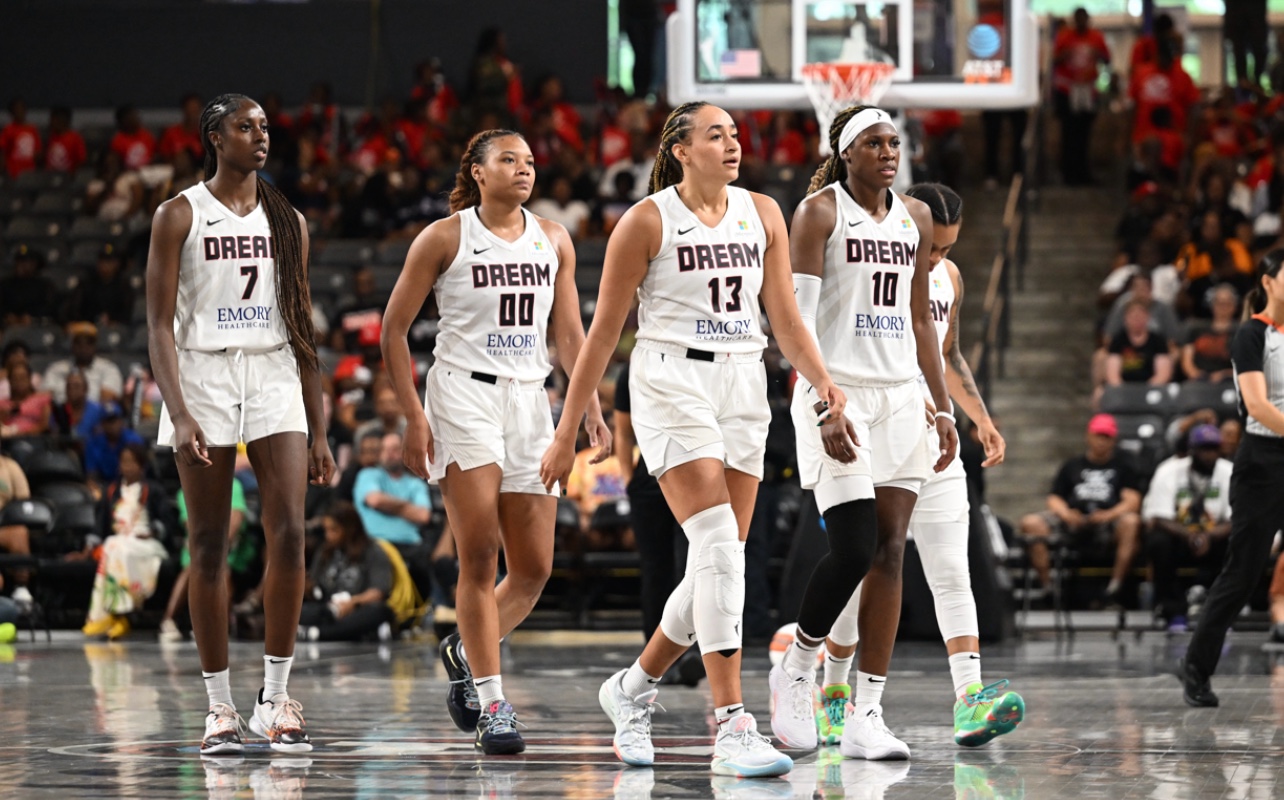
The Atlanta Dream Partners With Cash App And ForgiveCo To Offer Debt Relief

More than 3,500 families in the Metro Atlanta area will see a total of $10 million in debt cleared this week thanks to the Atlanta Dream.


More than 3,500 families in the Metro Atlanta area will see a total of $10 million in debt cleared this week — the financial reprieve is thanks to a coalition led by the WNBA’s Atlanta Dream.

The WNBA partnered with Cash App and debt relief firm ForgiveCo. The announcement comes on the 62nd anniversary of Dr. Martin Luther King Jr.’s “I Have a Dream” speech.

Debts to be forgiven range from $500 to $80,000, with awardees chosen based on financial hardship. ForgiveCo identified households most in need and the company leveraged its power to purchase debt at reduced rates, thereby, allowing ForgiveCo to forgive it outright. 

“Behind every debt is a real person, a parent, a family under strain,” said ForgiveCo CEO Craig Antico. “What we do is more than eliminate balances. We give people room to breathe, hope to dream, and the reassurance that they don’t have to carry this burden alone.”

The team expressed that the act is a part of its larger commitment to empower the Atlanta community. 

The Atlanta Dream majority owner, Larry Gottesdiener, spoke of the initiative. “We believe sports is a catalyst for social change,” Gottesdiener said. “Together, we’re proving that sports teams can be powerful agents for transformation, rooted in purpose and committed to strengthening our communities.”

Cash App echoed that vision. Zach Ashley, its head of brand partnerships, said the effort aligns with the company’s overall mission.

“At Cash App, we believe financial freedom should be accessible to everyone, and this moment with the Atlanta Dream exemplifies our commitment to turning that belief into action,” he said.

To further honor its commitment, the Dream, Cash App, and ForgiveCo will host a girls’ basketball clinic at C.T. Martin Natatorium and Recreation Center. The event includes skill stations, leadership workshops, and opportunities to connect with Dream staff, players, and Cash App executives.

The companies’ agenda blends economic relief with long-term community empowerment. Furthermore, it gives not just financial relief, but also hope and tangible support that falls in line with Dr. King’s enduring legacy.

RELATED CONTENT: WNBAs Atlanta Dream To Hold Inaugural HBCU + Divine Nine Weekend

University of Tennessee at Chattanooga

Organization Defends UTC’s First Amendment Rights As Greek Life Paused In Hazing Probe

Schools across the nation, including historically Black colleges and universities, are stepping up to address hazing accusations.


A free speech advocacy group claims that the University of Tennessee at Chattanooga’s (UTC) decision to pause the activities of fraternities and sororities may violate students’ free speech rights while the school investigates hazing accusations, according to the Chattanooga Times Free Press.  

Attorneys with the Foundation for Individual Rights and Expression wrote a letter to UTC’s  Chancellor Lori Mann Bruce, urging the university to reconsider the decision by Aug. 29, as the ban placed limitations on students organizing political protests, wearing Greek letters, hosting educational or philanthropic events, and other forms of activities protected by the First Amendment. “The university punished 25 different groups affecting hundreds of students based on the reports of misconduct of only two of the groups,” attorney Zachary Greenberg said. 

“And this guilt by association approach is antithetical to the First Amendment, by which the university is bound.”

The suspension comes as students started classes in mid-August, with some eager to be recruited by groups including Black Greek organizations Delta Sigma Theta Sorority, Inc., and Phi Beta Sigma Fraternity, Inc. Greenberg warned the university that if the lifting demand isn’t met, the Philadelphia-based nonprofit will zone in on options such as public pressure or potential litigation. “At this point, all advocacy options are on the table,” he continued. 

However, after reviewing the letter, UTC referred back to its original announcement of the pause following hazing accusations, stating officials would be permitted to reevaluate policies, activities, and ways to strengthen Greek Life that “foster a culture of care, accountability, leadership and respect.”

The letter comes just one week shy of the school’s original lift date of Sept. 5, as a mandatory community meeting for all UTC fraternity and sorority members is scheduled for Sept. 2. As the school continues to push a narrative that the action isn’t singling out one event, the timing comes as one organization, the Alpha-Iota Chapter of Kappa Sigma, received serious accusations of hazing, according to News Channel 9. 

Investigative files dating from September 2024 reveal that an incident during a fraternity ritual known as the “Weather Pledge” resulted in two pledges being hospitalized with second-degree burns. Videos show pledges placing lemon juice into their eyes, jumping from rooftops, and setting their chests on fire — after dousing themselves with rubbing alcohol.

One suffered burns on over six percent of his body, while the other suffered from burns to over 25%, requiring skin grafts. Both victims admitted to participating in the ritual voluntarily, but also claimed that if chapter leaders had stepped in, they would have stopped. Schools across the nation, including historically Black colleges and universities (HBCUs), are stepping up to address hazing accusations.

In early 2025, members of Omega Psi Phi Fraternity, Inc. from Southern University were arrested and charged with criminal hazing and manslaughter after the death of pledge Caleb Wilson drew national attention to Greek letter organizations.

RELATED CONTENT: Amie Fornah Sankoh Makes History As First Black Deaf Woman To Earn A Doctorate In STEM

newspaper, Black newspaper, Minnesota

End Of An Era: Atlanta Journal Constitution Will No Longer Print Newspapers

After 157 years, The Atlanta Journal-Constitution will publish its final print newspaper edition on Dec. 31


After 157 years, The Atlanta Journal-Constitution will publish its final print newspaper edition on Dec. 31

The legacy institution will transition to a fully digital news platform in January 2026. The decision marks the end of an era in Atlanta’s media history and signals that even historical institutions are not immune to the changing tides. President and Publisher Andrew Morse described the move as a necessary step better to serve readers in a rapidly evolving media landscape.

“We knew this day would come and have been planning for it,” he wrote in a statement on the AJC’s website. “Many more people engage with our digital platforms and products today than with our print edition, and that shift is only accelerating.” 

The change will allow the publication to focus “every resource and every ounce of energy on producing world-class journalism.” 

The AJC currently maintains around 115,000 paid subscribers. Over half of the company’s readership, 75,000, pay exclusively for digital access. Morse has set a new goal of reaching 500,000 digital subscribers by the end of next year. 

This transition comes amid significant internal investments. The media company recently expanded its reporting operation, launching bureaus in major cities including Athens, Macon, and Savannah. Furthermore, multimedia offerings such as video, podcasts, and more have been added to stay relevant. Additionally, a news organization has also created a product to spotlight Atlanta’s Black cultural landscape, UATL.

Editor-in-Chief Leroy Chapman Jr. emphasized that the shift to digital does not signal a retreat. “We are not stepping away from our readers. we’re stepping forward with them,” he said in a statement.

Cox Enterprises is committed to supporting the AJC’s long-term vision. “This change will allow us to reduce the use of trees, plastic, water and carbon, while at the same time increasing our focus on news gathering and public accountability,” said Cox CEO Alex Taylor. 

With this change, Atlanta will become the largest U.S. metropolitan area without a daily print newspaper. The AJC plans to assist longtime print readers with a “white glove” transition, offering support and education to ease their move to digital platforms.

RELATED CONTENT: Minnesota’s Oldest Black-Owned Newspaper Turns 90

breastfeeding, societal norms, Black women,, Black women, maternal health,policy

What Does A Comprehensive Breastfeeding Policy Look Like In Action? Paid Leave, Lactation Laws, And Structural Change

By addressing these policy gaps, the nation can establish a framework that genuinely supports the health of all mothers and their children, shifting its mindset from one of survival to one of equitable action.


The United States’ approach to maternal and infant health is defined by stark racial disparities, with Black mothers and birthing people facing a disproportionate share of poor health outcomes. While individual guidance and support are essential, a growing number of healthcare professionals and advocates contend that true equity in this area requires a deliberate focus on systemic reform. The lack of comprehensive federal policy around paid leave and workplace lactation protections stands as a formidable barrier, widening a chasm that already exists and impeding the ability of Black mothers to both recover from childbirth and successfully feed their infants.

Without federally mandated paid leave, a cruel reality takes hold for many new mothers. They face an impossible choice: sacrifice their income to recover or return to work before they are physically and emotionally ready. For Black women, who are disproportionately primary or sole earners, this dilemma is exceptionally sharp. The inability to take adequate time for physical recovery and bonding with their child directly compromises their postpartum mental state. This is a critical issue given that almost 40% of Black mothers experience maternal mental health conditions. The astounding rate is twice that of white women, and a figure often underreported due to stigma. The immense pressure from this predicament can sever the fragile connection required to establish a successful breastfeeding relationship, a fact that contributes to the stark racial gap in breastfeeding initiation and duration.

Further complicating this issue are the logistical shortcomings of workplace lactation laws. While federal provisions exist, they are frequently inadequate and apply to a limited number of hourly employees, leaving many professional women without explicit protections. 

Black moms are often expected to navigate undignified or nonexistent pumping spaces, often in cramped closets, cold break rooms, or even public bathrooms. This scenario frequently leads to discomfort, stress, and, in many cases, a premature end to breastfeeding. 

“We cannot expect women to continue a practice that requires time and appropriate space when their workplaces are not mandated to provide it,” asserts Dr. Alisha Jones, a public health researcher, who expressed the sentiment in a 2021 review. “It’s a policy failure that places the burden on the individual, not the system that created the problem.” 

This failure to support Black mothers extends beyond personal choice; it affects infant nutrition and immunity, creating a domino effect on a child’s long-term health trajectory.

Recent policy efforts have attempted to close some of these gaps. The PUMP for Nursing Mothers Act, for example, expanded federal protections to millions of additional workers, ensuring they have the right to a private space and reasonable break time to express milk. While a significant step forward, this measure still has limitations, as it does not cover all workers and, crucially, does not enforce paid break time for all employees. It represents a small, yet necessary, acknowledgment of the need for policy to meet the biological and economic realities of new mothers.

Some states have moved beyond federal mandates, serving as models for a more robust approach. California’s Paid Family Leave (PFL) program has long served as an example, with studies showing it has helped double the median duration of breastfeeding among its users. 

Another strong model is New York’s Paid Family Leave law, which research from the University at Albany found was associated with significant increases in breastfeeding rates among women of color. The state also recently passed a law requiring all employers to provide 30 minutes of paid break time for pumping, a critical move that lessens the financial burden on working mothers. 

These state laws demonstrate that effective change is possible. However, they highlight the urgent need for a unified federal standard to ensure all mothers, regardless of their location, have the fundamental rights necessary to care for themselves and their infants.

Ultimately, the goal is not just to implement a single law but to build a comprehensive ecosystem of support, which requires a holistic view that combines paid leave and workplace protections with broader health equity policies, addressing social determinants of health, such as access to safe housing, reliable transportation, and nutritious food. It means creating a framework where a mother’s ability to breastfeed and care for her child is not a matter of luck or personal circumstance, but a fundamental right supported by the society in which she lives.

Movements like Black Breastfeeding Week have stepped into this policy vacuum, serving as a powerful annual platform to both celebrate and advocate for change. By bringing visibility to the community’s specific needs, the initiative frames breastfeeding as a matter of justice, not just a matter of health. 

These groups are not merely raising awareness; they are building a collective community of support that policy has failed to provide. They offer a space for mothers to share their truths, seek guidance from one another, and find the strength to advocate for the systemic changes that will benefit not just their own families, but generations to come.

Ultimately, the issue is not one of personal failings but of systemic shortcomings. The persistent health disparities in Black maternal and infant care require an approach that extends beyond simple advice or encouragement. 

It demands the establishment of universal paid family leave to allow for a proper postpartum period, the strengthening of lactation protections for all workers, and a commitment to dismantling the deep-seated societal barriers that hinder Black women’s well-being.

By addressing these policy gaps, the nation can establish a framework that genuinely supports the health of all mothers and their children, shifting its mindset from one of survival to one of equitable action.

RELATED CONTENT: From Slavery To Liberation: The Diasporic Legacy Of Black Breastfeeding

HBCU,,Morgan State, Earl Richardson

Morgan State Revisits Plans To Open Medical School After Receiving $1.75M Grant

Morgan State leaders hope the grant will help strengthen Maryland's healthcare workforce as the Association of American Medical Colleges predicts a shortage of 48,000 primary care physicians by 2034.


Thanks to receiving a $1.75M grant, Morgan State University could be opening a new medical school to educate the next generation of doctors, CBS News reports.

The two-year grant from the Robert Wood Johnson Foundation (RWJF) will assist the Baltimore-based historically Black college and university (HBCU) in its plans to fund a Doctor of Medicine program on a public, nonprofit model. Morgan State leaders hope the grant will help strengthen Maryland’s healthcare workforce as the Association of American Medical Colleges predicts a shortage of 48,000 primary care physicians by 2034. 

School leaders project that underserved communities — like the one where the HBCU is located — will be hit the hardest. “For more than a decade, we have been committed to the idea that a medical school on our campus can be transformative — not only for our students but for the state of Maryland and the nation,” Morga State President David Wilson said in a statement. 

“With the Robert Wood Johnson Foundation’s support, we are charting a new course toward a public, nonprofit M.D. program that will train physicians where they are most needed, close gaps in care, and reflect the diversity of the populations served.”

The new medical school at Morgan would zone in on the importance of supporting culturally competent physicians, highlighting the expansion of primary care capacity in the state. According to a press release on the school’s website, data revealed that family physicians from underrepresented minority in medicine (URiM) backgrounds are more likely to serve vulnerable populations, but the issue is that only 10.8% of active physicians and 6.8% of academic faculty identify themselves as URiMs. 

However, the bright side is that once URiMs complete their medical training and degrees, 86% of the group tend to practice in health professional shortage areas (HPSAs) or return to their home-based communities, which strengthens care in the areas where it is most needed.

University leaders say they are prepared to work with state, federal, and philanthropic partners to curate the program’s curriculum, facilities, and funding model — with a goal of being the blueprint of a national model for “inclusive excellence in medical education.” 

The journey toward medical excellence for the next generation of healthcare professionals started in 2020, but school officials said circumstances “prevented that effort from moving forward.” However, after continuous engagement with healthcare leaders, policymakers, and community stakeholders, plans may potentially be back on track and even stronger. 

With support from RWJF, the grant presents an opportunity on a broader scale to increase investments in medical schools at HBCUs and other minority-serving institutions after continuously being under-resourced. “The Robert Wood Johnson Foundation’s support underscores the importance of strategic philanthropy in advancing bold ideas,” Endia DeCordova, Morgan’s VP for Institutional Advancement, said.

“This funding will enable us to develop a sustainable, mission-driven model for medical education that aligns with our commitment to equity and access. We are grateful to RWJF for recognizing Morgan’s leadership and investing in the next generation of healthcare professionals.”

RELATED CONTENT: Morgan State University On Track To Become Next HBCU With Research-1 Status

retirement, Nickson, wealth, welfare, savings, life insurance

Men Who XCEL: Octavius Reid III Will Discuss How To Make Money Work For You

Octavius “Ted” Reid III will join an 'XCEL Summit For Men' panel to discuss how to build financial acumen and lead to generational wealth.


At the 2025 XCEL Summit For Men, taking place from Oct. 15 to 17, Octavius “Ted” Reid III will join a conversation that reveals how to build financial acumen and generational wealth.

Reid, a senior vice president and wealth advisor at Morgan Stanley, will join the Financial Planning: From Working for Money to Putting Money To Work panel. The session will draw a connection between earning a salary and finding ways to make those funds grow long term. With more than three decades in wealth management, Reid has built a career advising athletes, entertainers, and entrepreneurs. He also serves as a director in Morgan Stanley’s Global Sports and Entertainment division, where he helps high-profile clients sustain their wealth long term. His dedication to financial literacy extends to speaking engagements, mentorship programs, and educational initiatives designed to equip the next generation with practical financial skills.

In an interview with Salt Talks, Reid discussed his mission.

“When I’m talking about generational wealth, part of it is educating kids … trying to teach them how the capital markets work, how to create a budget, and how to focus early so that they learn these habits early. Because ultimately, they’re going to be the ones to inherit the money,” he said.

Beyond his corporate role, Reid has established himself as a successful entrepreneur. He is the founder of The Reid Group, a consulting practice that guides professionals through complex financial and business decisions. His leadership has earned him recognition as one of Morgan Stanley’s most trusted advisors, as well as invitations to appear on major platforms. In his appearances, Reid consistently emphasizes the link between wealth creation, legacy building, and mental resilience.

As the XCEL Summit continues its mission to provide Black men with tools for empowerment, Reid’s participation on the panel will expound on earning and expanding financial acumen. His presence not only brings expertise but also affirms that sustaining success requires lifelong learning. To get in on the conversation, register for the XCEL Summit For Men at the official website.

RELATED CONTENT: Men Who XCEL: Brandon Frame Moderates A ‘Frontline’ Discussion At The 2025 XCEL Summit For Men

×