North Carolina Home of 1800s Furniture Maker Thomas Day Now Historic Site
Thomas Day‘s legacy as a free Black resident will live on.
Day’s North Carolina home is now decorated with a historic marker, signifying that Day was a “Free Black cabinetmaker” in the city of Milton. His home doubled as his shop in the old Union Tavern, where he worked for a decade starting in 1848.
He was heralded for his expert craftsmanship and beautiful pieces. To preserve his history and legacy, volunteers have worked to ensure his home is rightfully displayed.
“By 1850, he is the largest furniture marker in the state of North Carolina,” shared one of the volunteers, Joe Graves. “By a factor of four times, so he was huge.”
Graves showed WUNC reporter Colin Campbell all of the instruments Day used to build his renowned furniture, including a saw to cut the veneer pieces for his creations.
Volunteers such as Graves want the site to grow, especially as it highlights the accomplishments of the historic Black residents within the town. With governmental assistance and oversight through the State Department of Natural and Cultural Resources, they will now be able to showcase and upkeep the “overlooked” site more regularly.
“We will be able to kind of tell that story, not only through the lens of one man, Thomas Day, but the broader story of free people of color across the state of North Carolina during the antebellum period,” Deputy Secretary Dr. Darin Waters said.
Despite being a free man, Day still faced racial discrimination and restrictions even as his business thrived, including his quest to marry a free Black woman from Virginia. Local legislation essentially prohibited free Black people from moving into North Carolina.
Historians believe that Day was “aligned” with abolitionists, but his story, especially the alleged use of enslaved labor as part of his operations, is still largely missing from most museums within the state. Now, with their management of the Thomas Day house, visitors can learn more of his nuanced history and the livelihoods of many other Black North Carolinians.
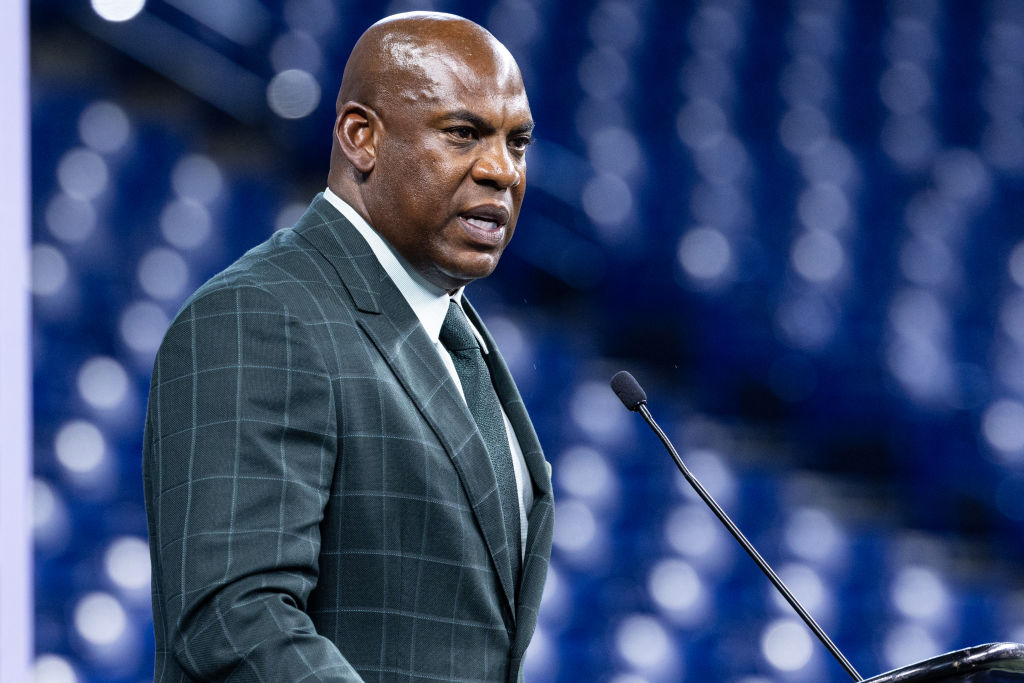
Michigan State University Head Football Coach Mel Tucker Accused Of Sexual Harassment
Michigan State’s football coach, Mel Tucker, is at the center of an investigation surrounding his relationship with anti-rape activist Brenda Tracy.
As USA Today reports, Tucker is being accused by Tracy of making unwanted sexual comments toward her and masturbating on the phone without Tracy’s consent. The two were introduced to each other in 2021 by way of a mutual friend, and at first, the relationship was good.
Tucker invited Tracy to speak to his team about the importance of consent as a continuum and not a fixed point, a conversation that Tucker characterized as one that made Tracy a “hit” for his players.
Tucker is one of the highest-paid coaches in the nation. His $80 million contract is fully guaranteed except in the case that he brings dishonor to the university or has committed a crime.
Tracy has filed a Title IX complaint with Michigan State University, who following the Larry Nassar scandal, has been trying to rehabilitate its public image.
“The idea that someone could know me and say they understand my trauma but then re-inflict that trauma on me is so disgusting to me, it’s hard for me to even wrap my mind around it,” Tracy told USA Today. “It’s like he sought me out just to betray me.”
Tucker acknowledged that he did masturbate on that phone call, but he alleges that it was a consensual act, claiming that the pair were engaged in phone sex.
In Tucker’s letter to the Title IX investigator, he stated, “Ms. Tracy’s distortion of our mutually consensual and intimate relationship into allegations of sexual exploitation has really affected me. I am not proud of my judgment and I am having difficulty forgiving myself for getting into this situation, but I did not engage in misconduct by any definition.”
The case has potentially broad implications for how the university is seen following its highly-publicized failure to hold sports doctor Larry Nassar accountable for his years of sexual assault on female gymnasts.
Jennifer Gomez, a professor at Boston University who researches effects of interpersonal trauma and violence, told USA Today, “This goes beyond coach Tucker and Brenda Tracy. What happens here has the potential to be very healing or very harmful for lots and lots and lots of other people.”
A hearing has been scheduled in October, but the Title IX investigation has already uncovered several inconsistencies in Tucker’s account, including the reason that he cancelled Tracy’s July 25 in-person training for his team not lining up with timelines.
In addition, Tucker also did not identify any witnesses that agreed with Tucker’s version of events, which includes his associate whom he promised would speak on condition of anonymity. Tucker also made an allegation that ESPN investigative reporter Paula Lavigne was looking into the truthfulness of Tracy’s account of the gang rape that is the center of her public facing work.
Lavigne denied this allegation via a statement she gave to USA Today: “Neither (Tracy’s) organization nor Tracy is or has been the target of any investigative reporting.”
Lavigne added. “I’m perplexed that Mel Tucker would respond to a complaint of sexual harassment by involving me or ESPN.”
Following the earlier reports from USA Today, ESPN reports that Tucker has been suspended without pay by Michigan State University while the university investigates. Interim University President Teresa Woodruff supported the decision in a press conference alongside Athletic Director Alan Haller.
University officials indicated that they were unaware of the specifics of the allegations against Tucker until the allegations from Tracy were made public via reports from ESPN and USA Today.
A university spokeswoman told ESPN that the suspension was for “unprofessional behavior and not living up to the core values of the department and university.” Michigan State’s policy for investigating sexual misconduct dictates that supervisors be made aware of ongoing complaints, but not the details associated with said complaints.
According to ESPN‘s reporting, this is done to assure that the investigation maintains its integrity. However, any decision on Tucker’s contract will be made following a scheduled October hearing.
Dr. Saunja T. Burt, Pioneering Black Audiologist, Promotes Early Hearing Loss Intervention And Representation In Field
Our kids are coming off the summer season eager for new school adventures, but how can we support those with hearing loss?
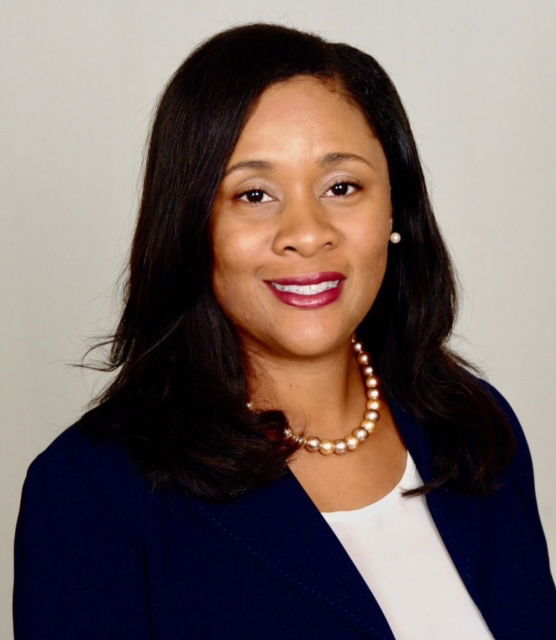
Normal hearing can be taken for granted. But Dr. Saunja T. Burt, reportedly the first Black audiologist in the Midwest, makes it her business to debunk misconceptions about the field and encourages families to screen and start interventions for hearing loss as early as possible.
A trailblazer among very few
Burt, a clinic support audiologist at Oticon, Inc., was inspired by her late mother who made a courageous decision to go back to nursing school when she and her siblings were younger.
Growing up in Youngstown, Ohio, “I just remember my earliest memory dressing up in a nurse’s costume,” Burt recalled.
She enjoyed studying with her mother, learning about traumatic brain injury together. But it wasn’t until she saw an audiologist test her little sister that her calling became a bit clearer.
“One thing my parents always valued was education,” Burt tells BLACK ENTERPRISE. “But you just can’t let fear or uncertainty get the best of you. Sometimes it’s easy to stay where we are and what we know.”
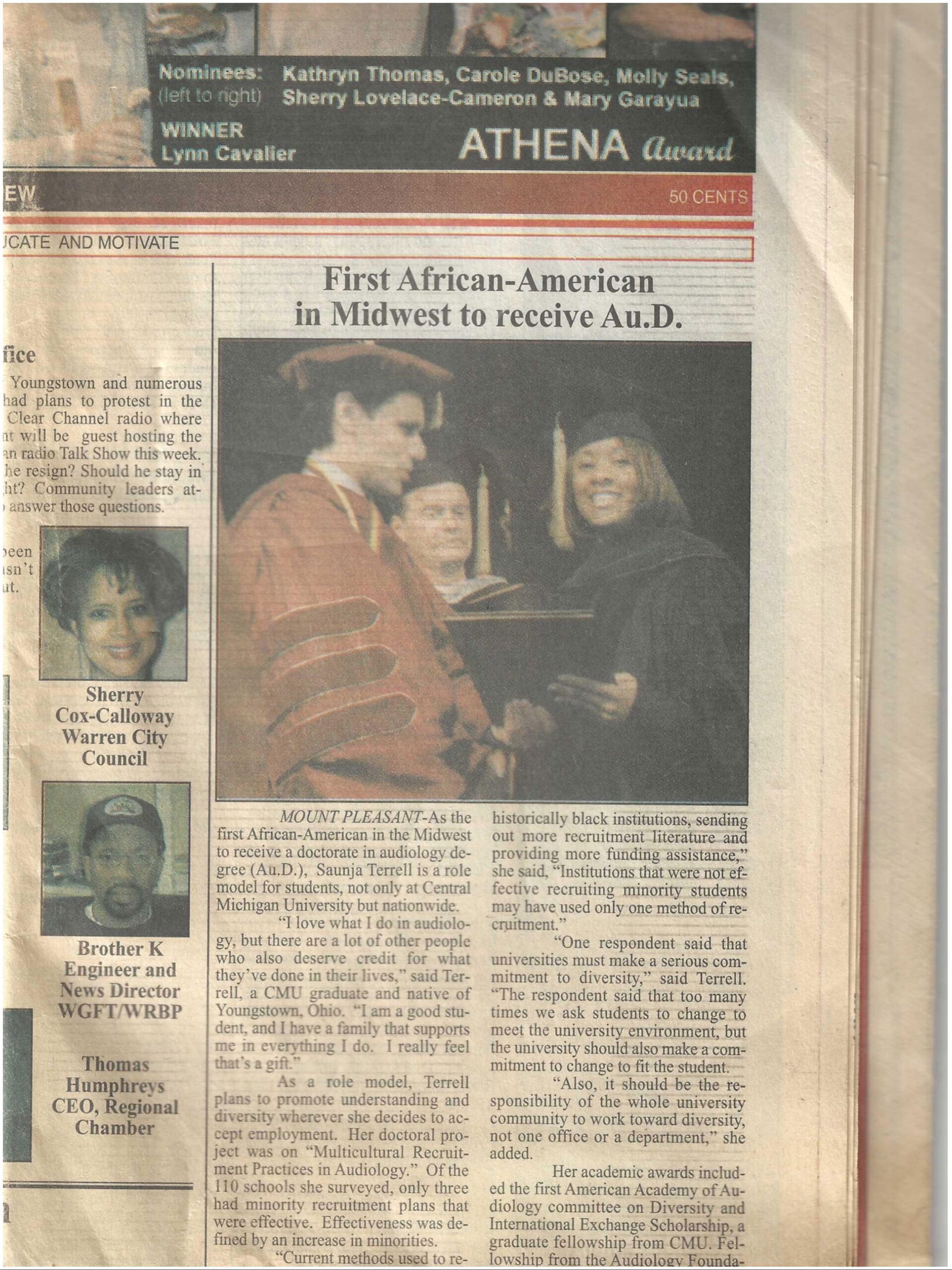
Newspaper clipping printed in the “Buckeye Review” from Youngstown, Ohio. (Photo courtesy of Dr. Saunja Burt)
Burt received her B.A. in communicative sciences and disorders from HBCU Hampton University and her master’s in business administration from Nova Southeastern University. Then, she was the first Black student to attend and graduate a four-year Au.D. program at Central Michigan University. Her clinical interest focused on auditory processing and traumatic brain injury.
During commencement, it was rewarding to “see these generations of older Blacks come up to me because they didn’t have the opportunity to realize this is for them,” she said. Her late grandfather, who once wore hearing aids, was proud to have a granddaughter in the profession.
Having transitioned from an HBCU to a predominantly white institution (PWI), she found support in speaking about certain challenges, like access to Black hair care. And with that, she left an indelible legacy with her involvement in the Black Graduate Student Association and worked in minority student services.
But the journey wasn’t without experiencing bigotry. Insensitive comments can come from patients or supervisors. In an article that Burt co-wrote with her mentors, she suggests that when students complain of bigotry from patients, supervisors should be more proactive, get training, and believe the student.
Be involved as early as possible, Burt advised. “That’s how you get information. That’s how you meet people. That’s how you start to feel comfortable in your profession,” she says. She tells BE that she didn’t see a lot of people who looked like her on the board of American Academy of Audiology.
“I found that my reach has been greater because of the visibility. Students see me on the board,” Burt says.
“I was very active in the early part of my career, but then I got married, I had children. My mom passed away. I had to step away to do life.”
During the tumultuous time that followed George Floyd’s death, Burt was amazed by how many people reached out to her on Facebook.
“People were really trying to cope,” Burt says. “That was traumatic for all of us. But nobody was acknowledging that what we saw was a psychological issue. That’s when I realized, I need to do more. And so I ran for the board.”
(Photo courtesy of Saunja Burt)
Audiology at its finest
When you hear audiology, you might think of hearing aids. But there is much more to this misunderstood discipline. From diagnosing and treating balance disorders and other neurological systems, there are different areas to specialize in.
Burt shares a story about a mom and her five kids who immigrated to this country. The youngest of the bunch was about seven, but he was still in kindergarten. A social worker took action after realizing how many times he was held back. Burt recognized a problem after he opened his mouth to formulate words.
“He has a hearing loss,” Dr. Burt recalls telling the mom. “It’s so important to catch the hearing loss early on and to detect it.” Newborns are not exempt from hearing loss screenings: “Younger kids are more susceptible, especially babies.”
The social and professional impact of hearing loss can be detrimental. School-age hearing screenings are an integral tool to minimize negative academic consequences. “If it’s an ear infection, it needs to be treated,” Burt said.
“Without mandated routine hearing screenings in schools, students with unilateral, less severe, or late onset hearing loss may not be identified or will be misdiagnosed and managed,” according to the American Speech-Language-Hearing Association.
An ear infection is caused by fluid build-up in the middle ear, making it harder for your child to hear because of a conductive hearing loss. Burt said it feels like you’re underwater. However, parents must keep in mind that Black children are less likely to be diagnosed with and less likely to receive broad-spectrum antibiotics for ear infections than white children are, according to a 2014 study.
“But the discrepancy in prescribing fewer broad-spectrum antibiotics means Black children actually are more likely to receive care that aligns with the recommended guidelines for treating ear infections,” per the University of Utah Health Sciences.
Prior to joining Oticon, Dr. Burt was the supervisory audiologist at the Miami Veterans Administration (VA) Healthcare System for 17 years, where she managed the northern outpatient and community-based clinics. She was also a clinical preceptor for third- and fourth-year AuD students. Though some states have guidelines for newborn screening, she witnessed all of the misconceptions about audiology.
“They’re not paying attention.”
“They’re not listening to me.”
“It’s just wax in their ears.”
There are over 40 states with statutes or other regulatory language related to universal newborn hearing screening. “The fact that some states set the standard as low as 85% of all newborns raises significant issues about accessibility and coverage,” per the National Center for Hearing Assessment and Management.
A mentor and community servant
As a certified mentor, Burt has mentored over 45 students and professionals throughout her career. She often encourages students to pursue an audiology degree by discussing her journey. Besides being on the Board of the American Academy of Audiology, she is vice president of Jack and Jill of America Inc, Greater Fort Lauderdale Chapter as well as a member of Alpha Kappa Alpha Sorority.
That’s not all aspiring audiologists should do.
“You have to do an externship. Get in contact with professional organizations, attend conferences if you can because people are always looking for opportunities to recruit students.”
Much like an internship, an externship offers a brief opportunity for professional development. However, unlike internships, where participants engage in job-related tasks, externs primarily observe and learn from seasoned professionals in their field. Externships generally maintain a more informal structure compared to internships and typically do not provide monetary compensation.
She also advises to reach out to your university and professors. And don’t forget the power of social media for networking.
“Don’t make all the mistakes on your own. Listen to other people.”
Invest Fest Empowers Over 20,000 People of Color in Atlanta with Financial Education
Thousands flocked to Atlanta late last month to attend Invest Fest, a three-day financial empowerment festival geared toward Black and brown communities. The annual summit showcased an array of world-class experts, celebrities, entrepreneurs, executives, and influencers who spoke on a wide variety of topics about entrepreneurship and finance. It also featured keynote fireside chats with business titans Sean “Diddy” Combs, Robert F. Smith, and Steve Harvey, in addition to live performances from entrepreneurial rap stars Jeezy, Ja Rule, and Jim Jones.
Event organizers say more than 20,000 people attended Invest Fest, which took place Aug. 25–27 at the Georgia World Congress Center, while the VIP Night kickoff was held at Guardian Works in downtown Atlanta. Now in its third year, the festival was created by Rashad Bilal and Troy Millings, the co-founders of the popular financial education podcast and multimedia platform Earn Your Leisure (EYL), to equip millennials of color with wealth-building strategies and tools.
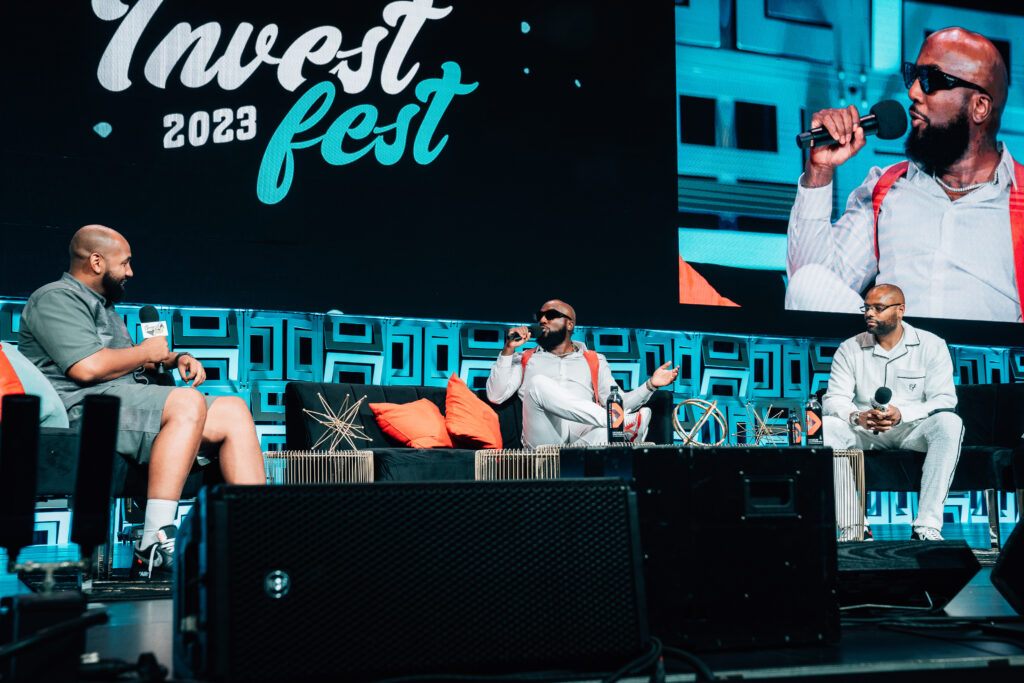
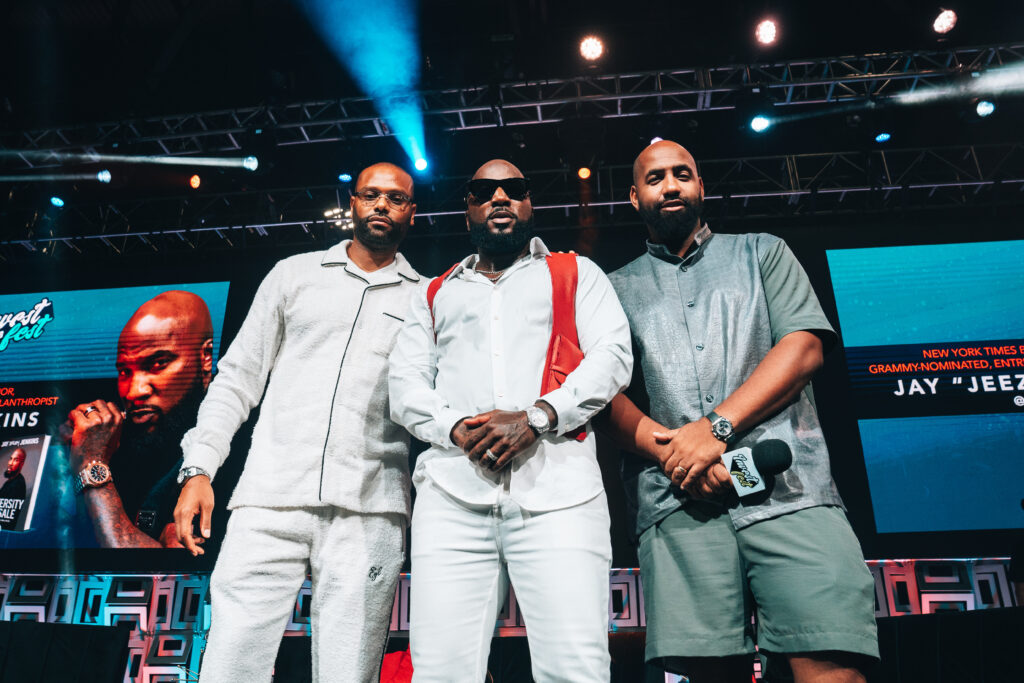
Earn Your Leisure co-founders Troy Millings (L) and Rashad Bilal (R) interview rapper and entrepreneur Jeezy (center) at Invest Fest 2023. (Rashiid Marcel Photography/EYL InvestFest)
“We created Earn Your Leisure and now Invest Fest to marry culture and commerce,” said the co-founders in a joint statement. “We know that information and resources about financial literacy, investing, entrepreneurship, and building generational wealth have traditionally been inaccessible for our culture. Our goal with Invest Fest is to make this information available for our communities, and to do it in a way that is entertaining and enriching.”
Sean “P. Diddy” Combs speaks at Invest Fest 2023 (Rashiid Marcel Photography/EYL Invest Fest)
During a candid keynote fireside chat, Combs opened up about his career journey, business hardships, and the importance of Black ownership. The music mogul also spoke frankly about the racial discrimination lawsuit he filed in June against multinational spirits conglomerate Diageo, which owns Don Julio, Casamigos, Smirnoff, and other alcohol brands. According to Combs, Diageo treated their joint venture, DeLeón Tequila, unfairly by not producing agave plants to create the tequila. The suit also claims that Diageo stigmatized DeLeon as a “Black brand” and “urban.”
“The situation is in the courts now, so I’m going to share with you all what I can,” said the legendary producer on stage. “I had to send my people down to Mexico—this is what the fight is about. They went down to Mexico, and when they got down there, they found out that there was zero agave planted for DeLeon. There was no plan for it to be successful. There was no equal treatment. The other brands, they had agave planted.”
The hip-hop billionaire says his mission to disrupt the spirits industry and dismantle racial boundaries moved him to file the suit.
“No one is coming to save us,” Combs said. “Out of all the business revenue in America, only 1% goes to Black businesses. But then it’s an accountability from us because we have $1.8 trillion in buying power, and only 2% of that recirculates. So, we can’t complain. We know what it is. It’s time to change the call. We have to unify our dollars, or nothing will change.”
Diageo has dispelled Combs’ claims, arguing that the agave plants grown on its farm in Jalisco, Mexico, are used to supply all Diageo liquor brands.
Sean “P. Diddy” Combs (centers) presents Troy Millings and Rashad Bilal with $1 million check (Rashiid Marcel Photography/EYL Invest Fest)
Following the conversation, Combs presented Bilal and Millings with a huge $1 million check issued to the Earn Your Leisure Fund to provide Black investors and business owners with educational tools and resources. According to a statement obtained by People, the funds will go toward financial literacy efforts, “[putting] the investment strategies discussed on EYL into action” and “providing a practical model for economic empowerment.”
“I’m thrilled to join forces with Earn Your Leisure. We’re going beyond discussing finances and taking action to demystify the world of investing for our community,” said Combs in a press release. He added that proceeds will be allocated toward his three Capital Preparatory charter schools in New York and Connecticut.
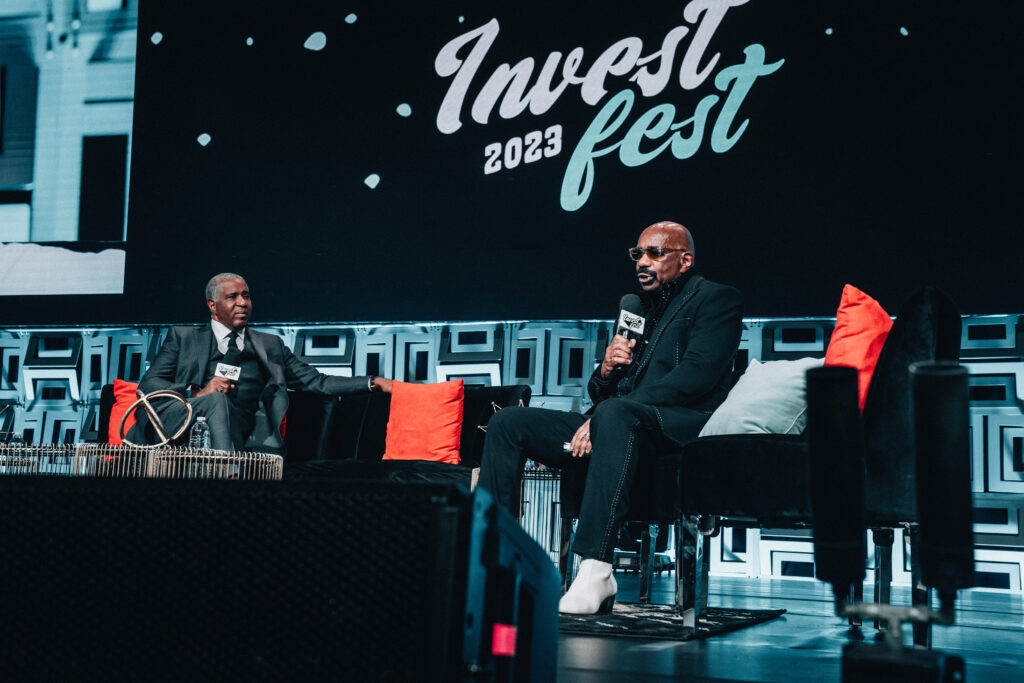
Robert F. Smith and Steve Harvey (Rashiid Marcel Photography/EYL Invest Fest)
Smith’s one-on-one conversation with Harvey was another highlight of the summit. During their chat, Smith talked about the fundamental principles of succeeding in a capitalist society, giving a nod to Black Enterprise Magazine.
“There was a magazine called Black Enterprise that actually presented a number of…Black folks on Wall Street, and I started to understand that experience from reading [about] the difference between labor and capital,” said the billionaire investor. “America is built on capitalism, and I was a good laborer in a capitalist system. I was a professional [with] a chemical engineering degree,” he continued. “But, the value of labor was very different than the value that is placed on capital. And, in fact, in this society, there is an exponential opportunity if you utilize capital efficiently — more efficiently than utilizing labor.”
(L-R) Ari Fletcher, Monique Rodriguez, Selena Hill, and Tisha Thompson (Rashiid Marcel Photography/EYL Invest Fest)
At another point during the conference, Monique Rodriguez, the founder and CEO of haircare giant Mielle Organics, opened about the historic $100 million investment she received in 2021 from Berkshire Partners, a private equity firm, making her the first Black woman entrepreneur to receive a nine-figure business investment. Rodriquez also addressed the backlash she received from online critics in the Black community who accused her of “selling out” after it was announced in January that Procter & Gamble acquired Mielle.
“I don’t look at it as a sellout; I look at it as we’re selling up because when we’re able to sell our businesses, that allows us to do more and to make a bigger impact for the community,” she said, adding that she did not want Mielle to be “pigeonholed” as just a “Black brand,” but rather a company for multicultural consumers with textured hair. “[Black businesses are] going to stay behind if we don’t sell our companies.”
Actress, social media personality, and entrepreneur Tabitha Brown (Rashiid Marcel Photography/EYL Invest Fest)
Other speakers at the summit included sports marketing guru Maverick Carter; actress, entrepreneur, and vegan advocate Tabitha Brown; actress and entrepreneur LaLa Anthony; legendary producer and entrepreneur Jermaine Dupri; famed sports agent and founder Rich Paul; NFL star Cam Newton; mega investor Cathie Wood; thought leader 19 Keys; and celebrity host and real estate investor Terrence J.
“When we think about Invest Fest, we think about Black economic empowerment,” civil rights attorney Benjamin Crump told BE after speaking on a panel about reparations. “Who’s going to build the 21st century Black Wall Street? Well, it’s going to happen from the individuals that come to the Invest Fest festival.”
Earn Your Leisure co-founders Troy Millings (L) and Rashad Bilal (R) and rapper and entrepreneur Jeezy (center) at Invest Fest 2023. (Rashiid Marcel Photography/EYL InvestFest)
Hip-hop legend and Atlanta native Jeezy closed the 2023 festival with a fireside chat focused on his budding real estate portfolio and rap career, followed by a live performance of his top hits.
“Witnessing over 20,000 individuals come together underscores the urgency to create platforms that uplift and educate, which is why Invest Fest was created – to transform lives, spark conversations, and drive change,” said Millings in a press release sent to BE.
“There’s no place that you can be around 20,000 plus people of a positive mindset [and] like-minded goals, and receive information and receive inspiration,” Bilal told BE, encouraging those who missed the experience to attend next year. “There’s a variety of different reasons why you should come. But I think [for] anybody that’s serious about improving their life, it would be beneficial.”
Kicks & Fros Founder Melissa Carnegie Steps Into The Spotlight
Melissa Carnegie wears multiple hats–or should one say shoes?
Carnegie not only oversees communications for the global haircare brand Cantu, but she is also growing her own platform. Her vision for her company, Kicks and Fros, is to make space for women in the male-dominated sneaker industry.
By utilizing the full scope of her network, Carnegie is carving out a niche as a prominent voice in the shoe game. Many say the time has come for Black women, such as Carnegie, to have a place in the industry to express their “sneaker style” and connect with like-minded others.
From her insight into business from prior experience to how she has found the Charlotte, North Carolina, community to be the perfect support system, Carnegie is ready to step into this spotlight.
BLACK ENTERPRISE connected with the entrepreneur on how she manages it all to discuss the challenges and triumphs of being a Black woman CEO and how Kicks & Fros has its foot in the door.
The Melissa Carnegie of Kicks & Fros, how do you feel today, and where is your brand now?
Melissa Carnegie: I feel like my brand is growing so much. We’re trying new things, launching new products. This is a moment, a year, of growth. Of stepping out to try something new. I’m here in our Kick & Fros headquarters in Charlotte, North Carolina, in an area called Camp North End.
Basically, it’s an old Ford Motors plant that became a military campground during wartime, then they revamped it, so now it’s home to a lot of small businesses. I was just ready to get out of the house, and I called them to see if they had any space because I wanted to connect with other like-minded creatives. And luckily, they had air streams out here that they converted to office spaces, and I was so down. It became its own branding moment, with pop-ups and our outdoor space, and that’s what we’ve been able to do.
What makes your business stand out the most with so many sneaker and apparel brands catering to the Black demographic?
MC: Women really dominate this space when it comes to sneakers and personal style; we give that style and that fashion. And I felt like we weren’t being catered to or talked about as we should be, especially Black and Brown women. I wanted to change that.
I started out as an “inspo” page, just to share for women looking to find their sneaker style or trying to rock them and where to purchase them. That has grown into a full-fledged business catering to women in the sneaker space because this is such a male-dominated field, and I wanted to figure out how to talk to women. I have a passion for sneakers. I love wearing and styling them with their versatility and the comfort, and I knew there was a community of women who probably felt the same way. Starting as a content creator, we built a community, a merch shop, a blog, and a newsletter. Now we have our own space for it.
You felt there was a lack of visibility for women to participate in the sneaker game. Was that the main reason you built this space, or did you think this was your niche that you could really grow into?
MC: As I mentioned, I started as a content creator. I had a blog and talked a lot about sneakers and my personal style, and that’s where the questions began: “How many sneakers do you have in your collection? What are your favorites? How do I style them for myself?”
I realized with these questions that there may be some opportunity there, and I just wanted to create this community and have a space for us to feel heard and supported. That’s really where it started, as I can do something here where we can converse and feel inspired by one another.
Where do you see Kicks & Fros going?
MC: I want us to be that household name for women and sneakers. We did a brunch tour last year and connected with women in those places, not just sneaker lovers but artists, shoe customizers, and even teachers! The list goes on, and we want to be able to continue doing that and supporting different communities of Charlotte and beyond. We’re also working on a sneaker cleaner that launches in October, so we’re super excited about that. I just want to continue providing, whether that is merch, items to help protect your kicks, or events to build sisterhood.
You say you are not a household name yet, but all your big-name partnerships with Jordan and Nike show that you are one in the making. Do you have any other collaborations on your bucket list?
MC: I’m an Air Force 1 girl; I have it tattooed on my arm. It’s the first shoe that really started me on this journey and being a collector, as well as lover, of all things kicks. So, of course, I’d love that, but whoever is down to partner with us, I’m 100% down too. I hope something comes in the future; a goal of ours is to have a collaboration where we can continue to build that storytelling about the sisterhood that we created through sneakers and the culture.
Have you faced any serious setbacks when building Kicks and Fros? How did you overcome them?
MC: I started slow. I won’t start anything fast or do anything too much. I always want to learn, of course. With our merch shop, I’ve ordered some things in the past without getting a sample and then had hundreds of dollars worth of products that were totally wrong. Making sure something is exactly what you want before ordering large quantities was a lesson I learned early on. So I start small and then build upon that, ease into it.
Lastly, from the sneaker guru herself, what’s your sneaker style?
MC: I would say it’s a tomboy chic. Like, I love Nike Vomeros, 10 out of 10. They are like a running shoe that’s been around but have become more popular. Super comfy and cute colors, that’s my sneaker of the moment. I love a clean, sleek silhouette because I want to be able to dress it up or down, like an All-Star Converse or Jordan 1. I can give the tomboy vibes, but I can also get really chic when I want to.
Detroit Business Owner Kiara Smith Turned Her Son’s Pain Into A Family Business
When Kiara Smith opened the doors of her family-owned business, Fresh & Pressed Juice, in Troy, Michigan, it was not just the marker of an entrepreneurial dream realized after her son developed a microbiome deficiency nearly five years ago.
Born out of a desire to restore the glimmer and energy of a young child, Smith’s passion for nutrition and wellness now serves both her dedicated online following as well as her in-store customers who come for the juices but leave with a new lease on living their best lives.
“This is a community-based situation. This is not just, come in and pay for these expensive premium juices,” she told the (Detroit) Metro Times. “No, you’re gonna get a juice, you’re gonna nourish your body and your soul, and you’re gonna learn something in the process, because I want to share what I know.”
The 34-year-old wife and mother of two took the road less traveled to help heal her son’s digestive concerns, opting for natural remedies.
“It was a really awful experience, a little 2-year-old in the back seat bent over screaming ‘My stomach hurts!’ every single day,” Smith recalled. “As a mom, I wanted to resolve that, like this cannot be [his] life. He can’t be in pain every day.”
(Photo: Jemme)
Healing her son with the use of organic fruits and vegetables turned into a mission to help others restore their health from the inside out.
Customers at Fresh & Pressed marvel at the meticulous detail the former stay-at-home mom has squeezed into every ounce of the experience, including the names of the juices that double as affirmations.
“Affirmations are big in our household,” Smith said. “Every night and every morning I want to remind my children that they are worthy, successful, and unique.”
With fad diets, risky weight-loss surgeries, and a lack of proper nutritional education plaguing our communities, Smith is leaning on the power of positive self-talk to create lasting change for her growing number of supporters.
(Photo: Jemme)
“When we decide to drink fresh and organic juices we are choosing self-care and I want to remind people that they are worthy and deserving because sometimes we can forget those things,” she told Black Enterprise exclusively. “The names on the juice bottles are constant reminders that you are great and doing great things for yourself, even if it’s just choosing one healthier option a day.”
Starting in the fall, Smith plans to host monthly community events at Fresh & Pressed to further cement her dedication to making healthy lifestyle choices accessible for everyone. However, what the native Detroiter has already poured into the foundation of her family-friendly brand’s success is a heavy dose of focused intentionality and a whole lot of love.
Federal Judges To Draw New Congressional District In Alabama After GOP Lawmakers Refuse
Following Alabama’s months-long refusal to draw new congressional lines rendering Black voters the majority, federal judges will establish a second district themselves to increase Black voter turnout, the Associated Press reports.
“This is a significant step toward equal representation for Black Alabamians,” said former U.S. Attorney General Eric Holder, chairman of the National Democratic Redistricting Committee.
In Jan. 2022, Alabama faced off against the federal court after being sued by progressive rights groups, including ACLU of Alabama and the NAACP Legal Defense and Educational Fund, Inc. Plaintiffs claimed that the state’s current district lines kept Black voters from choosing their desired representatives.
The state subsequently appealed to the U.S. Supreme Court, alleging intentional discrimination and claiming that districts should not account for race. However, the Supreme Court affirmed the initial decision and Alabama was instructed to create a new congressional map. Still, despite the ruling, state lawmakers attempted to draft only one congressional district with a majority-Black population.
Alabama has been involved in an ongoing conflict surrounding voter rights for well over a year, much to the dismay of civil rights groups and Democratic leaders.
In June, the Supreme Court voted to uphold the Voting Rights Act, which requires that majority Black states’ congressional maps represent its population. This came after a concentrated GOP-led campaign to abolish the measure. As the battle of wills between Alabama Republican lawmakers and the state’s Black constituents and progressive rights groups continues, the state of upcoming elections within the region, which is steadily approaching, remains unclear.
Oregon Black Man Convicted Of 1998 Murder In 2004 Has Conviction Cleared
A Black man in Oregon who was convicted of killing a woman and sentenced to death in 2004 had his conviction cleared after the decision was overturned two years ago.
According to WWAY TV 3, Jesse Johnson, who spent 25 years locked up for a crime he did not commit, has the satisfaction of officially being declared a free man and was released Tuesday. The Oregon Innocence Project was responsible for the latest victory.
Johnson has been declaring his innocence for years, even refusing plea deals to assert his innocence.
The organization stated on Wednesday, Sept. 6, that the state of Oregon committed a “heinous injustice” in the way it handled Johnson’s case.
On Tuesday, the Marion County District Attorney’s office asked the Marion County Circuit Court to dismiss the case against Johnson due to “the amount of time that has passed and the unavailability of critical evidence in this case, the state no longer believes that it can prove the defendant’s guilt.”
Johnson was convicted of stabbing nurse’s aide Harriet “Sunny” Thompson to death in her Salem home.
“I’m happy and excited and ready for the next phase now. Been a lot of years for something I didn’t do,” Johnson said, according to Oregon Public Broadcasting.
The media outlet reported that the conviction was overturned in 2021 when the Oregon Court of Appeals said that his original defense attorney did not give Johnson adequate legal representation. He also failed to interview at least one key witness who told police officers that Johnson didn’t commit the crime. The witness, a former neighbor of Thompson’s, said police officers dismissed her attempts to give them the information clearing Johnson.
She was told, “A n**ger got murdered, and a n**ger is going to pay for it.”
Both Thompson and Johnson are Black.
The Oregon Innocence Project started to work on DNA testing that was related to the case in 2014, to prove Johnson’s innocence through various pieces of evidence left at the crime scene. In a written statement, legal director Steve Wax said the Marion County District Attorney’s Office was more interested in “protecting its own reputation than with uncovering the truth.”
“Jesse Johnson walked out of jail last night a free man but has been left with absolutely nothing by the State of Oregon,” Wax said Johnson did not even receive the small amount of “gate money” that is usually given to people leaving prison after they have the case dismissed.
“No resources, no support. We need the community to rally round Mr. Johnson now.”
A GoFundMe account has been set up to help Johnson.
Tennessee Judge Rules Against SBA Program, Many Minority Businesses In Panic
The business world is witnessing a casualty of the Supreme Court’s landmark decision to strike down race-conscious admissions systems at Harvard College and the University of North Carolina (UNC).
After one federal ruling in Tennessee, thousands of Black, Latino and other minority business owners are in a frenzy. The U.S. Small Business Administration’s 8(a) loan program, designed to bridge the gap between government contracting and historically disadvantaged groups, has been upended.
In the case of Ultima Services Corp. v. U.S. Department of Agriculture, a Tennessee judge ruled that the 8(a) loan program “violates a federal contractor’s Fifth Amendment right to equal protection,” according to an Inc. report. At least 5 percent of all federal contracting dollars have been awarded to small disadvantaged businesses each year for the past five years.
Roughly 4,800 businesses participate in the program, while nearly 4,000 benefited from qualifying under the presumption of social disadvantage, according to the SBA. In 2020, 8(a) participants were bestowed with $34 billion in federal contracts, including $9.3 billion in 8(a) set-aside awards and $11.1 billion in 8(a) sole-source awards, according to the nonprofit think tank Federation of American Scientists. A set-aside award is for certain contractors to compete for; sole-source awards is a “contract-awarded, or proposed for award, without competition.”
With that, businesses also receive training and technical assistance designed to enhance their ability to compete effectively in the marketplace.
Under new requirements, small business owners will no longer have the opportunity to qualify as socially disadvantaged. They will now have to submit an essay describing their negative experience on how their race impacted their success. For existing members of the program, they will also have to pen their hindrances on the basis of their race.
Nicole Pottroff, a government contracts lawyer with Koprince McCall Pottroff in Lawrence, Kansas, has assisted many small business owners in qualifying for the 8(a) program. She told The Washington Postthat she has already witnessed a “massive influx” of businesses requesting help with the essay writing portion. From clients to contractors, businesses are in a “full-blown panic.”
In the meantime, SBA is working with the Justice Department to provide additional assistance while staff members undergo trainings.
Funeral Services Begin For 3 Black Jacksonville Race Shooting Victims
On Friday, September 8, funeral services began for the three Black people killed in the racially motivated shooting at a Jacksonville Dollar General, as reported by the Associated Press.
At the funerals, friends, family, and community members shared memories of the victims, called for reform in gun violence laws, and spoke out against the rise of hate crimes.
The racist gunman committed suicide afterward. First, he killed 52-year-old Angela Michelle Carr, an Uber driver, who in her car outside of Dollar General. He then went inside and fatally shot 19-year-old store employee, A.J Laguerre and Jerrald Gallion, 29, who had entered the store with his girlfriend.
At Carr’s funeral service, civil rights activist Reverend Al Sharptoncalled attention to the lax gun laws that allowed the shooter to purchase assault-style rifles after having a history of mental health issues.
According to the Jacksonville Sheriff, the shooter, Ryan Palameter, specifically targeted the victims because they were Black. Racist rhetoric was later found scrawled in Palameter’s diary.
“How many people have to die before you get up—whether you’re a Republican or a Democrat—and say, ‘We’ve got to stop this, and we’ve got to bring some sanity back in this country?’” Sharpton said. “Have we gotten so out of bounds that we’ve normalized this stuff happening?”
Reverend David Green St. said, “We gather together as a hurting community because this was not just an attack on the Carr family and our other two families who lost their loved ones. This was an attack on our entire community.”
He continued, “Rhetoric and other policies and governors have made it comfortable for people to come out of the closet with their hatred of those of us whose skin has been kissed by nature’s sun.”
The memorial service for 19-year-old Laguerre was also on Friday at a different church in Jacksonville. Laguerre, who graduated high school the previous year, got a job at the Dollar General to financially support his grandmother and four siblings.
The Mayor of Jacksonville, Donna Deegan, attended the service; additionally, Jacksonville authorities provided security for the funerals. Deegan also attended Carr’s service at The Bethel Church.
Gallion’s funeral is scheduled for Saturday. His family called him a loving father, who worked three jobs to care for his young daughter, Je Asia Gallion.