News You Can Use: A New Blood Test Can Predict What Age Alzheimer’s Symptoms Start
More than 7 million Americans live with Alzheimer's disease.
There’s a new blood test that can predict when a person is likely to start experiencing symptoms of Alzheimer’s disease (AD).
Researchers at Washington University School of Medicine in St. Louis helped develop the highly accurate single blood test. It’s a part of a public-private partnership known as the Foundation for the National Institutes of Health Biomarkers Consortium.
More than 7 million Americans live with Alzheimer’s disease. Health and long-term care costs for AD and other forms of dementia were projected to reach nearly $400 billion in 2025, according to the Alzheimer’s Association.
“Our work shows the feasibility of using blood tests, which are substantially cheaper and more accessible than brain imaging scans or spinal fluid tests, for predicting the onset of Alzheimer’s symptoms,” said Dr. Suzanne E. Schindler, an associate professor in the WashU Medicine Department of Neurology.
She noted that these models could enable clinical trials of potentially preventive treatments to be conducted more quickly.
“In the near term, these models will accelerate our research and clinical trials,” Schindler added. “Eventually, the goal is to be able to tell individual patients when they are likely to develop symptoms, which will help them and their doctors to develop a plan to prevent or slow symptoms.”
Protein Forecasts Symptoms in Alzheimer’s Clock
Schindler is the senior author of the new study, which she said provides an “Alzheimer’s clock” to predict when symptoms would appear within a margin of error of three to four years.
The models that researchers developed use a protein called p-tau217 in an individual’s plasma, the liquid part of the blood, to estimate the age at which they will begin experiencing symptoms of neurodegenerative disease.
Currently, levels of p-tau217 in the plasma can be used to help doctors diagnose Alzheimer’s in patients with cognitive impairment.
These tests are not recommended in cognitively unimpaired individuals outside of clinical trials or research.
“We aimed to use measurements from a single plasma sample to estimate not only the probability of a cognitively unimpaired individual with positive AD biomarkers developing AD symptoms but also when they would be likely to develop symptoms,” researchers wrote in Nature Medicine, where the study was published.
Andrea Lacy, founder and CEO of Luv’s Brownies®, the iconic Bay Area bakery behind the Original Heart-Shaped Brownie®, is celebrating Women’s History Month with major milestones that highlight its continued growth, community impact, and commitment to expanding educational opportunities.
As her company approaches its 30th anniversary this October, she is strengthening her regional presence through her popular dessert truck, which now attends approximately 300 events per year, serves more than 20,000 items annually, and appears at some San Jose Earthquakes games and every BayFC soccer game at PayPal Stadium. “Everyone loves when Luv’s Brownies are at the matches,” said Bianca Padilla, Earthquakes and BayFC event operations.
Featured on KRON4’s Live in the Bay
Luv’s Brownies was recently featured on KRON4’s Live in the Bay, where Lacy shared the company’s creative roots and ongoing innovation.
The feature highlighted how a simple college baking idea evolved into a nationally recognized brand known for its signature heart-shaped brownies and purpose-driven mission.
From Campus Hustle to Community Leader
While attending San José State University, Lacy worked three jobs to put herself through school before discovering she had dyslexia—a learning difference that ultimately revealed her creative strengths. A recipe error caused by transposing ingredients led to the creation of the brand’s now-iconic heart-shaped brownie.
Dr. Cynthia Teniente-Matson, president of San José State University, recently celebrated Lacy’s journey in a message to the Spartan community: “What if the brownies you baked in college ended up at the Super Bowl? That’s not a dream. That’s Andrea Lacy, CEO of Luv’s Brownies… I love how Andrea has mixed her heart and hustle into a 30-year Bay Area success story.”
She continued: “What inspires me most is her CEO voice and commitment to ensure others have a path forward. She created the Grit Award Scholarship to support students who demonstrate perseverance in pursuing higher education. That’s Spartan spirit. Entrepreneurship with purpose. Success with heart.”
Fifth Annual Grit Scholarship Now Open
In honor of Women’s History Month, Luv’s Brownies is opening applications for the fifth annual Grit Scholarship, which supports students who have demonstrated resilience, perseverance, and determination in overcoming adversity while pursuing higher education or vocational training. Up to three scholarships of $500 each will be awarded.
Eligible students must submit:
• A 500-word “grit story” essay • Letters of recommendation • Proof of community service • Verification of enrollment in a four-year college, community college, or vocational program • Documentation of financial need
“Being a woman founder approaching 30 years in business is not just a milestone—it’s a responsibility,” said Lacy. “We stand on the shoulders of women who created pathways before us. Our job is to widen those pathways for the next generation.”
Expanding Community Impact
Luv’s Brownies continues to deepen its community partnerships, particularly in Alameda County, where its dessert truck has become a beloved presence at regional events in collaboration with the Fremont Chamber of Commerce and Fremont Street Eats.
“The Luv’s Brownies Food Truck has expanded its business to Alameda County and has become a local favorite, appearing at community events in partnership with the Fremont Chamber of Commerce and Fremont Street Eats. The Fremont Chamber of Commerce and Fremont Street Eats are proud of the connection that we have built between awesome food trucks like Luv’s Brownies and the community that comes out to our events. Luv’s Brownies contributes so much to bringing a sense of community through delicious brownies,” said Napoleon Batalao, Director of Digital Communications for the Fremont Chamber of Commerce.
From campus beginnings to regional expansion, Luv’s Brownies’ journey represents entrepreneurship powered by perseverance—and heart.
About Founded in 1996, Luv’s Brownies is a digital-native bakery best known for its signature heart-shaped brownies, offering nationwide shipping and local delivery. The company also operates a Cuban café and dessert truck serving Santa Clara and Alameda counties, featuring Cuban sandwiches, signature drinks, and award-winning desserts.
No other details regarding Pop’s Place have been revealed.
A couple of days after the job posting, there was an announcement about a free March 31 pop-up event in Canarsie. The Instagram post revealed that this location will be Pop’s Place when it opens, calling the event a soft launch. Attendees can purchase exclusive merchandise and sample a private food menu. It promises to be a party atmosphere, with Jackson, a DJ, playing host.
“💫For Pop. Always.
“🗓️Tuesday, March 31st, from 6 p.m. to 9 p.m., we’re bringing it back to 1454 Rockaway Parkway to celebrate and honor the legacy the right way.
🛍️New exclusive merch drops you won’t find online, special in-person deals, and a first taste of our private food menu. Drinks will be available, the music will be right, and the energy will feel like magic.”
The Brooklyn rapper was shot to death during a home-invasion robbery on February 19, 2020, at a rented Hollywood Hills home. The Los Angeles Police Department stated that the intruder who shot Pop Smoke was after the rapper’s Cuban link chain.
Pop Smoke was only 20 years old.
The alleged gunman, Corey Walker, shot and killed Pop Smoke while he was “in the shower naked.” Walker didn’t get the chain, but took the Rolex. It was reported that Walker sold the watch for $2,000.
Walker, 24, was sentenced to 29 years in prison for his role in Pop Smoke’s killing in February 2025, People reported. Three people involved with Pop Smoke’s murder were only 15, 16 and 17 when it happened. They were convicted in juvenile court at the time, each reaching separate deals, according to Entertainment Weekly.
Studies Show That Attending A HBCU Is Healthier For Black Students
As the study pointed out, HBCU graduates had better memory and cognitive function than those who attended a PWI.
A new study found that attending a historically Black college or university (HBCU) as a young adult is better for the long-term cognitive outcomes of Black Americans.
The study, published in the JAMA Network Open last month, featured co-authors from Rutgeters University, the University of Alabama at Birmingham, Columbia University, Boston University, and Harvard University. As The Guardian first reported, the authors sampled over 1,900 Black American adults who attended college between 1940 and 1980 and who attended high school in a state with an HBCU. Approximately 35% of those sampled attended an HBCU. Researchers found a correlation between the collegiate environment and long-term wellness.
During this timeframe, students nationwide experience two major policy changes that shape education nationwide. In 1952, the Supreme Court ruled that racial segregation was unconstitutional in the landmark case Brown v. Board of Education. More than a decade later, the Civil Rights Act of 1964 barred racial discrimination in schools.
Dr. Marilyn Thomas, an assistant professor of medicine at the University of California, San Francisco, wanted to investigate whether students who attended HBCUs had different outcomes than those who attended predominantly white institutions (PWIs) during this timeframe.
Two Different Life Outcomes
As the study pointed out, HBCU graduates had better memory and cognitive function than those who attended a predominantly PWI. HBCU students also had varied early-life experiences, including encouragement to attend school.
“Participants who attended HBCUs were more likely, for example, to have mothers or female caregivers who had a college education,” Thomas told The Guardian. “They were also more likely to have reported being shown affection when they were growing up, love and affection.”
While Thomas noted the study was only exploratory, she said it is the first of its kind to look at the effect of years of schooling on cognition.
“What’s really important about this finding is that it suggests that, yes, culturally affirming spaces actually can help promote and protect cognitive health,” Thomas added. “It’s even more than that because it doesn’t just demonstrate that it’s protective against cognitive health, but the benefits of this exposure last well beyond graduation.”
Government Restrictions Prevent Tyler Perry’s From Giving Money to Unpaid Atlanta TSA Workers
The filmmaker was seen at the airport talking to workers who showed up to work despite not being paid during the partial government shutdown.
Movie executive Tyler Perry’s attempt to give Transportation Security Administration (TSA) workers at Atlanta’s Hartsfield-Jackson Airport some cash to offset their lack of paychecks during the current shutdown was grounded.
According to 11Alive, the Madea actor went to the airport but was not allowed to hand workers any cash due to government restrictions.
The partial shutdown has been in effect since Feb. 14 after lawmakers couldn’t agree on new terms for the Department of Homeland Security (DHS) over funding for Immigration and Customs Enforcement (ICE) following recent agency activities. In ICE’s attempts to carry out President Donald Trump’s mass deportation initiative, the agency has been accused of using inhumane tactics.
Perry reportedly took time to speak directly with the workers and thanked them for reporting to work despite not being paid.
Last year, during the longest government shutdown in history, he donated $1.5 million to Atlanta-based groups to assist families who were not receiving their SNAP benefits due to the shutdown.
But the Associated Press reported that the Senate has approved Homeland Security funds to pay Transportation Security Administration agents and other agencies. The deal , which still does not provide funds for ICE, was approved in a unanimous vote early Friday morning.
The House of Representatives is expected to consider the deal on Friday, March 27.
“We can get at least a lot of the government opened up again, and then we’ll go from there,” said Senate Majority Leader John Thune, R-SD. “Obviously, we’ll still have some work ahead of us.”
Trump Pushes The Limit By Becoming The First Sitting President To Add His Signature To Paper Currency
Polls reveal Americans wish the president would focus on the economy in another way like addressing the rising inflation rates and the heightened cost of gas and living expenses.
For the first time in the history of U.S. sitting presidents, President Donald Trump’s signature will appear on paper currency, NBC News reports.
The March 26 announcement from the Treasury Department said Trump’s signature will go on the bills in celebration of the country’s 250th anniversary, making a historic move as paper currency is known for carrying the Treasury Secretary’s and the Treasurer’s signature alone since it was first printed in 1861. But Treasury Secretary Scott Bessent doesn’t seem to mind sharing. “The President’s mark on history as the architect of America’s Golden Age economic revival is undeniable,” Bessent said in a statement.
“Printing his signature on the American currency is not only appropriate, but also well deserved.”
Polls reveal that Americans wish the President would focus on the economy in other ways, such as addressing rising inflation and the increasing cost of gas and living expenses. However, Bessent feels Trump’s signature is a great way to celebrate where the country is going. Under President Trump’s leadership, we are on a path toward unprecedented economic growth, lasting dollar dominance, and fiscal strength and stability,” the Treasury secretary said, according to Fox News.
“There is no more powerful way to recognize the historic achievements of our great country and President Donald J. Trump than U.S. dollar bills bearing his name, and it is only appropriate that this historic currency be issued at the Semiquincentennial.”
Treasurer Brandon Beach seems to agree, saying adding Trump’s signature to U.S. currency is “not only appropriate, but also well-deserved,” labeling him as “the architect of America’s Golden Age economic revival.”
The first $100 bills featuring Trump’s signature are scheduled to be produced in June, with additional denominations in the months that follow. But this is not the only new currency coming out.
Trump seems to be rolling out his own red carpets ahead of the 250th anniversary, unveiling a 24-karat commemorative gold coin featuring his image after a federal commission with a group of Trump-appointed members finally approved the design. The coin still has to go through Treasury approval.
Since returning to the Oval Office, the President has made moves to put his name to everything despite massive criticism. He added his notoriety to the Kennedy Center for the Performing Arts and the U.S. Institute of Peace in Washington, D.C., as well as discount drug programs, savings accounts, and proposed warships.
He made similar moves before leaving after his first term, stamping his name on COVID stimulus checks and giving direct cash payments to Americans during the pandemic.
Grand Slam Champion Coco Gauff Admits, ‘I Can Get Imposter Syndrome’
There is no imposter in the room with Coco Gauff.
Following her victory at the 2026 Miami Open, tennis star Coco Gauff, in a rare, vulnerable, and introspective moment, admitted to sometimes having “imposter syndrome.”
The 22-year-old Grand Slam winner opened up after defeating Switzerland’s Belinda Bencic (6-3, 1-6, 6-3) to reach her first career semi-final at her home-state tournament, becoming the youngest American to do so since tennis great Serena Williams over two decades ago, according to BBC Sport.
“I think sometimes I can get imposter syndrome,” Gauff told reporters during her post-match press conference. “Even when they’re saying my accomplishments when I walk on or during the warm-up, it doesn’t feel like me. I’m like, ‘Oh, actually, you do have a good career,’ but it doesn’t feel like that in the moment.”
World number four and two-time Grand Slam winner Coco Gauff says she sometimes gets "imposter syndrome". pic.twitter.com/o3thXiVuwc
The win over Bencic is a testament to Gauff’s “fighting spirit,” a quality she values even when her self-confidence wavers. In her six previous appearances at Miami, Gauff failed to progress beyond the fourth round.
Gauff will face Karolína Muchová on March 26. While Gauff holds a dominant 5-0 head-to-head record against Muchová, she remains cautious. The champion stressed that anything can happen on the court as her success will depend entirely on her “mentality out there at the end of the day.”
Gauff joins other high-profile athletes who have spoken about their struggles with mental health despite their success. Despite her personal feelings, Gauff’s history of winning on the court and securing the title of “highest paid female athlete” is a testament to her athletic prowess and business acumen. There is no imposter in the room with Coco Gauff.
In Black communities, we have always known how to show up for the funeral. The question we’re not asking loudly enough is: who shows up after?
I know this grief intimately. As a trauma nurse, a certified grief counselor, and a nurse executive, I have spent my career sitting with people in the hardest moments of their lives. And on Jan. 3, 2023, I became one of them, when I lost my son, Darius.
What I know clinically, I now know in my body.
Grief is not an event. It is a long, nonlinear process that our systems, our workplaces, and even our communities are not built to hold.
The Weight of Being Strong
Black Americans carry a particular burden when it comes to grief. Culturally, there is deep value placed on resilience, on holding it together, on not letting them see you break.That strength is real. It was earned through generations of surviving what should have broken anyone.But strength was never meant to be a substitute for healing.
Research shows that Black Americans are less likely to seek mental health support after loss, not because the need is not there, but because of stigma, distrust of systems that have historically failed us, financial barriers, and a cultural script that says grief should be private and brief. The church holds some of it. The family holds some of it. But the professional and systemic infrastructure to support sustained grief is largely absent.
There is no federal law in the United States requiring bereavement leave, paid or unpaid. Only five states, California, Oregon, Illinois, Colorado, and Maryland, have codified any bereavement protections for private sector workers. For the rest of the country, what a grieving employee receives depends entirely at the discretion of their employer.
The typical employer offers three to five days. Three to five days isn’t support. It’s a deadline. Three to five days to bury someone you loved, manage their affairs, hold your family together, and return to full productivity. Research from Grieve Leave found that 94% of grieving employees report difficulty concentrating at work after loss, and 78% do not feel supported by their workplace. These numbers are not surprising to anyone who has lived it.
For Black employees, this gap is compounded. Grief in our community often carries additional weight: the specific trauma of sudden or violent loss, the administrative burden of settling an estate with limited legal and financial resources, the reality that taking unpaid leave is not an option for many working families. The policy gap is not race-neutral and it becomes most visible in the workplace. It lands harder on people who already have less margin.
Research published in the journal Sociology in 2024 documented what bereaved employees already know: that workplace bereavement policies are typically based on a linear model of grief that fails to account for its ongoing, nonlinear reality. They tend to measure loss by closeness of relationship, granting leave for a spouse but not a best friend of 20 years, a grandmother who raised you but not a mentor who shaped your career. Loss does not work that way.
Unaddressed grief does not stay home. It shows up in absenteeism, in reduced productivity, in turnover, and in the quiet erosion of workplace culture that no engagement survey fully captures.
What Sustained Support Actually Looks Like
Grief is not a two-week problem. For most people, the hardest moments come weeks and months after the loss, when the adrenaline fades, the community disperses, and the anniversaries and birthdays begin to surface. What bereaved employees need is not just time immediately after the death. They need a workplace culture that acknowledges grief as a long arc.
Employers who want to do better can start with a few concrete changes. Flexible and floating bereavement leave, available across a defined window rather than only in the days immediately after death, allows employees to take time when they most need it. Broader definitions of family that include chosen family, extended kin, and non-legal relationships reflect the actual shape of Black family structures. Manager training that normalizes grief conversations, not as a one-time check-in but as an ongoing practice, builds the culture that policy alone cannot.
Healthcare systems can do more as well. Grief-informed care means training physicians and care teams to recognize and address the psychological and physical toll of bereavement, not just in the immediate aftermath, but in the months and years that follow. Community institutions, including churches, nonprofits, and HBCUs, are already filling gaps that the formal system has left open. That work deserves recognition, resources, and partnerships rather than being treated as a last resort.
The Conversation We Need to Have
We are a community that knows how to love people in crisis. The repast, the prayer circle, the practical help when it is needed most, this is who we are. But love without infrastructure is not enough, and infrastructure without cultural honesty is incomplete.
We must talk about grief the way we talk about other public health issues, openly, collectively, and with the understanding that silence does not protect us. We must demand more from the workplaces and healthcare systems that employ and serve us. And we must extend the same grace to grieving people that we show so beautifully in the days after loss, not just for the first week, but for the long road after.
The funeral is not the finish line. It is the beginning of something that our communities, our employers, and our institutions need to be present for. The question is whether we’re willing to stay once the world moves on.
Kelly Edmondson, MSN, MBA, RN, NEA-BC, CGC, is a nurse executive, certified grief counselor, trauma nurse, and bereaved mother based in Orlando, Florida. She is the founder of Timely Presence, a bereavement support service built around meaningful connection during the first year of loss. Her work has been featured in TIME. Learn more at thetimelypresence.com.
While major studios debate how artificial intelligence will reshape Hollywood, 22-year-old Tierre Hummons has already built his own cinematic animated series called Synth City, which delivers studio-level quality without studio-level funding. The series is produced using AI, original music, self-built systems, and an independent distribution strategy — establishing a scalable blueprint for Black ownership in entertainment.
A recent graduate of the University of Cincinnati, Hummons says the project is about more than technology. It is about ownership and infrastructure.
At its core, Synth City follows Caden, a talented college music producer attempting to leave the drug economy behind while being pulled back in by a local artist-turned-dealer who depends on his beats. The series does not glamorize street life. Instead, it explores the economic pressure, psychological tension, and survival decisions many young creatives face while trying to build legitimate careers.
The show reframes a rarely examined truth in hip-hop culture: the producer is the architect. While artists command the spotlight, producers build the sonic foundations that shape global music.
Synth City centers the strategist behind the sound — highlighting the ambition, sacrifice, and moral crossroads that come with chasing success from underserved environments.
Hummons leveraged AI not as a shortcut, but as a production equalizer — dramatically reducing overhead while maintaining full creative control. By combining animation tools, AI-assisted rendering, original scoring, and direct-to-audience digital rollout, he created a vertically controlled system without outside investors, licensing deals, or creative compromise.
The series continues expanding its cultural footprint. National recording artist Jhonni Blaze is set to appear in upcoming episodes, marking a significant crossover between independent animation and established music talent. Hummons has also collaborated with Diamond of Crime Mob, known for the cultural anthem ‘Knuck If You Buck,’ reinforcing the show’s authentic connection to hip-hop culture.
In an era when Black creatives often generate culture without retaining ownership, Synth City represents a different model:
• Creator-owned intellectual property • AI-powered cost efficiency • Independent digital distribution • Long-term franchise scalability
Rather than waiting to be funded or selected by gatekeepers, Hummons built his own ecosystem — demonstrating how emerging technology can shift leverage back to creators. As artificial intelligence continues to disrupt the media landscape, Synth City stands as an early example of how Black innovators can lead the next wave of entertainment production — on their own terms.
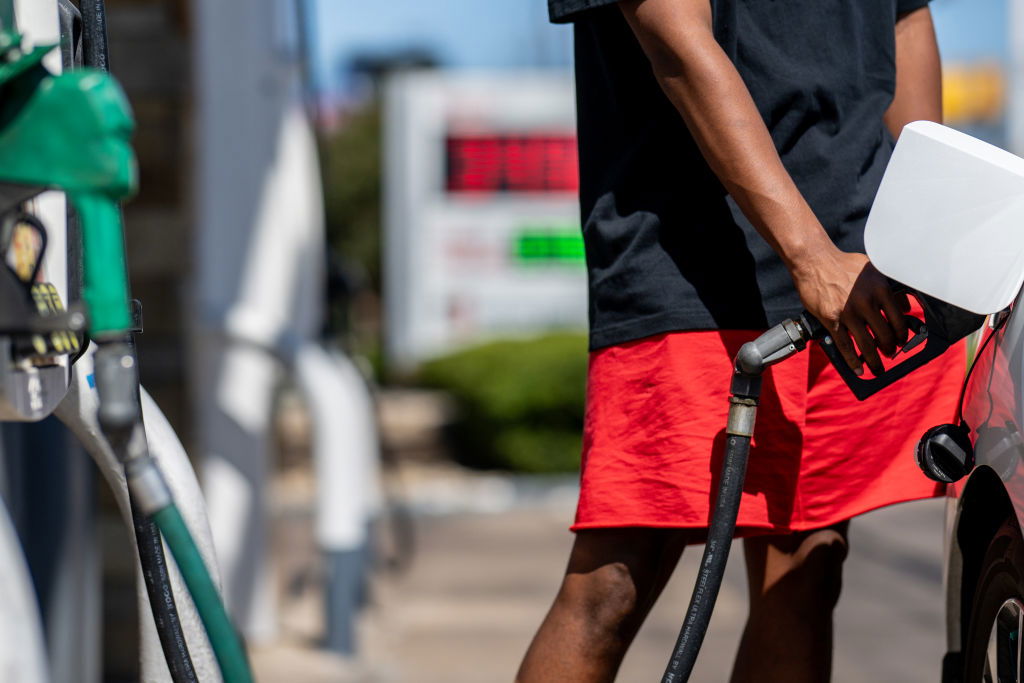
8 Actions To Help Save Money On Gas As Prices Continue To Soar
Combining errands into one trip and driving safely are among ways to help reduce gasoline spending.
Likely to soon reach their highest level in four years, $4-a-gallon gasoline prices are imminent.
The national average was around $3.98 a gallon as of March 27, according to the American Automobile Association (AAA). That was up from about $3.91 a week ago and around $2.98 a month ago. The price has climbed 83 cents since a year ago, when it was roughly $3.15.
Analysts attribute the surge largely to the U.S..-Israeli war on Iran, fueling rising global oil and gas prices this month. U.S. consumers, including Black Americans, are now being forced to endure the extra hardship when struggling with inflation, and managing money is already difficult.
Exacerbating matters, a fresh report from GasBuddy projects the U.S. average for a gallon of gas could reach $4 as soon as next week. That reportedly would mark the first time the cost has risen to that level since 2022, when Russia invaded Ukraine.
Patrick De Haan, head of petroleum analysis at GasBuddy, said, “There are few signs of stabilization so far, as global oil prices continue to climb and early indications suggest consumers may begin to pull back in response to the rapid pace of increases.”
However, the uplifting news is that BLACK ENTERPRISE is here to provide many ways to help drivers offset the impact of losing money rapidly while cutting gasoline spending:
Combine errands: Merge these tasks into a single trip to reduce driving time.
Check out gas apps: Consider using AAA, Gas Guru, and GasBuddy to find lower gas prices near where you live.
Use cash instead of plastic: Observers suggest paying with cash rather than a credit card at the gas pump. They claim you can save money doing that. Be aware that some gas stations might levy a fee for using a credit card.
Avoid premium gas: Research shows this higher-octane gasoline is not essential or beneficial for most cars. As such, do not spend extra cash to buy that grade.
Explore fuel rewards programs: Several grocery stores and national gas stations offer gasoline discounts for patrons. Try to find one near you. And be sure to link your purchases to the same account regularly.
Drive cautiously: Don’t drive aggressively, as that can trim gas mileage by 15% to 40%, data shows. Accelerating rapidly and braking suddenly can lead to accidents and cause vehicle deterioration.
Reduce driving: This can be done by carpooling, walking, biking, or using public transportation. Another option is working more from home if that’s an available option.
Maintain good vehicle maintenance: This can enhance fuel economy and peak engine performance, helping trim gas usage. Viable maintenance tasks, such as maintaining proper tire pressure, replacing air filters, and using recommended oil grades, can be beneficial.