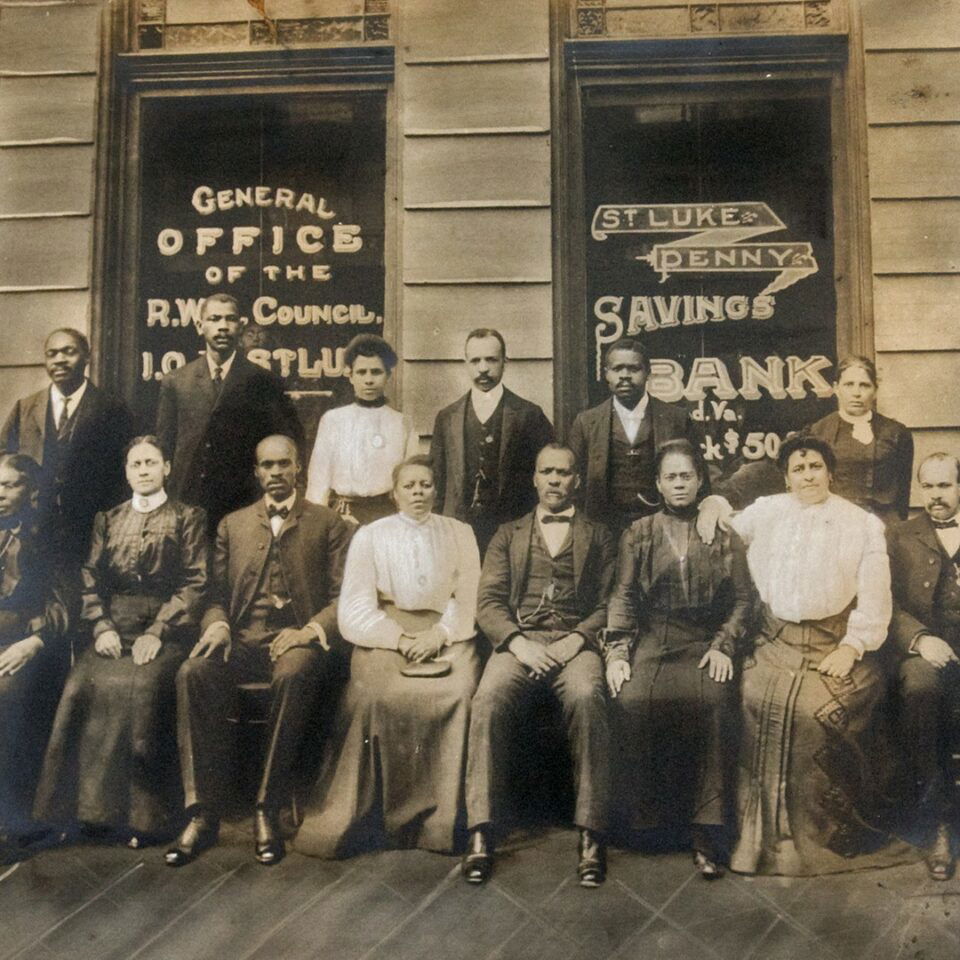
Banking On Self-Reliance: A History Of Black Banks From 1888-1930

Banking On Self-Reliance: A History Of Black Banks From 1888-1930


Are you familiar with the concept of “Big Bank Take Little Bank?”

Rap artists, from Ice Cube to 2 Chainz, have amplified this phrase as a succinct depiction of the harsh realities within the financial world, where larger banks and affluent individuals exert their dominance over their smaller counterparts.

However, this game has a rich historical background, tracing its origins back to the late 19th and early 20th centuries. During this time, African Americans, acutely aware of the transformative potential of formalized financial systems within a capitalist society, established thriving banks and insurance companies. Visionary pioneers, lacking access to white-operated banks and opportunities for clerical and managerial experience, embarked on a journey of trial and error. The resulting institutions, both large and small, emerged as beacons of liberation, defiantly challenging the pervasive grip of deeply rooted racism.

Prior to Emancipation, the establishment of Black-owned banks in America was non-existent. However, on the eve of the Civil War, free Blacks residing in the North engaged in discussions about the importance of credit and banking and began exploring avenues to establish such institutions.

In the face of exclusionary practices and discriminatory Jim Crow policies, African Americans took matters into their own hands. Between the years 1888 and 1930, they demonstrated remarkable independence by organizing and operating over 100 banks, along with thousands of other financial entities, that catered specifically to the needs of their communities. These customer-centric banking systems bolstered successful entrepreneurs and safeguarded Black businesses and individuals who were routinely robbed by white predatory practices and terrorism. They also provided a source of credit, loans, economic development, jobs, and training opportunities for their communities.

The rapid growth of Black banks, which allowed Black wealth to stay within our communities and even outperformed some larger white institutions during financial panics, marked a monumental achievement for the first generation of emancipated people.

An editorial published on May 16, 1914, in The Denver Star remarked: “How the Negro has succeeded in this branch of business without previous experience,

without a coach and even without the semblance of encouragement is really more surprising to white men than to the Negro himself.”

Yet, the success of these institutions, such as those along the prosperous district Tulsa’s Black Wall Street, made them prime targets for racism and violence, laying the groundwork for our present-day profound intergenerational consequences on Black wealth.

Presently, we witness a stark reality: Blacks remain more unbanked or underbanked than any other racial group. Our reliance on fringe banks, often ensnaring us in cycles of debt, is a distressing truth. Additionally, we contend with higher interest rates on mortgages, small loans, and basic services compared to our white counterparts. The decline in the number of Black-owned banks, dwindling from their peak of 100 to a mere two dozen today, stems from consolidation within the banking industry, mounting regulatory burdens, exorbitant compliance costs, limited access to capital, and the persistently higher unemployment rates and lower wages prevailing in our communities.

However, this is not yet another story about Black suffering, failure, and repeated injustices, although these forces undoubtedly form a crucial backdrop to any historical reflection on Juneteenth. Instead, this is a moment of celebration and spotlighting the early organizing efforts and heroic struggles of individual Black bankers, who despite their limited or nonexistent access to the circle of finance, emerged triumphant in their quest for racial uplift.

As we delve into the annals of history, particularly through the pages of esteemed Black media outlets such as The Nashville Globe, The Crisis, The Cleveland Call and Post, The New York Age, BLACK ENTERPRISE, and others, we can see how Black people made it a point to celebrate their hard-won successes. An inspirational narrative unfurls before our eyes – a tapestry woven with threads of triumph, resilience, and unabating dedication to the achievements of Black financial institutions. Through these reports and impassioned editorials, we witness a profound story that transcends time—one of unwavering racial pride, Black protest and unity, and the pursuit of self-determination.


“Blood and Tears”

slave auction
Flyer announcing a slave sale, 1859, United States. (Photo by: Photo12/Universal Images Group via Getty Images)

Emerging from the shackles of slavery with their spirits unbound, millions of formerly enslaved African Americans had little grasp of the intricate operations of businesses and banking institutions. After all, these were a people who were deprived of self-ownership, as they were legally defined as human chattel for three centuries.

The bodies of enslaved people were used as collateral for thousands of mortgages and to finance the acquisition of land or goods, serving as a haunting reminder of their commodification. Reduced to mere transactions, enslaved Blacks were traded to offset debts or torn apart from their children who were callously handed over to creditors by the merciless hands of the courts.

While slaves were forbidden to own anything, free Blacks residing in the north had faced limited opportunities for wealth accumulation due to pervasive discrimination. Undeterred, they formed mutual aid societies and fraternal organizations which provided financial assistance and social networks. These organizations pooled money to ensure dignified burials, extended monetary aid in times of need, and fostered economic cooperation and solidarity among Black communities. Black leaders like Frederick Douglass and David Walker used their platforms to advocate for equal rights, access to education, economic justice, and to promote self-reliance.

“America is more our country, than it is the whites—The greatest riches in all America have arisen from our blood and tears,” proclaimed Walker in his influential 1829 “Appeal to the Colored Citizens of the World.”

“America is more our country, than it is the whites—The greatest riches in all America have arisen from our blood and tears,”

-David Walker

Douglass remarked that “the history of civilization shows that no people can well rise to a high degree of mental or even moral excellence without wealth. A people uniformly poor and compelled to struggle for barely a physical existence will be dependent and despised by their neighbors and will finally despise themselves.”

Walker expressed the belief that African Americans had played a significant role in building the wealth and prosperity of the United States through their forced labor and suffering under slavery. Meanwhile, Douglass believed that without wealth and economic stability, Black people would face constant hardships, leading to dependence on whites and a diminished sense of self-worth. For Walker and Douglass, wealth would not only provide material well-being, but also enable Black individuals and communities to pursue higher ideals, intellectual growth, and moral progress.

emancipated black people
In Harper’s Weekly on December 20, 1862, a cartoon depicting a group of emancipated slaves called “Our Colored Brethren” reading the news that the New Year’s Day celebration they were supposed to play at has been postponed until the year 1900. (Photo by © CORBIS/Corbis via Getty Images)

Not surprisingly, the transition from bondage to freedom was marked by poverty, insecurity, and violence. Emancipated slaves found themselves trapped in a state of destitution, lacking financial resources and access to formal employment opportunities. The institution of slavery had systematically denied them the ability to accumulate wealth, property, or monetary savings. They often had little more than the clothes on their weary backs and lived in dilapidated and overcrowded housing, with limited access to safe and sanitary living conditions. Some former slaves resorted to squatting on abandoned or unclaimed lands or lived in makeshift shelters.

Freed slaves faced significant obstacles in securing employment. Many were coerced into continuing their toil on plantations or in other agricultural labor, subjected once again to exploitive conditions reminiscent of their time in slavery. Others sought employment in cities and towns, but faced discrimination, low wages, and limited opportunities for advancement.

African American’s initial experiences with formalized banking as a collective began during the Civil War through military savings initiatives which granted Black troops the opportunity to save their pay. The culmination of these efforts materialized in 1865 when Congress established the Freedman’s Savings and Trust Company, known as the Freedman’s Savings Bank, headquartered in Washington, D.C. With 32 branches principally located in the South, this visionary institution attracted over 61,000 Black depositors, channeling over $55 million to their quest for financial security.

Initially, the bank was decently run. However, a pivotal turning point arrived in 1870 when the bank’s charter was amended, permitting investment in risky real estate mortgages. This amendment marked the beginning of a tumultuous period for the institution.

The bank’s leadership became entangled in speculative ventures, embracing high-risk investments, often without proper due diligence. Those investments were not always aligned with the best interest of depositors. The absence of robust oversight and regulator mechanisms, coupled with inadequate supervision of bank officials, resulted in mismanagement of depositors’ funds. Henry Cooke, the bank’s president, and other officials engaged in self-serving practices, extended loans to themselves, their associates, and family members without sufficient collateral or evaluation of creditworthiness.

Furthermore, the economic upheaval of the post-Civil War era, including the Panic of 1873, had a significant impact on the bank’s financial stability. The culmination of these factors resulted in the defrauding of thousands of Black depositors who had entrusted their savings and hopes for a better future to the Freedman’s Savings Bank. The failure of the bank and the subsequent loss of funds dealt a severe blow to the economic aspirations and progress of African Americans at that time. It served as a clarion call for the establishment of stronger safeguards and regulatory oversight within financial institutions, essential pillars of financial justice.

Frederick Douglass
American social reformer and abolitionist Frederick Douglass (c.1817 – 1895), circa 1880. (Photo by Graphic House/Archive Photos/Getty Images)

When Frederick Douglass was appointed as the last president of the bank, he remarked that the institution was, “the black man’s cow but the white man’s milk.”

“the black man’s cow but the white man’s milk.”

-Fredrick Douglas

Reflecting on this era, the eminent civil rights activists, W.E.B. DuBois, mourned the consequences of the Freedman’s Bank’s failure, stating that it “not only ruin[ed] thousands of colored men but taught thousands more a lesson of distrust which it will take them years to unlearn.”

But the story of Black banking did not culminate with the disastrous failure of Freedman’s Bank, which left a staggering debt of over one million dollars to its depositors at the time (equivalent to around $30 million today).

Despite the profound disillusionment caused by the bank’s demise, Black communities still held the institution in high esteem. At a time when opponents argued that ex slaves were incapable of self-sufficiency, the existence of the Freedman’s Bank served as undeniable evidence that they could indeed thrive.

Resilient and undeterred, Black people refused to rely on the slow progress of justice. Instead, they charted their own independent path in the realm of banking, leveraging their collective ingenuity and unwavering determination.

Celebrate Juneteenth 2023 with BLACK ENTERPRISE with month-long content that explores the history of prosperity and banking, and the future of investing and financial literacy for Black communities.

RELATED CONTENT10 Black Entrepreneurs Share The Profound Spirit Of Juneteenth In Business



Former Starbucks Manager Awarded $25M Settlement After Infamous Arrest Of 2 Black Men

Former Starbucks Manager Awarded $25M Settlement After Infamous Arrest Of 2 Black Men


A former regional manager of a Philadelphia Starbucks has been awarded $25 million following a lawsuit against the coffee corporation in which she alleged that she was fired because she was white, according to The New York Times. The New York Times reports that, in April 2018, two Black men entered a Starbucks in Rittenhouse Square Neighborhood, where they waited for a business meeting with a white man who had not yet arrived. The two men were waiting in the coffee shop prior to ordering when one of the men requested to use the bathroom. He was denied and an employee asked them to leave. After the two men remained, an employee called the police who then arrested the pair. This incident, which was recorded and posted online accumulating millions of views, sparked national outrage and boycotts.  

The Chief Executive of Starbucks, Kevin R. Johnson, issued a public apology and condemned the employee’s actions on Starbucks’ official site. According to the New York Times, the corporation shut down 8,000 Starbucks locations to teach employees about racial bias, and the regional manager of the shop, Shannon Phillips, was subsequently terminated from her position.

The public backlash to the arrests was swift as was her firing, which came less than one month after the video’s release according to Newsone. Upon her dismissal, Phillips filed a lawsuit against her former employer, claiming that she had been fired on account of her race, CNN reports. Phillips sued the Starbucks company for the loss of earning capacity, benefits, “pain and suffering, embarrassment, humiliation, loss of self-esteem, mental anguish, and loss of life’s pleasures,” Newsone reports. Now, five years after the incident, she is receiving compensation. 

CNN states that Phillips has denied any involvement in the two men’s arrests and claims that she was fired for opposing placing the white district manager at the 18th and Spruce Streets store on administrative leave. According to Newsone, the district manager of the location had been facing administrative leave for allegedly paying Black employees a lower salary than white workers.

Newsone reports that, in her lawsuit, the former Starbucks employee stated that Starbucks tried to “punish white employees who had not been involved in the arrests, but who worked in and around the city of Philadelphia, in an effort to convince the community that it had properly responded to the incident.” The suit also alleges that Starbucks did not take action against the store’s Black regional manager, who is being accused of promoting the employee who did contact the police during the incident. 

According to Newone, Phillips asserts that her performance has been more than good, having received a bonus just one month before she was excused from her role. She also claims that she was set to be promoted before the arrests took place.

Thanks To The Internet, ‘The Home Depot Girl’ Is Forced To Quit After Harassment And Doxxing

Thanks To The Internet, ‘The Home Depot Girl’ Is Forced To Quit After Harassment And Doxxing


Ariana Cossie, the Christian Influencer, who the internet recently dubbed “The Home Depot Girl” is the subject of conversation once again. The social media influencer, who gained attention on Twitter for holding down a retail job whilst being beautiful, is now facing backlash.

However, Cossie started to receive hate after popular social media page DailyLoud shared her selfie seen ’round the world, asking their following in a now-deleted tweet if the internet beauty should start an OnlyFans account.

Cossie proceeded to condemned the use of OnlyFans, a website popularly used by sex workers, due to her religious beliefs. Critics began to flood her comments, leading to Shaquille O’Neal, aka Shaq, to send her a message of encouragement.

Despite Shaq coming to her defense, the content creator shared that she has to find a new home and source of income due to the backlash and doxxing of her work location.

Cossie’s picture of a mirror selfie while wearing her work uniform went viral on June 8, making the college student the ultimate trending topic among the Black Twitter community on how attractive women should be for certain jobs. The conversation of the “Home Depot Girl”  and beauty in the workplace made rounds on multiple platforms including Instagram and Tiktok. She claims that she has since had to leave her role at Home Depot, the very job she was initially praised for having despite her looks, due to all the attention–and harassment.

“Since I blew up on the internet, I’ve had so much backlash,” shared the viral social media user. “So now I’m going to have to probably move and, you know, kind of relocate and start fresh.”

The influencer posted a final selfie to Instagram in her Home Depot apron, sharing to her over 170k followers that things unnecessarily  escalated,


View this post on Instagram


A post shared by Ariana Cossie (@ariijosephine)


However, Cossie chooses to walk by faith and not by sight in her tumultuous road to fame.

“I’m grateful to God because this opportunity gives me a chance to start over. I also gained a platform, and that means a lot to me.”

RELATED CONTENT: ‘Caught up in the Rapture’ Of Ongoing Twitter Feud, Anita Baker Drops Babyface From Tour

The ‘Critter Fixers’ Team Up With PetSmart To Open Black Owned Veterinary Hospital


Veterinarians and reality show stars Drs. Vernard Hodges and Terrence Ferguson are partnering with PetSmart to open a new animal hospital in the Atlanta suburb of Smyrna, Georgia. The hospital is located inside PetSmart which is located at 2540 Cumberland Blvd. SE., according to Pet Product News

The pet doctors believe partnering with PetSmart allows them to assist emerging vets in starting their own businesses

It’s very expensive to open a hospital,” Dr. Vernard Hodges told The Atlanta Journal Constitution.

“With the PetSmart model, you can come in at a really low cost.” 

The new clinic is also co-owned by. Dr. Paul Norwood. The Tuskegee University graduate will serve the clinic’s primary veterinarian. 

Dr. Terrance Ferguson is confident in Norwood’s animal healthcare abilities.  

 “You know, we wouldn’t  hook our wagon  up with someone that we don’t know or didn’t feel comfortable with and know that they’re gonna treat people and treat pets just like Hodges and myself do,” he said.

A grand opening celebration is happening on Sat., June 17 from 11a.m. to 4p.m.  The first 50 attendees will receive a $10 gift card and the first 25 pets will receive a free dental exam.

Doctors Hodges and Ferguson will also open another hospital at the PetSmart in Warner Robins, Georgia, where Dr. Clarissa Porter will serve as its head veterinarian. 

Dr. Porter worked as a technician in the Critter Fixers hospital before becoming a veterinarian.  The hospital is expected to open in September 2023.

Veterinarians Hodges and Ferguson gained popularity via their reality show Critter Fixers: Country Vets which documents their daily activities as they care for household pets, farm animals and reptiles in their bustling animal hospital located in Bonaire, Georgia. The show, which appears both on the National Geographic Network and The Disney Channel, has been on the air for five seasons. 

The Critter Fixers: Country Vets received a Critics Choice Award for best animal/nature show in 2022.

Video Shows Ja Morant Toyed With A Fake Gun, Allegedly, A Day After May Incident


Allegedly, Ja Morant filmed a video the day after his second gun incident to reveal in a misguided effort to his family and friends that the firearm witnessed on Instagram Live was merely just a lighter.

While the clip was taken on May 14, TMZ released the footage on June 17 that allegedly shows Morant’s arm, identified by his tattoos, using the infamous gun to light a candle. Within the video, a voice assumed to be his explains how the contraption works, saying “you hold it, and everything comes out.”

The tabloid also reports that the Memphis guard sent the video to his loved ones to prove that he was not parading a weapon across social media again.

However, the private admission was not made public until now with Morant dealing with his second suspension from the NBA after multiple incidents.

It is unclear if NBA commissioner Adam Silver is aware that the gun was fake, but the optics of the situation proved to be damaging enough to warrant punishment to the 23-year-old.

On June 16, Silver announced a 25-game suspension toward Morant for his reckless action on a public scale.

Throughout both gun-related issues, Morant has remained apologetic for his lapse in judgement in his statement after the ruling.

“I’m spending the offseason and my suspensions to contouring to work on my own mental health and decision making,” shared the 2020 Rookie of the Year in a tweet posted by ESPN’s Adrian Wojnarowski.

The NBA star’s consecutive scandals has caused a stir across social media and the sports world with many public figures reaching out to the South Carolina native to offer words of wisdom, but some to no avail.

However, in the aftermath of all the drama, Morant will now have plenty of time to reflect on his actions as he will miss nearly a third of next season, as well as lose out on over $7 million.

As of the most recent release of his private footage, the controversial athlete has yet to make a comment.

Blue Ivy Happy To See Beyonce Fans Holding Blue Balloons During Her Renaissance Tour Performance


Blue Ivy Carter has acquired her own fan club thanks to her dance performances on Beyoncé’s Renaissance world tour.

On Thursday, June 15, a Beyoncé fan page shared a video showing how happy Blue Ivy, 11, was when she saw a group of Beyonce fans holding up blue balloons in her honor during Queen Bey’s tour stop in Cologne, Germany.

“Blue Ivy gets emotional seeing her fans waving blue balloons in the air tonight in Cologne, Germany,” the fan page wrote.

https://twitter.com/RenaissanceWT/status/1669431345704062991

Fans praised the video clip with their approval of Blue Ivy’s latest performance and the love she’s receiving from the Bey Hive.

“Yes Niece,” one fan wrote.

“Blue must don’t know how many fans she got she literally have more then her own mama,” added someone else.

Blue Ivy’s dance cameo has become a fan favorite since she started joining her mom on the world tour last month. The eldest of Beyoncé’ and Jay-Z’s three children made her first surprise appearance at Beyoncé’s May 26 show in Paris, stepping out to perform the choreography to the beat driven-track “My Power.”

The 11-year-old Grammy award-winner’s performance gained steam and even birthed a TikTok trend with many replicating Blue’s standout dance performance. It also helped spike streams for Bey’s “My Power” which was released on her 2019 “Black Is King” album for “The Lion King” film, as noted by The Hollywood Reporter.

As Blue Ivy continued performing the dance routine, streams continued to soar with U.S. and global on-demand streams jumping 111.2 percent and 105.6 percent from June 2nd to June 8, and digital sales growing 27.6 percent and 50.5 percent.

Now Blue Ivy has her own fan club that has dubbed themselves the “Ivy League” since she made her tour debut. The middle schooler was surprised when she saw a group of fans holding signs with her name on them during the Barcelona tour stop.

“Go awf Blue! #IvyLeague,” one fan wrote.

The Ivy League fanbase is going strong as the 11-year-old adjusts to the limelight.

Deion Sanders Faces New Health Challenges Ahead Of Upcoming Season


Deion Sanders, also known as Coach Prime, is facing health scares that could impact his upcoming season as the University of Colorado’s head football coach.

In the latest episode of Thee Pregame Show, the youtube series showcased Sanders with his medical team as they revealed he may need his left foot amputated.

Coach Prime expressed how he “can’t not feel the bottom of his foot” to his team of medical professionals, including vascular and orthopedic surgeons, as well as athletic trainers.

The former Jackson State University coach relayed that the problem was poor circulation with one of the doctors affirming that the numbness stemmed from a significant drop in pressure levels in the area.

His medical advisors suggest he remain proactive by resting more to give his body time to heal, instead of  going into the season without remedying the issue. Sander’s foot trouble has impacted him in the past with nine surgeries in 2021, leaving him with only 8 toes after two were removed. His recovery period has impacted his coaching ability before.

However, Sanders states that he’s “not going to sit down” as the busy coach has big plans for the Colorado Buffaloes season set to begin in September.

However, despite the alarming news, Sanders remained optimistic about his future, sharing to his over 3 millions followers about the status of his ongoing health ordeal.

“As you know I’ve faced some medical challenges with my foot but I’ve never said ‘WHY ME’ – I keep moving forward, progressing,” shared the 55-year-old.

“Just keep the faith and know if he brought you to it, he will bring you through it. I’m Coach Prime and I’m built for this.”

As his coaching updates and health struggles remain headlining news in the collegiate sports world, Coach Sanders is still determined to make a legacy for himself in his coaching career even through the medical setbacks.

RELATED CONTENTDeion Sanders ‘Ashamed’ of NFL For Only Drafting One HBCU Player

10 Last-Minute Tech Gifts To Get Your Dad On Father’s Day

10 Last-Minute Tech Gifts To Get Your Dad On Father’s Day


Need help grabbing a good last-minute gift for the father’s in your life? Are you at a loss for what gift to give in the clutch? In this digital era, you can’t lose giving the gift of gadgets and there’s something out there for a diversity of dads. BLACK ENTERPRISE spotlights 10 tech gifts to snatch up last-minute for fathers who are tech savvy, interested in innovation—and those who are tech curious.


1) Ninja® Foodi® Smart XL 6-in-1 Indoor Grill & Air Fryer with Built in Thermometer

Ninja specializes in kitchen appliances. If your fathers is a grill master and puts it down like an iron chef, this Smart XL joint makes a thoughtful gift at only $279.99. This baby not only grills but also air crisp, roast, bake, broil and dehydrates. It comes equipped with a built-in thermometer, so dad’s meals are cooked to perfection. 


2) Backbone One for iPhone PlayStation® Edition

The backbone one is a wireless controller that has the power to turn your phone into a fully functional, mobile gaming console. This gamepad works with a mobile phone and does not require a charger which makes it a great gift. It’s priced at $99.99 and your father is a gamer who games on-the-go, he’ll want this in his life. 


3) Apple Watch Ultra

The Apple Watch Ultra is the most durable Apple Watch to date, and it’s made with titanium. The Apple Watch Ultra is corrosion, water and dust resistant which makes this watch a must-have for the dad who gets it in hiking, swimming and anything dealing with adventure and fitness. For $799 you can make your Father’s Day a special day.


4) Bartesian Professional Cocktail Maker 

The Bartesian Professional Cocktail Maker does just that—mixes up professional cocktails in the comfort of dad’s own home. If your father is a cocktail connoisseur, then this gift is the one. The cocktail maker allows dad to choose the strength of the cocktail by measuring out shots and prepares it in seconds. This cocktail maker will turn your father into a true mixologist for just $448.99, of course; bar not included.

5) Meta Quest 2 Advanced Virtual Reality Headset

Meta Quest 2 Headset is a virtual reality console that lets users play multiplayer and solo games, watch sports, shows, movies, paint, exercise and much more. Meta Quest 2 is a great gift for a father who has unlimited imagination and curiosity for the VR world. The headset retails at $299.99.


6) Beats Studio Buds +

https://twitter.com/supersaf/status/1667160902443909120?s=46&t=EnI8LpkKUkdwbsuH0OtHUQ

Beats By Dre is notable for headphones and earbuds.The Beats Studio Buds + are noise canceling and have up to nine hours of playing time. These earbuds offer a sharp and immersive sound if you’re talking on the phone or listening to music. This makes for a great fathers day gift to a dad who enjoys the deep sonics of music for $169.99


7) Nebula Capsule

Nebula is a company that specializes in projectors. The Nebula capsule is a great fathers day gift for fathers who are on the move or the outdoors type, The projector can be used indoors or outdoors, and is perfect for camping or traveling. The portable projector also offers 360-degree speakers so you can experience surround sound. This gem has a battery life of four hours for videos, 30 hours of music play time and is only $299.99.


8) Cobra DualPro 360° Radar Detector

Cobra is a brand that sells jump starters, CB radios, dash cams and other driver awareness tools. If your father is swift on the roads, the Cobra DualPro 360° Radar Detector is a great gift. While dads may be able to get around speeding tickets with multi-directional radar, but we’d much rather for them to drive safely. Available for purchase at

Cobra-dual-pro-360 for $399.95. 


9) Kuvings Evolution Whole Slow Masticating Juicer

Kunings is a brand that offers a range of blenders and juicers. If you know a dad who is into healthy lifestyles this is the perfect gift. The whole slow Juicer allows for you to drop whole pieces of fruit and vegetables to save time juicing. It’s not only a juicer, it’s also a sorbet and smoothie maker that cuts down on the amount of ingredients and prep time, as well. Cop this for $699.99.


10) TCL 6 Series 85-inch Roku TV

The TCL company has a large selection of TVs, speakers, phones, headphones and home appliances. A TV is a fathers day gift that you just cannot go wrong with especially if it’s a TCL 6 Series Roku TV. The 85in smart tv offers a variety of apps with compelling sound and color, for a father who likes to couch surf, watch movies or play video games. The television is $1,599.99 and well worth the price tag.

RELATED CONTENTBlack Fathers Matter: 5 Hip-Hop Songs That Celebrate Black Fatherhood

Did Beyoncé’s Renaissance World Tour Boost Swedish Inflation? Economists Think So

Did Beyoncé’s Renaissance World Tour Boost Swedish Inflation? Economists Think So


Beyoncé already told us who runs the world, but apparently the singer-songwriter is running up inflation in Sweden.

The self-proclaimed diva has allegedly increased inflation in Sweden by 0.2% according to economists. The Financial Times reported Danske Bank Chief Economist Michael Grahn’s thoughts on the matter.

“Beyoncé is responsible for the extra upside surprise this month.”

Beyoncé may have been a beautiful liar in a collaboration with Columbian singer Shakira, but economists said Swedish numbers are not lying. Sweden saw a decrease of 0.8% in inflation from April to May this year, AfroTech reported. In April the percentage was at 10.5% and reduced to 9.7% in May. However, the outlet reported hotels and restaurants bumped up their prices by about 3.3% as a result of Beyoncé’s Renaissance World Tour.

The “Alien Superstar” singer’s impact is out of this world. Grahn said, according to CNN, the change in statistics is “definitely not normal.”

“Stars come here all the time, [but] we seldom see effects like this,” the chief economist for Denmark’s largest bank added.

Some members of the singer’s online fanbase, known as the BeyHive, flew all the way across the world to see Queen Bey. BuzzFeed News reported one fan from Las Vegas, Nevada snagged tickets to a show in Sweden for cheap when she couldn’t get one in her hometown. The fan said Sweden was “the only place I could get through.”

The Renaissance World Tour is expected to bring in between at least $382 million in revenue. If all shows sell out, the singer can bring in more than $2 billion in revenue, Forbes reported. This would mean the tour would have the highest gross ever of all tours.

Beyoncé made her first stop in Stockholm, Sweden on May 10. The world-renowned artist will appear in Amsterdam June 17 according to the tour website.

RELATED CONTENTBeyoncé’s Dancers Les Twins Partner With Kids Write Network to Promote Wellness Through Dance

career, coach, workplace, relationship, DEI, DEIAB, diversity, equity, inclusion,

10 Black Entrepreneurs Share The Profound Spirit Of Juneteenth In Business


As Juneteenth nears, it is a time for Black America to especially reflect and honor its beginnings and the journey still left ahead. The celebration of the emancipation of enslaved people everywhere has not always been nationally recognized, but in the cities across Texas such as Houston, Dallas-Fort Worth and origin place Galveston, it is fundamentally ingrained in its communities and history. For the entrepreneurs who found success in these areas, the remembrance that they are a part of a grander legacy, owning their own businesses on the very land of their ancestors who were the last to be free, is ever present. From 6th generation Houstonians to those who recently migrated in hopes of promise and advancement in the Alamo state, these trailblazers in their industry remain committed to the values of resilience and determination as the fight for freedom, albeit of a different measure, lives on. Through their professions within retail to banking and creative marketing spheres, these business  leaders all utilize their specific avenues to contribute to the uplifting mission instilled by their predecessors.BLACK ENTERPRISE‘s tribute to the 168th anniversary of Juneteenth goes back to the state it was first enacted, to highlight those who directly walk in the footsteps of the last freedmen.

BE spoke to each entrepreneur on how Juneteenth influences their business model, through direct celebration and holistic contribution, and how they feel about being a part of its legacy as Black business owners.


1) Warren Broadnax, CEO of She’s Happy Hair

Warren Broadnax, CEO of She’s Happy Hair
Warren Broadnax


I feel an obligation to the community, if you do well, you have to do good. It is an obligation to be transparent with the struggles of a Black entrepreneur and to also be visible to the youth so that they can see what’s possible. I try to lead by example by putting money back to the community. Unlike other groups, we don’t have much access to people who have access to capital. We have to be very intentional about circulating our dollars within the Black community. Luckily, in Houston, we do have a very close knit Black entrepreneurial community, where we support each other through all aspects. We make sure that we patronize one another. And at She’s Happy Hair, we’re unapologetically Black, because Black women are our core customers, and have a foundation dedicated to Black youth. On Juneteenth specifically, it’s a time for reflection, and at our company we’ve been treating it like a holiday, including double-time pay for employees who choose to work, even before the federal government made it official. Just putting our money where our mouth is. 


2) Gerald Smith, CEO of Smith Graham

CEO of Smith Graham
Gerald Smith


It is a lot more thoughtful these days, and in what is meant behind Juneteenth. I think as a business leader within the community, we’ve always tried to embrace Juneteenth as something that was important to us and supporting it. It’s an official holiday, we are not open on that day, and will continue not to. One of the great benefits and values that I think we at Smith Graham did last year is when we sold our fixed income business to Loop Capital to create a major platform of asset management with two Black firms coming together. I think that’s something to recognize, as most businesses grow through acquisition, and you don’t see that often with firms of color. And it gives us the ability to compete better. One of the things that I realized, when I started my business 33 years ago, was knowing I was stepping out and taking control of my own destiny. In a sense, as Juneteenth is a celebration about freedom, my own journey to step out on my own was about that too. 


3) Kim Roxie, Owner of Clean Cosmetics Brand, LAMIK Beauty

Kim Roxie, Owner of Clean Cosmetics Brand, LAMIK Beauty
Kim Roxie


Actually, one of the major retailers that I do business with had a vendor webinar scheduled for June 19th, and I was like ‘wait what?’ And this is a billion dollar company, so I emailed them back and said ‘Is it normal for you to host a webinar on a federal holiday?’ And two hours later, I got an email that went out to everybody with the subject ‘Webinar Date Updated’ explaining that they are moving it due to Juneteenth being an important holiday. That’s how Junettenth influences my business model, making these people understand. And to be honest, I almost let it slide, as they always try to make us feel like we should be grateful to be a part. But no, I’m going to stand up for who we are, and just in that moment I activated change for a huge company. Juneteenth makes me want to work even harder, impact other generations ever more, and feel the strength of those who found out about their freedom late. 


4) Lamonica Orr, Love of Love Law Group

Lamonica Orr, Love of Love Law Group
Lamonica Orr


My team honors it by attending events in our community, taking this day to rest and reflect, and ensuring that our clients know of its importance. We are blessed as Black business owners to be able to elevate our communities. Our Greater Houston Black Chamber of Commerce has always  done such a wonderful job at creating events around Juneteenth and championing Black businesses. We still want to ensure that Black voices are elevated, and that’s something I’m proud to do. And the history of Juneteenth impacts my life, let alone my business model. The type of integrity that I have, the legacy that I want to live, that is a core of who I am. I am a sixth generation Texan, and a proud Houstonian, so these values definitely show in the way I treat my clients and how I show up for them. 


5) Byron Lundy, Founder of iBrandMedia Company

Byron Lundy, Founder of iBrandMedia Company
Byron Lundy


I am literally living in the legacy of those who came before me. I follow in their footsteps, I feel as an entrepreneur I help carry the banner for my family. And while Houston is a thriving market for Black entrepreneurs, some people across the country are just now understanding what Juneteenth means. But, in collaboration with the rebranding of the Greater Houston Black Chamber of Commerce, I’m carrying on the legacy of representing Black businesses in our city. With all of the history that has been instilled in us, it just gives me the pride to show up for my clients and push them to set an example for the next wave of Black entrepreneurs.


6) Eric Lyons, Partner with Impact Strategy Consultants

Eric Lyons, Partner with Impact Strategy Consultants
Eric Lyons


Throughout the year in the spirit of Juneteenth, we’re very intentional about how we operate as a Black-owned businesses and how we support them. We try to do it in a holistic approach. If there is a company dinner or meeting, we try to utilize Black vendors. Our goal is to return the dollar into the Black community as best as possible. When there’s an opportunity from a workforce development standpoint, we really try to engage students from the local HBCUs to give them business experience. It’s a generational impact. We’re standing on the shoulders of our forefathers, and keeping that spirit of resilience as we approach business challenges. 


7) Mark Allen, Managing Partner of Commercial Real Estate Firm, Onyx Legacy Realty

Mark Allen, Managing Partner of Commercial Real Estate Firm, Onyx Legacy Realty
Mark Allen


We are here in Dallas-Fort Worth, which is the home of Opal Lee, the grandmother of Juneteenth who pioneered to make it a national holiday. So Juneteenth is a big deal in this city. For us specifically, we try to uplift Black People in commercial real estate, as we only represent 2 to 3 percent of agents. Juneteenth is a time to remember the ancestors that didn’t have these opportunities, so we pride ourselves in exercising our freedoms in the entrepreneurial space and
expanding that to others. 


8) Chimere Norris, Owner of Creative Agency, Designs by Chimere

Chimere Norris
Chimere Norris


We help our clients, primarily Black-owned businesses, show up and compete in their respective marketplace. The community here that I’ve been a part of since 2012, has been so supportive of one another in the initiatives surrounding Black entrepreneurs. Last year, I was actually fortunate enough to
design the Juneteenth logo for the nonprofit Houston First. I was proud and honored to be a part of  that representation, and learn more about the history of Juneteenth, especially not being from the South. Being a business owner here, it offers an opportunity to recognize the resiliency of the city and the creativity of Black businesses that came before me and overcame so many historical and systemic barriers to build successful enterprises. It encourages my skills, talents, and resources to promote economic growth. 


9) Moncy Hawkins, CEO of Credit Consulting Firm, Fig Restoration

Moncy Hawkins
Moncy Hawkins


I come from a family of Juneteenth advocates, all about empowering and educating the community. In fact, a couple of Black women business founders including myself are building a cohort to help aspiring entrepreneurs  learn to grow and scale their businesses. It makes you feel a part of something important that will impact generations to come, because we’ve come so far from that initial day when freedom was really granted. Juneteenth holds a very significant place in our community, and for my business specifically it shows through education. Being able to equip our people with credit education and financial freedom has allowed so many to break free from limitations.


10) Marcus Davis, Restaurateur at The Breakfast Klub

Marcus Davis
Marcus Davis


We honor Juneteenth by living out the freedom and liberties that our ancestors did not get to experience. Black entrepreneurship is a testament in general to what we’re made of, we’re made of a people that exude resilience. We come from a lineage of people who saw what didn’t exist in the physical but did in the spiritual, and that’s what the entrepreneur does as well. I am confident and courageous in my actions with regard to the history of my people, and Juneteenth is a tremendous part of that. It impacts how I approach my day to day, and how I encounter my customers, with gratitude and an obligation to fulfill their hopes and dreams, and to be an inspiration that it can be done.

RELATED CONTENTThe Meaning of Juneteenth: A Blast From The Past That Somehow Escaped Us


×