Yahya Abdul-Mateen II Is On Top As A ‘Man On Fire’
Beyond the action-heavy demands of his upcoming series, he has built a reputation for tackling roles that challenge social perceptions.
Emmy-winning actor Yahya Abdul-Mateen II is reflecting on the past and present status as a Hollywood powerhouse as he prepares for his leading role in Netflix’s Man on Fire.
On his promotional tour, Abdul-Mateen II spoke with Ryan Clark and the cast of The Pivot podcast. The actor revealed how his major in architecture led him to catch the acting bug. Before rising to fame in major blockbusters, Abdul-Mateen II worked in city planning as a UC Berkeley architecture graduate. He told The Pivot that his role as a student in a discipline that requires public-facing presentations was sometimes difficult because he has a speech impediment. In an effort to polish his speech, he signed up for an acting class.
“I studied architecture, and in architecture, you have to give presentations. So, I have a stutter. My father stuttered, and I would stutter during my presentations. I figured that taking an acting class would help me to overcome my stutter to help me with my architecture presentations. It didn’t. Not at all. I would still get up there and stutter, but I never stuttered when I was acting. And I was good at it,” He told The Pivot panel.
In Man on Fire, Abdul-Mateen II takes on the role of John Creasy, hopefully displaying how “good at it” he truly is. The character is a skilled, former special forces mercenary struggling with PTSD. In the blockbuster film iteration, starring Denzel Washington, the character fights his way toward redemption. Beyond the action-heavy demands of his upcoming series, he has built a reputation for tackling roles that challenge social perceptions. Many of the roles highlight the complexity of the Black experience.
This depth was notably on display in his Emmy-winning performance in HBO’s The Watchmen. The role allowed the dynamic creative to explore themes of hidden identity and racial trauma. He further solidified his status as a leading man in the 2021 reimagining of Candyman. Abdul-Mateen II is a Man on Fire and will be coming to Netflix April 30.
Hillary Clinton speaks onstage at the 24th Annual Vital Voices Global Leadership Awards at Perelman Performing Arts Center on April 23, 2026 in New York City. (Photo by Slaven Vlasic/Getty Images for Vital Voices Global Partnership)
Hillary Clinton Addressed The ‘Attacks On Women’s Voices’ At The Global Leadership Awards In NYC
The former sectary of state talked about the attack on women's voices and rights during the closing speech at her organizations's annual gala

Former U.S. Secretary of State Hillary Clinton didn’t mince words about what she described as “attacks” on women’s equality and rights during her closing speech at the 24th Annual Global Leadership Awards hosted by Vital Voices Global Partnership last month.
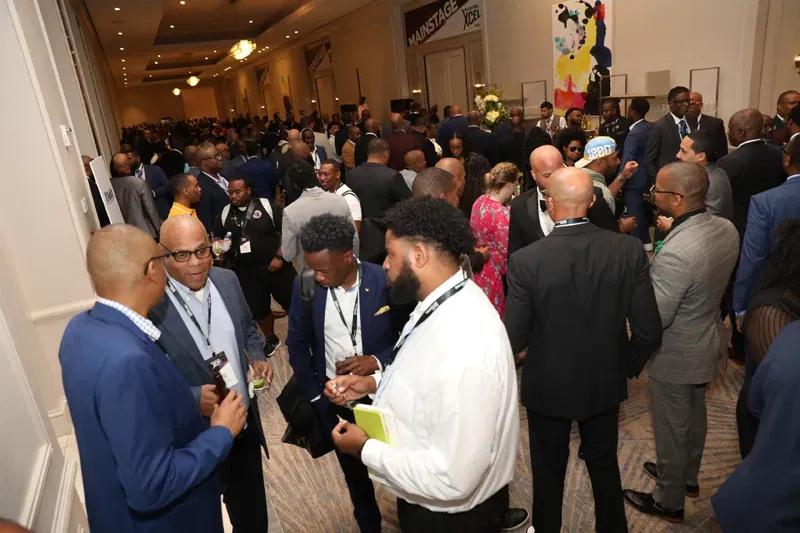
Held at the Perelman Performing Arts Center in New York City April 23, the ceremony honored women leaders who champion human rights and tackle pressing issues such as climate change, economic inequality, digital safety, and women’s rights. Speakers included marketing executive and entrepreneur Bozoma Saint John, legendary fashion designer Diane von Furstenberg, actresses Sophia Bush and Michelle Rodriguez, and CNN anchor Abby Phillip.
“There are [people] who have not heard of many of these honorees, but they’re doing incredible things in their communities. We have climate activists, we have a justice activist, we have tech activists,” Huma Abedin, a former Clinton top aide and author, told BLACK ENTERPRISE.
“To see what they’re doing and what they’ve successfully done in their communities is inspiring to all of these young women, and we need that now more than ever.”
Established in 1997 as the Vital Voices Democracy Initiative by the former first lady and U.S. Secretary of State Madeleine Albright, Vital Voices Global Partnership has supported more than 49,000 women changemakers addressing the world’s greatest challenges for nearly 30 years. The organization has provided early support for women who went on to become Nobel Peace Prize Laureates, U.S. Youth Poet Laureates, prime ministers, and social entrepreneurs.
Among the 2026 honorees was Dame Donna Langley, who received the Trailblazer Award for her leadership in entertainment. While accepting the honor, Langley reflected on the persistence required to create meaningful change.
“It will always feel like our momentum is uncertain,” Langley said. “Pushing forward when progress is stalled, and discouragement creeps in, is when the work matters most.”
Susie Wolff received the Icon Award, presented by Bush, who praised Wolff for paving the way for future generations of women in sports and leadership.
“Susie’s leadership isn’t just inspiring, it’s urgent,” Bush said during the ceremony.
Wolff later emphasized the importance of investment and opportunity in women’s sports.
“When we get the people with power backing us, when we get the investments, we’ve shown what’s possible,” she said.
Recipients also included Tracy Chou and Seyi Akiwowo, both recognized for their work combating online harm and improving digital safety. Additional Global Leadership Awards were presented to women leading transformative work around the world, including Dutch activist Shirin Musa and Indonesian conservationist Farwiza Farhan.
“I want young people to know that online harm is not inevitable. That dignity, safety, and care are not luxuries. They are non-negotiables… The tech we have today has been designed, and that means that it can be redesigned,” said Akiwowo, a British-Nigerian women’s rights activist and campaigner.
Throughout the evening, speakers stressed the urgency of protecting women’s rights and amplifying women’s leadership worldwide. Closing the ceremony, Clinton reflected on the organization’s nearly three-decade mission and warned against growing threats to women’s participation in democracy.
“The attacks on women’s voices, women’s rights, women’s opportunity, our full participation in society, have weakened democracies and strengthened the hand of authoritarians,” Clinton said. “This is not by accident. This is by design. Tonight’s honorees are part of the resistance to that growing repression,” she continued. “They, through their resilience and determination, have refused to accept the status quo or the efforts to turn the clock back. And that always inspires me.”
Adwoa Beauty Moves To Liquidation Following Chapter 7 Bankruptcy Conversion
The industry is watching how the collapse will affect future investments in the mainstream market.
Adwoa Beauty, a textured haircare brand that broke into prestige retail, is entering liquidation. A court ruling on May 1 converted the brand’s Chapter 11 reorganization into a Chapter 7 bankruptcy case, ending its current corporate structure, according to The Business of Fashion.
The transition to Chapter 7 bankruptcy case proceedings follows a prolonged legal and financial battle between Adwoa’s founder, Julian Addo, and Aurous Financial, a senior secured lender. A court-appointed trustee will now oversee the distribution of Adwoa’s remaining assets to satisfy outstanding debts.
Why Did the Sephora Trailblazer Face Liquidation?
Founded in 2017 with $80,000 of Addo’s personal savings, Adwoa Beauty became a symbol of success for entrepreneurs of color in the beauty industry. By 2020, the brand achieved a major milestone by launching in Sephora, bringing high-performance textured haircare to a global stage. But the cost of maintaining a Sephora presence proved unsustainable.
“It’s a very challenging time economically, and it’s a very competitive time in the market as well,” Addo said in an interview with Beauty Independent. “It’s just at a place where it doesn’t make sense, and it’s not fair to our retailers and our customers to not be able to really see this brand actualize.”
The Chapter 7 bankruptcy flip follows a Chapter 11 filing in October last year, sparked by a dispute with Aurous Financial over $375,000 in unpaid loans. While Adwoa Beauty raised $4 million in funding from Pendulum Holdings in 2022, the funding was insufficient to support the infrastructure needed to scale internationally.
What Is the Impact on Other Entrepreneurs of Color?
The closure of Adwoa Beauty is not an isolated event. It follows a concerning trend of recent closures involving entrepreneurs of color, including brands like Ami Colé and Good Light. Industry analysts point to a receding tide of diversity and equity commitments that surged in 2020 but have since cooled, leaving many minority-owned businesses undercapitalized.
Jeff Sirchio, director of operations at Aurous Financial, noted that while the lender did not wish for the brand’s demise, a viable turnaround plan was never established. Following the ruling, Sirchio stated that the firm supports the trustee’s efforts to maximize value for all creditors.
“Aurous, as the senior secured lender, is in favor of the trustee continuing the brand with a view to selling it along with the excessive packaging inventory,” Sirchio told Beauty Independent.
Lessons in Scaling High-Performance Textured Haircare
Addo, a former hairstylist who built a community through her Bella Kinks blog, has been candid about the “missteps” involved in growing a luxury brand. The Chapter 7 transition lays bare the financial pressures facing independent founders.
“Every issue you can think of–buying too much inventory, cash management, not having the right team early on to scale the business as it should–I’ve done,” Addo admitted. “I feel like I’ve aged in entrepreneurship 20 years over the past 18 months.”
Despite the liquidation, the demand for high-performance textured haircare remains high. Adwoa Beauty’s product line, including the Baomint and Blue Tansy collections, garnered a loyal following for their efficacy and gender-neutral branding.
Looking Toward the Future
While the Chapter 7 bankruptcy case marks the end of Adwoa Beauty’s current chapter, Julian Addo is already looking toward her next venture. She remains convinced that the market for entrepreneurs of color still contains untapped potential and “white space” that legacy brands have yet to fill.
“I’m ripe with ideas,” Addo said of her plans. “I’m actually excited again.”
As the trustee begins the liquidation process, the industry is watching how the collapse will affect future investments in the mainstream market.
The five-term Democratic mayor announced that she will officially resign June 30, despite recently winning reelection in 2025 by a wide margin. In a public statement, Lyles said the decision comes as she prepares for “the next phase” of her life and wants to spend more time with her grandchildren.
“Serving as Charlotte’s mayor has been the honor of my life,” Lyles said May 7. She also noted that leadership means knowing “when it is time to let the next generation of leaders take over.”
At 73 years old, Lyles leaves behind a legacy as one of Charlotte’s most influential political figures and a trailblazing Black woman who helped shape the Queen City. She made history in 2017 when she became Charlotte’s first Black female mayor after defeating Republican candidate Kenny Smith. Before taking office, she spent decades working in city government as a budget analyst, budget director, assistant city manager, and later as a member of the Charlotte City Council. During her tenure, Charlotte experienced major economic growth and population expansion. Lyles championed affordable housing initiatives, racial equity programs, public transit expansion, and violence prevention efforts across the city.
Her resignation comes amid growing political speculation about the city’s future leadership. The overwhelmingly Democratic Charlotte City Council will now appoint an interim mayor for the remainder of her term.
According to Fox News, the announcement follows months of public scrutiny and questions about her health and absence from public meetings. Lyles, however, has maintained that her resignation is rooted in family priorities.
The Ballot Remains The Battlefield: The Demise Of The Voting Rights Act
The Supreme Court has diluted the integrity of the Voting Rights Act
Written by Dr. Russ Wigginton
The Supreme Court’s decision in Louisiana v. Callais effectively renders Section 2 of the Voting Rights Act (VRA) a “dead letter” by requiring proof of intentional racial discrimination. This ruling mirrors the 2013 Shelby County erosion and threatens up to 15 Black-held House seats. Dr. Russ Wigginton argues that, as in 1966, the response must be massive civic mobilization.
How does Louisiana v. Callais change the Voting Rights Act?
In a 6-3 decision written by Justice Samuel Alito in Louisiana v. Callais, the Court effectively rendered Section 2 of the VRA all but a dead letter, requiring proof of intentional racial discrimination, a standard Congress never wrote into the law, and that is nearly impossible for plaintiffs to meet. Justice Kagan’s dissent pulled no punches: “Today’s decision renders Section 2 all but a dead letter. In the States still marked by residential segregation and racially polarized voting, minority voters can now be cracked out of the electoral process.”
The ruling could touch off a scramble by Republicans to redraw majority-minority congressional districts, especially in the South, costing many seats held by Blacks and representing Blacks. One analysis found that the gerrymandering unleashed by Wednesday’s decision could lead to white candidates winning 15 House seats currently held by Black members of Congress, a level of racial retaliation not seen since the end of Reconstruction.
Dr. Martin Luther King Jr. and others must have known this day would come. Not this specific date, but this specific resistance.
The Historical Precedent: The 1966 “Coalition of Conscience”
In 1965, King led the march from Selma to Montgomery not as symbolism, but as a strategy. He understood that the ballot was the non-negotiable instrument of self-determination, the one tool that could convert moral authority into legislative power. The Voting Rights Act, signed that August, was the direct result of bloodshed on the Edmund Pettus Bridge. King did not stop there. By 1966, he was building what he called a “coalition of conscience,” registering voters across the South, training community organizers, and insisting that the movement’s next chapter had to be won at the precinct, not just the pulpit.
It worked. The 1966 midterm elections saw record Black voter turnout in the South, shifting the partisan landscape in ways that had seemed unimaginable just two years prior. Black voters in Alabama, Georgia, and Mississippi translated their newly protected franchise into city council seats, judgeships, and congressional representation. The act didn’t just protect a right — it restructured power.
What today’s Court has done is reopen the wound those voters bled to close 60 years ago.
The Erosion of the VRA (2013–2026)
The erosion did not begin today. It began in 2013, when Shelby County v. Holder struck down the VRA’s preclearance provisions. After falling for decades following the VRA’s enactment, the racial turnout gap began to increase again, especially in counties once covered by preclearance. Today’s Callais decision is not an outlier. It is the culmination.
But history also tells us what comes next.
Strategy for Action: Out-Organizing the Gerrymander
When the law retreats, the people must advance. The answer to a Court that picks voters over democracy is a movement that out-organizes the gerrymander. Voter registration drives. Civic education in every school, church, and barbershop. Ranked-choice advocacy. Turnout operations that make suppression irrelevant through sheer numbers. The 1966 model still works, not because it is nostalgic, but because it is true: when enfranchised citizens of every race, background, and ZIP code show up, the map changes.
Janai Nelson of the NAACP Legal Defense Fund said the decision would allow states to “discriminate with impunity.” She is right. But impunity is not immunity from organized, relentless civic participation.
Dr. King asked us, “Where do we go from here?” The answer, 60 years later, is the same: to the polls, to the precincts, to the people. The ballot remains the battlefield. And we have not yet lost the war.
Courtesy of the National Civil Rights Museum
Dr. Russ Wigginton serves as the President of the National Civil Rights Museum. He assumed this role in August 2021 and brings vast experience in education, fundraising, operations, and community engagement. Prior to assuming this role, Russ served as the Chief Postsecondary Impact Officer for Tennessee State Collaborative on Reforming Education (SCORE), where he led the organization’s work for postsecondary access, retention, and completion.
This marks an important step in her career nearly a year after she left Fox Sports.
Joy Taylor is coming back to daily sports media with the launch of The Daily Playwith Joy Taylor, a new short podcast distributed through the Urban One Podcast Network. This marks an important step in her career, nearly a year after she left Fox Sports.
The project places Taylor in the growing micro-podcast space, where sports commentary is provided in short, mobile-friendly formats. Each episode of The Daily Play is expected to last 5 to 10 minutes, offering a quick analysis of major sports headlines and context for listeners seeking brief updates.
The show airs Monday through Friday on Urban One’s audio network, including Radio One, REACH Media, and various podcast platforms. The format serves as a daily sports check-in, with year-round programming in which Taylor breaks down what happened, why it matters, and what to watch next in ongoing stories.
Taylor described the concept as a response to how people consume media today. She wanted to create a format that is “fast, focused, and always authentic,” showing the need for short but meaningful sports commentary for audiences with busy lives and constant news cycles.
Taylor spent nearly 10 years at Fox Sports, where she worked on key programs like Speak, Undisputed, and The Herd, establishing herself as a prominent voice in national sports television and debate coverage.
Her departure followed broader programming changes at FS1, after which she focused on independent digital work and podcasting centered on on-demand sports content. This transition marks a significant shift in her media career as she moves away from traditional television formats.
This move also highlights a larger trend in sports media, with established personalities increasingly shifting from linear TV programs to digital audio platforms.
Sheinelle Jones Turns Lessons From Celebrity Moms Into A No. 1 Bestseller Ahead Of Mother’s Day
For Sheinelle Jones, the journey to becoming an author began with a simple question: How could she become a better mother?
The TODAY with Jenna & Sheinelle co-host recently debuted at No. 1 on The New York Times Advice, How-To & Miscellaneous bestseller list with Through Mom’s Eyes: Simple Wisdom From Mothers Who Raised Extraordinary Humans, a rare achievement for a Black woman in a category historically dominated by self-help mainstays and celebrity experts.
The idea first came to her when she was still relatively new at TODAY and trying to find her footing. At the time, she said, an NBC page she was mentoring asked what she would want to do if she could pursue a passion project.
“Honestly, I would love to interview the mothers of some of these folks that we admire,” Jones recalled saying. “You don’t hear from them about just how they did it, what they did right, what they did wrong, the things they did differently, and maybe they could share their wisdom with me.”
Her first “yes” came from Sonya Curry, the mother of NBA superstar Steph Curry. Jones flew to sit with Curry in her home, where the conversation extended beyond parenting philosophies into something more intimate. Curry later took Jones upstairs to Steph’s childhood bedroom, where trophies and basketball posters told the story of a boy’s dream before the world knew his name. What stood out was that Steph had gone on to compete against some of the players whose photos decorated his room.
“Before there were vision boards, we had high school bedrooms with posters,” Jones said. “I did the same thing. I had news people on my wall.”
The project began as a digital series for TODAY in 2018 before eventually expanding into broadcast. But Jones quickly realized the short television format could only hold so much of what these women were sharing.
During the pandemic, as much of the world reconsidered what mattered, Jones began thinking about what else she wanted to build.
“Some people started baking bread, other people started dreaming,” she said. “I remember thinking, I would love to be able to write a book using all of these interviews and write about what I’ve learned.”
After sitting with the mothers of Kevin Durant, Lady Gaga, Lin-Manuel Miranda, and others, Jones began to see a pattern.
Many of the women, Jones said, spoke openly about faith, resilience, heartbreak, and the private work of holding families together.
“For the woman who feels like she’s grateful to be a mom or a grandmother or an auntie or a teacher or a coach, but it’s just hard — you’re not the only one,” Jones said. “If you peel the layers and you look behind the curtain, they had a mother who was just doing the best she could, just like you are.”
The message feels especially personal for Jones as she approaches Mother’s Day while grieving the loss of her husband, Uche Ojeh, who died May 18, 2025, after battling brain cancer (Jones’ grandmother also passed on New Year’s Eve 2025) while parenting three teenagers who are grieving too.
“What I know to be true is they’re doing what I’m doing, which is we’re holding two things,” Jones said of her children. “We’re holding our heartbreak, but we’re also trying to honor him by moving forward.”
She looks and sounds polished on camera, but she is honest about the cost.
“I look like I’m operating with a full tank, but you can’t lie to your body,” Jones said. “I know that I’m not operating on a full tank. I’m heartbroken.”
Her children have also become part of the book’s emotional center. Jones dedicated Through Mom’s Eyes to them and says the magnitude of the moment did not fully land until they surprised her on TODAY during the book’s launch.
“I saw their faces, and I thought, OK, they get it,” she said. “They were proud of me, and that just moved me to tears.”
When asked what she hopes her children understand from watching her mother them, Jones said she is trying to model the qualities she wants them to carry: kindness, wonder, resilience, and faith.
“I think that’s our best bet as parents, to just move in the way that we hope our children would want to move,” she said. “And that they would be better than us, quite frankly, that they stand on our shoulders.”
That idea also shapes how she views the mothers in her book.
Some of the advice she gathered was immediately actionable. Sonya Curry told Jones that Steph once missed an eighth-grade basketball game because he failed to do his chores. Jones went home inspired, ordered a magnetic chore chart, and tried to implement the same system.
It did not last.
“My oldest was like, ‘Mommy, can we take this off the fridge? This is stupid. You’re never going to do it,’” Jones said with a laugh. “Because I didn’t even have the bandwidth to enforce it.”
Still, the advice that stayed with her the most was not about discipline.
“The part that I take to heart is when every single mom talks about how quickly it flies by, and you don’t want to wish it away,” Jones said. “We gotta slow down. We gotta slow down.”
That message feels even more urgent around Mother’s Day.
“I don’t need some lavish gift or some trip or anything crazy,” Jones said. “I just want to be surrounded by the kids that I love.”
With Through Mom’s Eyes, Jones is also beginning to understand her work not only as journalism or storytelling, but as ownership. She is an author. She is a brand. She is learning that business ownership and storytelling do not have to live in separate rooms.
“We can all take a piece of it and try to figure out how we can be our own best advocate and brand, and what that looks like in this new space,” she said. “I’m also learning in real time the power that we have, and our stories and our voices. And our support for each other has power.”
Jones is trying not to race past this moment. After years of dreaming, working, mothering, caretaking, grieving, and building, she is learning to sit still long enough to ask what comes next.
“I’m getting to know the new me,” she said. “Al Roker calls it Sheinelle 2.0.”
Hit Songs That Celebrate Black Moms On Mother’s Day
Mothers have no shortage of songs that honor and express gratitude for their love and care
Mothers have no shortage of songs that honor and express gratitude for their love and care. Across different musical styles and time periods, artists have drawn on their mothers as creative inspiration, writing songs about motherhood, maternal challenges, and devotion. This selection features popular songs that celebrate mothers through storytelling and musical tribute, showing why motherhood remains a timeless, universal theme in music.
“Mama Knew Love”
The song “Mama Knew Love” by Anthony Hamilton tells the story of a son who observed his mother’s love through her actions. The 2005 release “Ain’t Nobody Worryin’” features this Southern soul track, which showcases Hamilton’s storytelling abilities while drawing from his Charlotte upbringing. The song “Mama Knew Love” is in keeping with conventional Mother’s Day tribute patterns by recognizing a mother’s hardships and commending the sacrifices and commitments she’s made in her parental role.
“A Song for Mama” – Boyz II Men (1997)
The 1997 Soul Food soundtrack included Boyz II Men’s Grammy-winning R&B track “A Song for Mama,” which honors maternal love and guidance. The song follows Philadelphia R&B tradition by highlighting the mother’s role as an emotional anchor and teacher. The song’s crossover success established it as the ultimate “mom song” of the 1990s, which became essential for Mother’s Day and family celebrations.
“Hey Mama” – Kanye West (2005)
The song “Hey Mama” from Kanye West’s 2005 album “Late Registration” serves as a heartfelt tribute to his mother, Donda West. During his early mainstream hip-hop career, Kanye West created the song to honor Donda’s life. The song took on a deeper emotional meaning after Donda died in 2007. Through his live performances of “Hey Mama,” Kanye established the song as a timeless anthem for maternal love.
“I’ll Always Love My Mama” – The Intruders (1973)
The classic R&B song “I’ll Always Love My Mama” by The Intruders came out in 1973 as part of their Philly soul music legacy. The song, which songwriter Kenny Gamble wrote about his mother, has become a traditional Mother’s Day song, played at family events and celebrations for many years. The song “I’ll Always Love My Mama” emerged from the Philadelphia soul movement of Gamble and Huff, yet remains a timeless tribute to the unbreakable bond between mother and child.
“Mom” – Earth, Wind & Fire (1972)
The song “Mom” is a heartfelt tribute to mothers and appeared on Earth, Wind & Fire’s 1972 album “Last Days and Time.” The early 1970s funk and soul band Earth, Wind & Fire created this track as part of its musical evolution in R&B and funk. Maurice White and Verdine White wrote “Mom” to highlight family appreciation alongside spiritual grounding, which represents fundamental themes in the band’s musical collection.
“On My Mama” – Victoria Monét (2023)
During her breakthrough era in 2023, Victoria Monét released “On My Mama” as a confident and celebratory track, which earned her a Grammy for R&B music. The contemporary R&B track with West Coast production demonstrates how maternal lessons still shape modern musical narratives about identity, confidence, and womanhood, even though it is not a traditional ballad.
“Grandma’s Hands” – Bill Withers (1971)
The song “Grandma’s Hands” is a soulful tribute to Bill Withers’ grandmother, which was released in 1971 on his album “Just As I Am.” Through Withers’ personal songwriting approach, the song expands the meaning of “motherhood” by recognizing grandmothers as female matriarchs who often serve as the glue holding family and community bonds together.
“Dear Mama” – Tupac Shakur (1995)
The 1995 album Me Against the World featured Tupac Shakur’s deeply personal tribute to his mother called “Dear Mama.” The West Coast rap scene produced this hip-hop golden era song, which pays tribute to Tupac’s mother, Afeni Shakur. The song “Dear Mama” narrates Tupac’s childhood struggles with poverty and his mother’s fight against addiction while being an activist, and has become one of the most emotionally powerful rap songs in history. The song’s enduring cultural significance has made it a common reference point for motherhood in contemporary musical works.
‘Protecting My Peace…At ALL Costs’: Garcelle Beauvais Writes About Walking Away From Real Housewives In New Memoir
The actress, author, Real Housewives star, and former fashion model reflects on the moments that shaped her in an intimate new Audible Original
Garcelle Beauvais has spent decades in the public eye: on runways, on sets, on red carpets, and on Real Housewives—one of the most-watched reality franchises in television history. Now she’s spilling the tea about her journey and how she learned to stand firm, find her power in authenticity, and walk away on her own terms.
Her latest work, written and narrated by Beauvais, allows listeners unprecedented intimacy as she shares behind-the-scenes moments, personal revelations, and hard-won wisdom about relationships, identity, and what it means to refuse to shrink yourself for anyone. Protecting My Peace…At ALL Costs arrived exclusively on Audible this week.
“This is a story about knowing when your spirit says no more, and having the courage to honor that truth,” said Beauvais in a statement. “Learning to protect my peace, set boundaries without apology, and finally walk in the power that I have always carried isn’t selfish. It’s survival.”
“I wanted to share what I’ve learned about walking into rooms as my full self and refusing to leave any part of who I am at the door,” she continued. “Sometimes the most radical thing you can do is simply choose you.”
From growing up in Haiti to making it in Hollywood, raising three boys, navigating two failed marriages, and her groundbreaking run on The Real Housewives of Beverly Hills, Beauvais reflects on the experiences that shaped her life and shares the lessons they taught her in intuition, discernment, love, and faith.
In just-released clips from the audio book, she opens up about how news of her husband’s infidelity affected her career when it leaked to the press:
“My whole world exploded… The fallout didn’t stay inside my house. It followed me into audition rooms, on sets, through industry events where everyone knew my name—and my business.”
Garcelle on writing an email to her husband’s company, CAA, after his infidelity.
She also takes us behind the scenes of how Real Housewives of Beverly Hills affected her mental health, leading to her now infamous reunion show walk-off:
“When I realized I was crying more than I was excited to go to work, I knew something had to give. The executives were worried about me. They had never seen me that broken up. They recommended I talk to the show’s therapist. And he said something that stopped me cold, ‘It sounds like the negative is catching up to the positive.’”
Garcelle on the moment she walked off the ‘Housewives’ reunion stage for the last time.
Maj. Jas Boothe Turned Personal Trials Into Triumphs
She went from Homeless Single Mom To Housing Women Veterans
As a stage-three cancer patient, single mother at that time, and newly-disabled veteran who lost everything she owned in Hurricane Katrina, Maj. Jaspen “Jas” Boothe (U.S. Army, Retired) could have easily thrown in the towel and given up. But instead, she pushed forward, not just for her and for her son, but for the thousands of women veterans facing unstable housing and homelessness.
She recalls being rejected for housing support by the very federal agency designed to support her—all while undergoing two surgeries and 30 cycles of radiation during a six-month hospital stay in Texas.
“I’m a veteran at this time and I need supportive services, particularly housing for me and my son,” Boothe recalled, as she reached out to a federal agency for help and said she was told: “‘Yes, we help veterans, but you’re a woman.’ And I said, ‘Yeah, last time I checked.’ And she said, ‘Well, you mentioned you had an illegitimate child, right? You need to go get on welfare and food stamps like other women in your situation.’”
Appalled by the response, Boothe couch-surfed and stayed with an aunt for a time while getting back on her feet. A few years into her recovery, she decided the answer to solve this crisis was already within her.
Boothe founded Final Salute Inc. in 2010, which is one of the few nonprofits in the country dedicated exclusively to housing homeless women veterans and their children. In 15 years, Final Salute Inc. has provided more than 17,000 transitional housing days while serving more than 8,000 women veterans across 30 states and territories.
The organization has been a literal lifeline and lifesaver for so many women, who are now where Boothe once was. This includes Lisa, a Navy veteran and single mother of two girls who was separated from her youngest daughter’s father due to physical and mental abuse, according to a Final Salute Inc. testimonial.
“I had issues with my vehicle, which has caused me to fall behind on my rent. I reached out to Final Salute and they have helped me and my girls to keep our home,” Lisa stated. “Providing a safe and secure home for me and the girls is my No. 1 priority and Final Salute has helped me to do it.”
Minority veterans are overrepresented within the homeless veteran population, according to the National Coalition for Homeless Veterans. Additionally, Major Boothe shared with BLACK ENTERPRISE that more than 70 % of the homeless women veteran population have at least one child in their care.
“Unfortunately, for some, they suffer in silence. They stay in domestic violence situations. They hop from home to home, because unfortunately, if you go to [seek] resources and say, ‘I’m homeless, I don’t have a place for me and my child to live,’ you risk losing your child,” Boothe said. “So, a lot of us put ourselves in dangerous situations in order to stay with our children.”
From Midwest Roots to Military Boots
Born in Chicago and raised in her early years at the Cabrini-Green Homes—with family roots originating in Mississippi—she enrolled in Mississippi Valley State University (MVSU) on a full basketball scholarship. While other historically Black colleges and universities (HBCUs) were knocking at her door, Major Boothe said, “it was something about Mississippi Valley State that drove me to the university. And I’m telling you, I’ve been to other universities outside of an HBCU, and there is definitely nothing like the experience you get at an HBCU as a Black American.”
After completing her Bachelor of Arts in Mass Communications at MVSU, the proud member of Zeta Phi Beta Sorority, Inc., she then enrolled in the Army National Guard. As a single mother at that time, Boothe wanted to break stereotypes “placed upon women who become single mothers about how successful you can be in life.” Thus, she entered what is considered a male-dominated profession.
While higher education was something her family stressed as a key stepping stone to a successful life, entering the military put her at odds with some in her family—particularly her father.
“My dad was very old school, and he was of the mind that Black people don’t have a place in the military,” she said, noting that her father questioned why she would want to put her life on the line for a country that does not highly respect Black Americans.
Boothe understood her father’s harsh stance, as he viewed military service through a lens of skepticism, having witnessed segregation and its effects, particularly in the Deep South.
“But then, as he saw me progressing through the military and saw the things that I was able to accomplish, he then got on board,” Boothe said, “and he was very happy and ecstatic and telling everybody, ‘yes, my daughter’s in the Army! My daughter is a Captain in the Army!’”
Originally enlisted as a Mustang Officer and beginning as a truck driver, she then commissioned as a Human Resources officer. Boothe said she spent 17 years in the military—as she received a cancer diagnosis (now in remission)—and then got back into her military career. She later had both knees replaced and her spine fused. Although Boothe faced life-threatening health challenges and was three years shy of retirement, she believes the timing was just right for her to be able to use her personal journey to help other women.
“I would have loved to do 20 years, but I believe everybody’s journey is different for a reason,” she said. “And so, I believe that. I got out at the time that I needed to.”
Her father passed before Boothe became a major, but he was incredibly happy about her success in the military. Her oldest son, Brandon, followed in his mother’s footsteps by joining the U.S. Air Force. Now married and the proud mother of two sons, her husband is a U.S. Marine.
Black College: The Foundation for Service
Choosing an HBCU was pivotal for Boothe’s educational, military, and entrepreneurial journey.
“Going to an HBCU gave me that foundation of community and probably was essential in my journey to start my nonprofit organization,” she said.
Several years after experiencing homelessness, Boothe was watching one of Oprah Winfrey’s final talk shows. It happened to feature a homeless veteran woman living in her car.
“I was completely floored and shocked because of the several years that had passed by, I had kind of written off my situation as ‘maybe I was just one who slipped through the cracks,’” she said, feeling sure that the sexism and discrimination she once faced from the federal agency supporting veterans had since improved. “But after I saw that show and realized there were still tens of thousands of homeless women veterans without resources and without support, that’s basically what started the fuel in me to found Final Salute Inc.”
According to data from the U.S. Department of Housing and Urban Development, “overall Veteran homelessness decreased in 2024, and homelessness among female Veterans followed suit. However, levels still remain higher than they were in 2020.” Data shows nearly 3,500 homeless women Veterans as of 2024, with a concerning number of “unsheltered female Veterans living on the streets, in a car or in another unsafe situation” at 1,668.
Having never thought of running a nonprofit, Boothe “knew leadership from what the military taught me,” she said. “You see a problem, you find a solution.”
In asking about launching a nonprofit, many folks told her to establish a 501 (c) (3), which she was cautioned would be a lengthy process—possibly even taking years, she said. But the fuel within her continued to burn, as she daily thought of the women veterans and their children who do not have years to wait.
“And so, I did a thing. I wrote a letter to the IRS with my packet and asked if they could please expedite my 501 (c) (3) because women Veterans don’t have years to wait. They’re losing their children. Some are losing their lives. They’re losing their homes.”
Within 30 days, Boothe said she received her confirmation letter from the IRS, and Final Salute Inc. was officially approved. One hundred percent of her support comes from the private sector.
“It was completely unheard of, but I knew that this is my mission and my calling. And I had what I needed to get started,” she said.
Veteran S. Moore of Woodbridge, Virginia, lost her job while fighting cancer and suffered heart failure from the chemotherapy drugs, she said, putting her in the tough spot of no longer affording her critical electric bill while raising her son.
“Because I have to plug into the wall outlet at night to keep my heart pump going, it was causing me great stress knowing that I was in danger of getting my electricity cut,” said Moore. “Final Salute Inc. came in and paid the entire bill, ensuring me that I would be able to stay in my apartment. I have been to many agencies asking for help and was turned away for them all, but Final Salute came through for me and didn’t make me [feel] worthless.”
Proudly Representing All Women Veterans
There are three signature programs of Finale Salute Inc. The H.O.M.E. Program provides transitional housing, food, clothing, and on-site case management to homeless women veterans and their children. S.A.F.E. helps prevent homelessness by easing financial hardships, including emergency assistance with past-due rent, utility assistance, and offering financial education. And Next Uniform provides support for women veterans and military women in transition into the civilian workforce. At no cost, this program provides professional business attire, makeovers, image consulting, and headshots.
In late April, Boothe was honored as one of 100 Women to KNOW in America at a national summit in Phoenix. The program is deemed a “premier recognition program honoring high-achieving women who demonstrate exceptional leadership, professional excellence, and significant societal impact” across various sectors.
“My recognition is on behalf of all women who have served and sacrificed for this great nation. You know, we are not damsels in distress. We are not birds with broken wings. We are the trailblazers; we are the mountain movers.” Boothe shared with BLACK ENTERPRISE. “And so, for me, it just shows how successful we can be.”