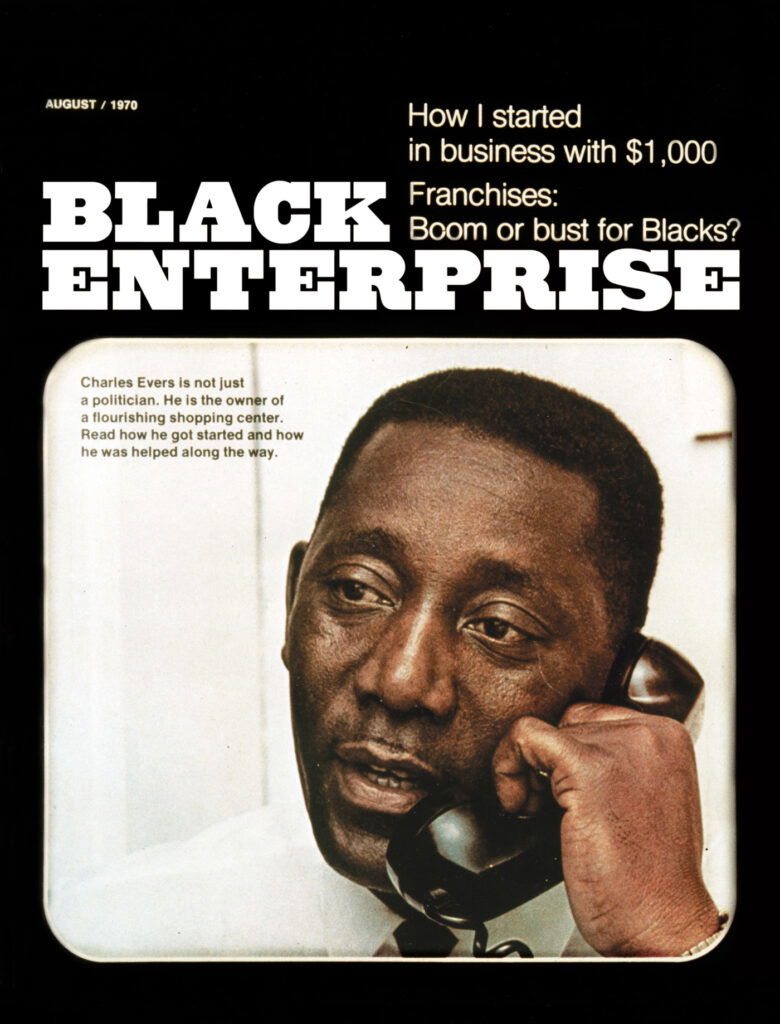
The 1st BLACK ENTERPRISE Cover Birthed A 56-Year Legacy
Founder and Publisher Earl G. Graves, Sr. launched a publication and gave birth to a media company.
In August 1970, the visionary Founder and Publisher Earl G. Graves, Sr. launched a publication and gave birth to a media company that to this day has enabled generations of African Americans to achieve “wealth for life” through building thriving businesses, gaining mobility in corporate America, and embracing sound money management and disciplined investing. As a result, it has been a source of inspiration and guidance for African Americans to become full participants in the economic mainstream as captains of industry, executives of immeasurable influence, and multigenerational wealth builders.
Charles Evers, the late mayor of Fayette, Mississippi, served as the magazine’s first cover subject and embodied Black entrepreneurs who emerged from the Civil Rights Movement and demonstrated the qualities required to be successful: Business savvy, political muscle, and boundless determination.
A member of BLACK ENTERPRISE‘s first advisory board, he developed and operated the profitable Medgar Evers Shopping Center, named in honor of his brother, the prominent civil rights leader slain by an assassin’s bullet in 1963.
D.L. Hughley gets personal, sharing a side never seen before.
D.L. Hughley had a top-billing spot on the comedy tour The Original Kings of Comedy. He was also an original host of BET’s Comic View and star of the ABC sitcom The Hughleys. He’s known for taking risks, overcoming setbacks, and speaking his piece.
A 2024 XCEL Summit Award honoree, Hughley is also a Peabody Award-winning radio and television host, commentator, and iconic stand-up comedian.
But there is a lesser-known side of him that he shared with fellow XCEL Summit Award Honoree Ed Gordon during a fireside chat. Hughley gets personal, sharing a side never seen before on stage or in the movies.
Check out the clip below:
As BLACK ENTERPRISE gears up for the upcoming 10th anniversary of XCEL Summit for Men, BE offers a hint of what to expect from our honorees and speakers this Oct. 21 – 23, 2026, at the Hyatt Regency Grand Cypress, in Orlando, Florida. It’s a safe space for professional, career-oriented men of color to be honest with one another about the world around us.
Jared Armstrong Builds A Purpose-Driven Sports Business Ecosystem On And Off The Court
The professional basketball player and entrepreneur is leveraging sports enterprise, and strategic associations.
Jared Armstrong is evolving the role of the modern athlete by building a sustainable, purpose-driven business while continuing his professional basketball career. His journey offers Black business professionals, executives, and aspiring founders a valuable example in asset creation, risk management, and planning for life after sports. Nearly half of professional athletes face financial hardship within five years of retirement. Armstrong challenges this trend by leveraging sports for financial empowerment, commercial partnerships, and community investment.
Turning Adversity into Entrepreneurial Equity
The 29-year-old Philadelphia native developed a passion for basketball at age 3, but his path was not straightforward. A rare foot condition disrupted his college prospects and led him to pursue a professional career overseas in Israel. Armstrong also overcame a highly publicized legal challenge related to his Black and Jewish identity to obtain Israeli citizenship.
“I always just believed in myself,” Armstrong told Fox News Digital. “The rest is just about the hustle and the work and the brains that you can find and put together. My goal is basically trying to build a business, which is rare, while you’re playing. That way, when I’m done, I have something to fall back on.”
What started as a youth basketball program has grown into JAB, a multifaceted platform integrating sports management, event production, real estate development, and youth mentorship. According to JAB Camp, the organization has served nearly 3,000 youth by combining athletic training with leadership and financial empowerment programs to build long-term economic confidence. Several alumni have earned college scholarships and launched neighborhood initiatives.
One participant, Malik Johnson, shared, “JAB taught me how to be a leader on and off the court. The financial training workshops helped my family plan for college, and now I mentor others in my neighborhood.”
Stories like Malik’s show how direct engagement and education through JAB produce lasting beneficial change in local communities.
Armstrong’s strategy includes infrastructure and community real estate development. Through the JAB Resilience Tour, he initiated renovation of 10 basketball courts in areas affected by violence after the October 2023 attacks. OK! Magazine reports his projects include court construction in Philadelphia and Israel with plans for further international expansion.
The $1 Million Tournament and Cross-Industry Ventures
Central to Armstrong’s growth strategy is the JAB Classic, a $1 million global basketball tournament set for Aug. 14 to 16 at Philadelphia’s historic Palestra. The event features eight teams from eight cities and is one of only two open tournaments with a million-dollar prize. It will showcase current and former NBA players such as Quinn Cook, Donte Greene, Erick Green, Jerome Randle, Lamar Peters, Darrun Hilliard, Taylor Funk, and Tyrese Martin of the Philadelphia 76ers.
The tournament has secured investment from ownership groups linked to the Philadelphia 76ers and Indiana Pacers, as well as corporate support such as 350 pairs of sneakers donated by Shaquille O’Neal’s team.
Armstrong also shows that social purpose can differentiate a brand through cross-industry collaborations. He sought mission-driven organizations and approached potential collaborators with a clear vision focused on unity and impact. Facing early skepticism from those outside sports, he emphasized shared principles and mutual benefit to build successful alliances. For example, in collaboration with James Beard Award-winning chef Michael Solomonov and Federal Donuts & Chicken, he co-created the JAB Donut to promote cross-cultural unity and expand brand awareness beyond sports.
“We created two donuts to really symbolize unity and combating hate,” Armstrong told Inc. Magazine. “That was a part of the JAB tournament. It is a symbolic thing that we wanted to do to send a message to the world.”
Armstrong reveals how purpose-driven leadership, proactive equity building, and calculated diversification can turn personal resilience into continual commercial success. Like many African American athletes and professionals who strive to overcome barriers, Armstrong’s story shows that harnessing specific experiences and staying committed to purposeful growth can lead to generational wealth and meaningful influence. His journey motivates those confronting similar obstacles and aspiring to create sustained impact in sports, business, and beyond.
ON THIS DAY: Spelman College Added Nursing To Its Academic Program
The nursing school established Black excellence in the field
August 12, 1886: The first African-American nursing school officially opened at Spelman College in Atlanta, Georgia. The program established the Black women’s excellence Spelman College is known for and pushing a golden standard among nursing students as they embarked on careers in the field of nursing.
The Iconoclast ‘The King Is Dead.’ Dinner Experience Celebrates Women Chefs On Martha’s Vineyard
The dinner took place at The FARM Institute, a 162-acre working farm and educational center in Edgartown
The Iconoclast Dinner Experience returned to Martha’s Vineyard on Aug. 9 for the sixth annual “The King Is Dead.,” bringing chefs, winemakers, and cultural leaders together for an evening celebrating women in the culinary industry and the island’s agricultural community.
Presented by Target, the dinner took place at The FARM Institute, a 162-acre working farm and educational center in Edgartown, Massachusetts.
Source: photo credit: Dave Welch
The farm-to-table experience challenged participating chefs to source ingredients from Martha’s Vineyard, placing sustainability, seasonality, and local agriculture at the center of the menu.
Chef Ting, culinary innovator and founder of Oak Bluffs-based Black Joy Kitchen, served as host chef. Chef Preston Clark, culinary director of Lure Fishbar and Bar Mercer in New York City, served as culinary chair.
Chefs-in-residence Monika Dominguez, chef de cuisine of Shiso in Miami, and India Doris, executive chef and co-owner of Markette in New York City, helped bring the dinner to life in addition to Chef Sahar Siddiqi and Chef Whitney Stancil. Jahdé Marley, portfolio manager for Zev Rovine Selections in New York, led the wine experience.
Source: photo credit: Dave Welch
Internationally renowned painter Tschabalala Self served as honorary chair, extending the evening’s celebration of women beyond the culinary world and into the arts.
The dinner is part of a larger mission established by Dr. Lezli Levene Harvell, a board-certified pediatric dentist who founded The Iconoclast Dinner Experience 11 years ago to increase visibility for diverse culinary and beverage professionals.
“For seven years, this dinner has brought together rising female chefs and Martha’s Vineyard’s farming community to create a celebration of place, seasonality, and innovation,” Harvell said.
The experience also carries a philanthropic component. Net proceeds from Iconoclast Dinner Experience events support international students from Jamaica and sub-Saharan African countries attending Spelman College. Under Harvell’s leadership, the organization has raised more than $150,000 for international Spelman students.
Source: photo credit: Dave Welch
On Martha’s Vineyard, that broader mission translated into an evening where food, farming, art, and philanthropy shared the same table.
Dr. Cynthia Smith Builds A K-12 STEM School And It’s Tuition Free
Minds of the Future Academy became fully accredited in July.
Dr. Cynthia Smith is expanding access to STEM education and workforce training for students in Jacksonville, Florida, in the East Side neighborhoodwhere she grew up, Afrotech reports.
Minds of the Future Academy, the tuition-free private K-12 STEM school Smith founded, became fully accredited July 17, according to the outlet. The milestone comes nearly a decade after Smith, a lifelong educator who spent 16 years in the public school system, launched the academy as a for-profit preschool in 2016.
In 2019, Smith expanded her vision into a K-12 school operating under the nonprofit Minds of the Future Foundation. The organization receives funding through Step Up For Students to help cover attendance costs.
“It was a big deal for me to open my school, my vision, in an area in which I grew up because I knew that I would be fully supported,” Smith told the outlet.
Smith said her goal was to give children access to specialized educational opportunities without the financial and admissions barriers families can encounter at other schools.
In October 2025, Smith purchased a 28,000-square-foot facility, bringing the academy’s operations under one roof. The campus includes computer and STEM labs, podcasting and media production facilities, and a makerspace where students can design clothing.
Career preparation is also central to the curriculum. Students in kindergarten through fifth grade can take daily electives in coding, robotics, and visual arts. Middle and high school students can participate in workforce development programs covering artificial intelligence, entrepreneurship, financial literacy, digital marketing, carpentry, cosmetology, graphic design, media production, CPR and first aid.
“We’re giving students an additional eight certification opportunities for them to be able to walk out of our doors and work immediately upon graduation,” Smith told the outlet.
The academy also provides arts programming and internships for juniors and seniors. Its community garden supplies students and their families with free produce on Fridays.
According to the publication, the academy has a 90% student retention rate and a 97% staff retention rate. Its staff has expanded from eight to 30 employees ahead of the new school year.
Smith is now seeking additional funding to expand the academy’s programs and continue creating educational and career opportunities for students in the Jacksonville community.
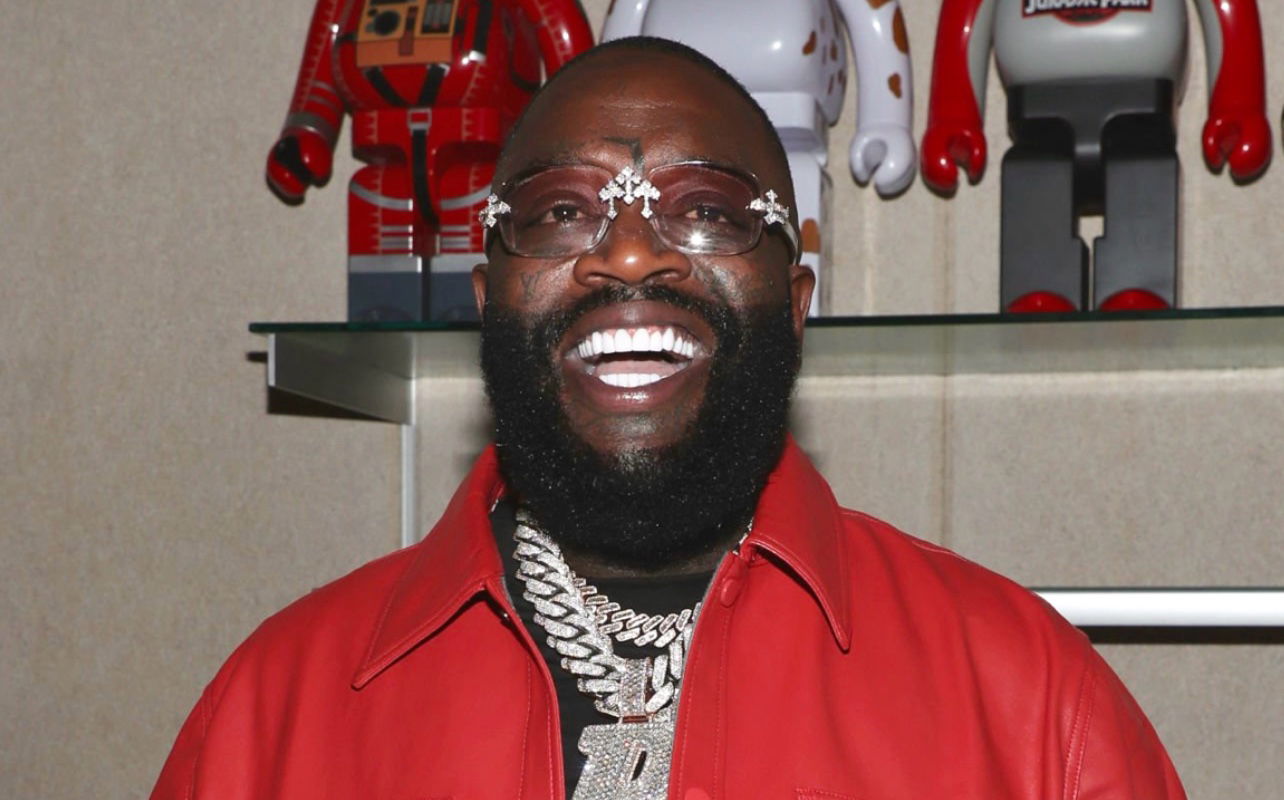
The Grammy-nominated rapper and entrepreneur has joined EnSima Technologies and EnSima Holdings as a partner, according to a July 28 announcement from EnSima. EnSima Holdings is behind EnSima Miami I, a mixed-use development planned near Hard Rock Stadium.
The eight-story project is expected to include 670 residential units and about 165,000 square feet of retail space. Ross joins EnSima Founders Shalom Arik Maimon, Lior Suchard, David Shapiro, and Ali Yesil.
Italian design firm Pininfarina, which has a decades-long history of working with Ferrari, is overseeing the project’s design. TerraForm Development is expected to handle construction. Financial terms of Ross’ partnership have not been disclosed.
The venture has personal ties for Ross, who was raised in Carol City, a neighborhood in Miami Gardens. His involvement comes as he marks the 20th anniversary of his 2006 debut album, “Port of Miami.”
According to Complex, residences are expected to start at roughly $593 per square foot. One-bedroom residences, measuring about 650 square feet, start at approximately $450,000, while two-bedroom units of about 900 square feet start at roughly $580,000. Developers have not announced a construction start date. A sales office is expected to open in September.
The project expands the business portfolio Ross has built beyond his music career. He founded Maybach Music Group in 2009 and has operated Wingstop franchises through Boss Wings Enterprises. His other ventures include a partnership with Sovereign Brands and Slippery Soap, an automotive detailing brand sold at AutoZone stores.
Ross has also invested heavily in real estate. In 2023, he purchased a mansion on Star Island in Miami Beach.
Grambling State Marching Band Stars In Urban Outfitters Campaign
The retailer released its "All Together Now" campaign featuring 76 students from more than 10 universities.
Six members of Grambling State University’s World Famed Tiger Marching Band are bringing HBCU culture to a national audience through Urban Outfitters’ first dedicated back-to-campus commercial, according to HBCU Gameday.
The retailer released its “All Together Now” campaign Aug. 11, featuring 76 students from more than 10 universities. Grambling State is the only historically Black college or university represented in the campaign, according to the outlet.
The Grambling students featured are Destiny Day, Raina Delee, Haylen Mallery, Dale Marshall Jr., Harmony West, and Jaylin Williams. Their academic disciplines include criminal justice, mass communication, sports administration, music education, history, and electrical engineering.
Filmed at Rutgers University’s SHI Stadium in New Jersey, the commercial features college students rather than professional actors. The cast includes musicians, dancers, student-athletes, and digital creators from universities across the country.
The Grambling students appear alongside members of the UNLV Rebel Girls & Company, the San Diego State University Dance Team, and Rutgers University athletes and performers.
The national campaign comes during a milestone year for Grambling State and its renowned marching band. The university is celebrating its 125th anniversary, while the World Famed is marking its centennial.
“Opportunities like this allow our students to see where their talent, discipline, and preparation can take them beyond the traditional performance setting,” Nikole Roebuck, Grambling State’s director of bands, said in a university statement.
Marshall, a music education major and former head drum major, said participating in the campaign demonstrated how experiences gained through the World Famed can translate beyond the marching band.
“Being part of this campaign was another opportunity to see just how far the World Famed experience can take you,” Marshall said.
Urban Outfitters is extending the campaign beyond the commercial with an original track composed by Bryan Master. “All Together Now (UO Version)” is available as a standalone single and appears on the retailer’s Game Day playlist.
The song is also expected to play in Urban Outfitters stores nationwide throughout the college football season, extending the campaign’s reach as students return to campuses this fall.