Georgia GOP, Chris Carr, Black Voters, Social Issues

Wisconsin GOP Rep. Bryan Steil Pushes Voter ID Bill, Drawing Pushback From Voting Rights Groups

The proposed bill, 'Make Elections Great Again Act' claims to 'improve voter confidence, bolster election integrity, and make it easy to vote, but hard to cheat.'


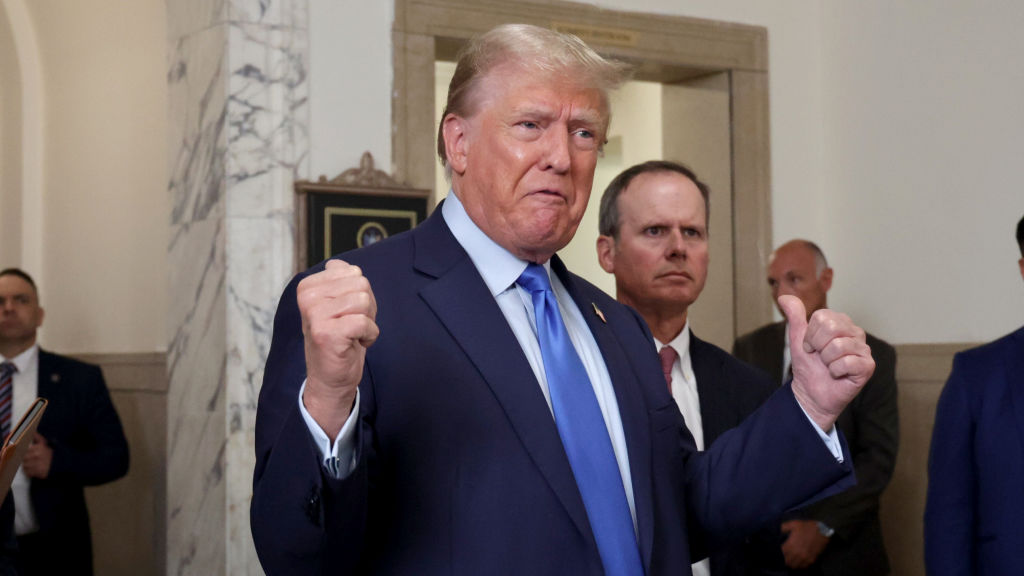
Wisconsin Republican Congressman Bryan Steil is drawing side-eye action from voting rights advocates after pushing legislation that would give voters without an ID one for free to vote. 

Steil was interviewed by Chris Stirewalt on NewsNation’s “The Hill Sunday” and compared requiring ID at voting booths to being carded for buying alcohol. The lawmaker says, “it makes sense.” “If we go and ask folks whether or not you should have photo identification to vote, it’s overwhelmingly popular because it makes sense. And it’s regular in their actual personal life,” he said.

“I go home and buy a six-pack of beer, I get asked for my ID. I want to board an airline, need an ID. Wanna open a bank account, need an ID. I think it’s common sense for the American people to recognize that if you wanna go and vote in an election in the United States of America, you should have a photo ID.” 

His proposed bill, “Make Elections Great Again Act,” claims to “improve voter confidence, bolster election integrity, and make it easy to vote, but hard to cheat.” According to the Wisconsin Examiner, the legislation would require voters in each state to show a photo ID for federal elections and require states to verify that registered voters are U.S. citizens. In addition, Steil wants paper ballots to be required in all federal elections.

The MEGA bill also places harsh restrictions on a person’s ability to collect ballots on behalf of others, banning universal voting by mail and ranked choice voting in federal elections. While Wisconsin Republican Party Chairman Brian Schimming labeled the bill as “a crucial step toward restoring trust in our democratic process,” the executive director of the Wisconsin Democracy Campaign, Nick Ramos, says otherwise. 

“The MEGA Act is a seriously problematic piece of anti-voter legislation. It will disenfranchise millions of voters across the country,” he said. Samuel Liebert, the Wisconsin state director for All Voting Is Local, appears to agree. “This is a sweeping federal takeover of election administration,” Liebert said. 

Wisconsin already passed legislation at the state level similar to Steil’s proposal. In 2011, The Hill reports that the Wisconsin state Legislature passed legislation requiring photo IDs to vote. As a stipulation, the bill outlined how state residents can obtain a free ID from the state’s Department of Transportation to vote. 

The push comes just as House lawmakers are scheduled to vote on the Safeguard American Voter Eligibility (SAVE) Act, which proposes proof of citizenship to register to vote and valid identification to cast a ballot, and it seems voters agree.

A 2025 study conducted by the Pew Research Center found over 80% of Americans, including 71% on the Democratic side, support legislation that would require individuals to show government-issued photo ID to vote, adding to Steil’s narrative that “Our legislation is built on commonsense principles that the American people support.”

RELATED CONTENT: Voter ID Proponents are Ready to Battle

TSA, precheck, DHS, shutdown, tsa agent

Minnesota Protestor Says Her TSA PreCheck Was Revoked After ICE Mobile App Scanned Face

The woman says she did not break any laws.


A Minnesota protestor says her TSA PreCheck was revoked after an ICE Mobile app scanned her face.

Ars Technica first reported the news of the Minneapolis resident and ICE observer getting her air travel status revoked. The woman, identified as Nicole Cleland, says she had her Global Entry and TSA PreCheck privileges stripped from her after she observed the actions of ICE agents in the city.

Cleland lives in the Richfield, a northern suburb city of Minneapolis. Since the ICE raids began, she has volunteered with an organization dedicated to observing immigration agent activity in her neighborhood.

While performing these volunteered duties to protect her community, Cleland began following a white Dodge Ram she believed ICE agents were driving in.

Cleland and a fellow volunteer began driving separate vehicles to follow the ICE agents from a safe distance. But other ICE agent-driven vehicles came along, blocking Cleland and the other volunteer from driving forward.

Cleland filed a formal declaration about the incident with the U.S. District Court in Minnesota on Jan. 21. In it, the 56-year-old recalled how the facial recognition occurred.

“An [ICE] agent exited the vehicle and approached my vehicle. I remained in my vehicle. The agent addressed me by my name and informed me that they had ‘facial recognition’ and that his body cam was recording. The agent stated that he worked for border patrol. He wore full camouflage fatigues. The agent stated that I was impeding their work. He indicated he was giving me a verbal warning and if I was found to be impeding again, I would be arrested,” Cleland wrote.

Here filing was part of a greater lawsuit by Minneapolis residents against the ICE raids and Department of Homeland Security officials.

She asserted that days later she received an email regarding her cancelled Global Entry and TSA PreCheck. However, she says the notification did not list a reason for the revoked status.

“…The only one that makes sense was ‘The applicant has been found in violation of any customs, immigration, or agriculture regulations, procedures, or laws in any country.’ I was not detained, I was not arrested so [it is] difficult to understand how I was ‘found in violation.'”

Cleland aid she believes the revocation directly stemmed from her encounter with the ICE agent. She referred to the matter as an act of “intimidation and retaliation,” despite behaving in accordance with Legal Observer laws.

“I am concerned that border patrol and other federal enforcement agencies now have my license plate and personal information, and that I may be detained or arrested again in the future,” she wrote. “I am concerned about further actions that could be taken against me or my family…I have instructed my family to be cautious and return inside if they see unfamiliar vehicles outside of our home.”

According to the New York Times, Cleland is one of several other U.S. citizens whose faces underwent facial recognition, all without their consent. The app completes this facial recognition through the help of Clearview AI. The tech company also told Ars Technica that it initially helped the DHS’ “child exploitation and cyber crimes investigations.”

But a contract renewal reveals that ICE also uses the tech to investigate “assaults against law enforcement officers.”

RELATED CONTENT: Steve Bannon Says ‘Damn Right’ ICE Will ‘Surround the Polls’ 


Method Man, photographer, super bowl

Method Man Returns As Official NFL Photographer For The Super Bowl

He also took the field last year at a New York Jets game.


Wu-Tang Clan member Method Man has achieved success in several aspects of entertainment, and now he is adding photographer to his list of titles, as he attended the Super Bowl as an official NFL photographer.

Although it’s not his first time serving as an NFL-approved photographer (he did so for the New York Jets in November 2025), it’s his first time doing so at the Super Bowl.

The man born Clifford Smith, Jr. became known to the world through his lyrical skills and vocal prowess as a member of Staten Island’s Wu-Tang Clan, becoming the first member to release a solo single on the self-titled “Method Man.” After being one of the popular, if not the most popular, emcees in the hip-hop collective for decades, he entered the acting world and has been working there ever since.

But now, it seems that acting and rhyming are just two of the skills he possesses as he has placed himself behind the camera.

According to Rock the Bells, during the New York Jets-Cleveland Browns game on Nov. 9, he was on the football field taking pictures as part of the NFL Celebrity Photographer Series. He joins other celebrities who have taken photographs on the sidelines of NFL games, including Kevin Durant, Marshawn Lynch, and Ken Griffey Jr.

The “Ice Cream” rapper showcased his photography skills on the field on his YouTube channel after covering the Jets game (who achieved a rare victory that day, winning 27-20, as they had only won three games all season).

Method Man continues his acting career in the meantime, as he is currently starring in a romantic comedy with another recording artist, Kelly Rowland. The movie “Relationship Goals” also stars Robin Thede, Annie Gonzalez, and Dennis Haysbert and is currently available on Prime Video.

RELATED CONTENT: A Look At Black Historical Halftime Performances On Super Bowl Sunday

Child Abuse, Arrest

Woman Receives $100K Settlement 3 Years After Premature Baby Died While She Was In Custody

The baby died in August 2022.


A woman whose premature newborn died in 2022 after she gave birth at the county jail in downtown Syracuse, New York, has received $100,000 from Onondaga County.

The family of Cheree Byrd reached the settlement more than three years after her traumatic labor at the Onondaga County Justice Center, Syracuse.com reports.

Byrd was being held on a misdemeanor petit larceny warrant, which was later dismissed by Syracuse police, when she went into labor and gave birth on Aug. 2, 2022, to a premature girl who was later pronounced dead after receiving medical care.

In a lawsuit filed in September 2023 against the county, the Onondaga County Sheriff’s Office, then-Sheriff Eugene Conway, and jail medical providers NaphCare and Proactive Healthcare Medicine, Byrd said that her baby would have survived had she received proper medical care.

Byrd, who was three months pregnant at the time of her arrest on June 1, 2022, claimed she was forced to go through labor alone in her cell for hours before receiving medical care, claiming correctional officers and jail medical staff delayed treatment, ignored clear warning signs of serious complications, and dismissed her reports that she was in labor.

According to the lawsuit, Byrd repeatedly told jail staff for days that she was in pain, bleeding, and in labor but was given only Tylenol and tampons.

On Aug. 2, despite being placed in an observation cell due to a history of premature labor, she said officers dismissed her pleas for help after her water broke. A deputy later found her in active labor during routine rounds. An ambulance was called, and Byrd gave birth shortly afterward. The newborn was taken to Upstate University Hospital, where she was later pronounced dead.

The lawsuit accused jail staff of failing to take Byrd’s concerns seriously, arguing that proper care could have prevented the premature birth.

NaphCare, which provided medical services at the jail at the time, was replaced after its contract ended in 2023. It had been cited by state regulators for care deficiencies following a 2021 inmate suicide. Byrd’s family also reached a separate settlement with Proactive HealthCare Inc., a NaphCare subsidiary.

“We are deeply saddened by these events and wish Ms. Byrd and her family health and healing in moving forward,” a NaphCare spokesperson said in a statement. “NaphCare previously reached a settlement in this case, the terms of which are confidential.”

RELATED CONTENT: Cori Broadus, Snoop Dogg’s Daughter, Mourns Loss Of 10-Month-Old Baby Girl

FAMU, Florida A and M University,DI, Black History Month

FAMU Law Student Says HBCU Axed ‘Black’ In Black History Month Flyers Over DEI Concerns

A FAMU Law student called the issue "insane" given the school's status as a Historically Black institution.


A Florida A&M University law student says the HBCU refused to signify the word “Black” in flyers for a Black History Month event.

The HBCU, like other public colleges and universities in Florida, has faced severe restrictions since the state passed anti-DEI legislation. Since then, the school has had to comply with state regulations and refrain from using any allocated funding for diversity, equity, and inclusion programs.

Given this, FAMU has opted not to promote the “Black” elements of Black History Month, an issue that has sparked discord with its Black Law Students Association. While seeking approval for certain event flyers, one student leader says she faced significant pushback on words central to Black History Month programming.

“It was ‘Black,’ ‘affirmative action,’ and ‘women’ as well,” explained Aaliyah Steward, a third-year law student at FAMU’s College of Law and organizer for its BLSA to News6.

Steward called the matter “insane,” especially given FAMU’s own status as a historically Black institution. Now, she must contend with how to promote the “Black” part of its Black History Month activities.

“We couldn’t use the word ‘black’ in Black History Month. We would have to abbreviate it,” said Steward. “I was very angry and baffled because this is a Historically Black College and University, and for them to say we can’t use the word ‘black’ was kind of insane.”

Florida was one of many states that not only complied with federal regulations on DEI but also promoted efforts to limit DEI initiatives in public schools through legislation passed in 2024. This news extended even to its racially uplifted institutions like Florida A&M and Bethune-Cookman University.

However, the current regulations feel like censorship to Steward, who just wants to celebrate and recognize Black History Month as many have in previous years.

“I just don’t want us to be censored this way. Not being able to use the word ‘black’ is very frustrating,” she said.

FAMU, on the other hand, has released a statement on the matter. The HBCU confirmed its “full compliance” and “support” of the DEI-specific policies implemented by the state’s Governor and Board of Governors.

“We support and have implemented the policy direction established by the Governor, the Legislature, and the Board of Governors as it relates to DEI, and consistent with related federal court rulings,” wrote the HBCU.

Its statement added, “Florida Agricultural and Mechanical University (FAMU) is committed to fostering a campus community that encourages the free exchange of ideas while ensuring an environment of mutual respect, safety, and awareness. The University recognizes that freedom of expression is fundamental to academic inquiry, personal development, and civic engagement.”

While the school seems adamant about adhering to statewide standards, Steward is adamant about promoting the Blackness of Black History Month. She has resubmitted her flyer with no changes to its original wording, hoping the school will allow her to promote the event’s initial vision of upholding diversity and inclusion.

As for FAMU, the school did not explain why administrators initially marked the flyer for changes.

RELATED CONTENT: Celebrate 100 Years Of Black History Month With These Events 

Drake, rapper, drake curse, super bowl bets, betting, gambling

The Drake Curse Lives On As Canadian Rapper Loses $1M Betting On New England Patriots

Drake loses betting on the underdog.


Drake has been suffering losses lately, with the infamous “Drake Curse” still in full effect: Another sports bet has come up short for the Canadian rapper, as he went for a New England Patriots victory in the Super Bowl.

Aubrey Graham, once again, showed the world (via social media) that he was placing a $1 million bet that the Patriots would win Sunday’s Super Bowl against the Seattle Seahawks.

But, as short-sighted as Drake has been over the past few years, he wrote on his Instagram post, “Bet against me if you dare 😂😂😂” 

As the Patriots were underdogs (for good reason), he would have cashed in close to $3 million, according to the Instagram post, as he placed the bet through Stake, with which he has a partnership. The Seahawks won convincingly, 29-13.

The “Drake Curse” dates back years, as people have called his bets almost sure losing propositions. Drake’s betting habits have drawn widespread attention because of a popular belief that the teams or athletes he supports often lose. The phenomenon, commonly referred to as the “Drake curse,” has been cited by media outlets over the years and closely followed by fans, who react with equal parts amusement and frustration whenever the rapper publicly backs a competitor or places a high-profile wager.

Last year, according to The Toronto Star, Drake reportedly wagered $1,150,000 on the Kansas City Chiefs in last year’s Super Bowl against the Philadelphia Eagles. The Eagles blew out the Chiefs, 40–22.

However, the “curse” took a year off in the 2024 Super Bowl, when he doubled his money after wagering $1.5 million that the Chiefs would beat the San Francisco 49ers. The Chiefs won 25-22 in overtime, allowing the OVO label owner to take home $2.3 million.

The Drake Curse counts the following as victims: tennis legend Serena Williams, boxer Anthony Joshua, the Toronto Raptors, MMA fighter Conor McGregor, the Kentucky Wildcats, the Baltimore Ravens, and the Golden State Warriors, to name a few.

RELATED CONTENT: Malcom Butler On How That 2015 Super Bowl Interception Changed Everything

no kings, protests, trump

‘I Will F***ing Kill You’: Indianapolis Police Officer Investigated After Threatening 17-Year-Old Anti-ICE Protestor

The victim's mother called the officer out for racial profiling.


An Indianapolis Metropolitan Police Department (IMPD) officer is under investigation after a viral video revealed he threatened to kill a 17-year-old Black boy after being pulled over for his car allegedly smelling like marijuana. 

The Feb. 6 video shows Trevion Taylor questioning why officers were pulling him over at a gas station. The Indianapolis Star reports his mother, Ambar, said her son was going to meet friends who were participating in an anti-ICE protest close to his alma mater, Warren Central High School.

Taylor, who graduated from high school early, noticed a police car following him He pulled over and followed protocol. He also put his phone on the dashboard and captured the encounter on video.

“We’re gonna get you out here. So when you get out, I’m gonna pull you out, I want you to put your hands on top of the car, OK?” the unidentified officer was heard saying.

Taylor asked why.

“The car smells like weed. Step out of the car,” the officer responded before he is seen opening Taylor’s car door and grabbing his wrist.  “I will f—ing kill you. Do you understand me?”

As Taylor was being searched, the officer can be heard saying the young man had a gun. 

After posting the encounter on Facebook, Ambar called the officer out for racial profiling. “He’s a young Black man. You’ve seen the news 100 times,” the mother said. “My son will not be a victim.”

A statement from IMPD paints a different picture.

As officers were monitoring the protest, officers claim Trevion was pulled over after allegedly seeing a juvenile get in with a gun. But he wasn’t stopped until the victim allegedly failed to use signals during a lane change.

“While the video does not show the entire incident, some of the language heard does not reflect the standards or values of IMPD. Accountability is essential to building trust and legitimacy with our community,” the statement, posted on X with alleged evidence, read. 

“The involved officer was equipped with a body-worn camera, which recorded the incident. An internal review is underway to determine the full circumstances of the encounter, including the statements captured on video.”

Officers of the Indiana-based police department have been the subject of a number of investigations relating to misconduct and harassment involving Black people. In 2025, a woman filed a complaint alleging an officer pulled her hair, tearing several braids from her scalp, during an encounter. 

Another officer was found guilty of violating the civil rights of Jermaine Vaughn, who was kicked in the face while being handcuffed.

On social media, users seem to be on the side of Taylor and the other youths that were in the car. “I hope his parents and every parent that son was in that car sues them,” @toilove_ wrote on Instagram. 

Other users called for the officer to be terminated. “He also needs to be charged with negligence, terroristic threat act, and racial profiling,” one user wrote.

RELATED CONTENT: Steve Bannon Says ‘Damn Right’ ICE Will ‘Surround the Polls’ 

grand rapids, police, teen, mother

Man Survives Home Invasion After Flashing Fake Money On Facebook

The 64-year-old admitted that the picture was a fake post and he did not have the money.


Being called broke led a 64-year-old man to post a photo of a stack of cash, prompting a home invasion by thieves who hoped to steal what he had posted.

Anthony McNary of Indianapolis man said he admitted that the Facebook post was fake, and he did not have the cash, leading him being beaten and shot in the back of his neck, FOX 59 reported.

“He just stuck the gun to the back of my head and pulled the trigger. I couldn’t believe it. Over a fake post,” said McNary, who spent several days in the hospital.

It all started when the two men saw McNary’s Facebook post two days before the attack. The photo was from an old Facebook memory he previously posted. McNary said the two men were wearing tactical vests with “police” on the front and back.

They told him that there were police officers when they confronted him.

According to McNary, one of the men said, “Where’s the money at? Where’s it at? I seen what you posted on Facebook. Where’s the money at?’”

McNary told the men that “it was a prank” and that the post was fake. When the men realized there no money in the home, they pistol-whipped and choked him. Then that’s when one of them placed the gun, execution-style, to the back of McNary’s neck and pulled the trigger.

Shortly after being shot, police officers arrived and rushed McNary to the hospital.

“I said to myself, ‘I’m about to die over a fake post.’ That’s what I was saying to myself,” said McNary.

The suspects have yet to be identified, and the Indianapolis Metropolitan Police Department said the case is active.

Anyone with information can call 317-262-TIPS (8477) to remain anonymous.

RELATED CONTENT: NRA Has Entered The Chat, Condemning ICE’s ‘Dangerous and Wrong’ Narrative After Deadly Minnesota Shooting 

Bad Bunny, Super Bowl, trailer

While Viewers Gushed Over Bad Bunny Super Bowl Halftime Show, Trump Calls It ‘One Of The Worst’ In Social Media Rant

Trump called the performance a "slap in the face" to America, despite Bad Bunny hailing from Puerto Rico.


President Donald Trump has continued his tirade against Bad Bunny’s Super Bowl Halftime show.

To little surprise, the President had choice words to say about the Puerto Rican singer’s performance. Given the Latino artist’s Spanish-heavy set, which nodded to his Boricua heritage and the diverse Latin culture, Trump condemned the performance as a “slap in the face” to U.S. youth and English speakers.

On a rant to Truth Social, Trump wrote a lengthy note critiquing Bad Bunny’s showcase of the Latino community, coinciding with a time where this group has become a target of ICE raids and deportation.

“The Super Bowl Halftime Show is absolutely terrible, one of the worst, EVER! It makes no sense, is an affront to the Greatness of America, and doesn’t represent our standards of Success, Creativity, or Excellence. Nobody understands a word this guy is saying, and the dancing is disgusting, especially for young children that are watching from throughout the U.S.A., and all over the World,” began the President.

The show was a portrayal of Puerto Rican life from beginning to end, with Bad Bunny emphasizing that this community is part of the U.S. and the Americas at large. While intended as a display of Latin heritage, culture, music, and unity for all, the President belittled the historic performance as “nothing inspirational.” On an off-topic note, he concluded his social rant by proposing a rule change for next year’s big game.

“This “Show” is just a “slap in the face” to our Country, which is setting new standards and records every single day — including the Best Stock Market and 401(k)s in History! There is nothing inspirational about this mess of a Halftime Show and watch, it will get great reviews from the Fake News Media, because they haven’t got a clue of what is going on in the REAL WORLD — And, by the way, the NFL should immediately replace its ridiculous new Kickoff Rule. MAKE AMERICA GREAT AGAIN! President DONALD J. TRUMP,” he concluded in the post.

Trump’s disinterest in Bad Bunny’s Super Bowl Halftime Show performance should come as no surprise, especially since Trump supporters opposed the idea from the start. As Bad Bunny primarily sings in Spanish and hails from the U.S. territory of Puerto Rico, many MAGA affiliates felt his inclusion was too “un-American.”

Instead, the MAGA movement decided to create its own alternative to the halftime show. Produced by Turning Point USA, a conservative organization founded by the now-deceased Charlie Kirk, the “All-American Halftime Show” sought to provide patriotic entertainment in lieu of Bunny’s his diverse celebration. Headlined by Kid Rock, Brantley Gilbert, Lee Brice, and Gabby Barrett, the show welcomed those who refused to listen to the 2026 Grammy Album of The Year winner and his highly-anticipated set.

While some tuned in to that show, which was streamed only on various conservative networks, Bad Bunny’s Halftime performance is expected to have secured over 100 million viewers across American households, according to Yahoo Entertainment. The most-streamed artist on Spotify performed many songs from his Grammy-winning album, “DeBÍ TiRAR MáS FOToS.”

The performance also featured guest singers such as Ricky Martin and Lady Gaga, with appearances by Cardi B, Karol G, Pedro Pascal, and Jessica Alba among those dancing on the lush green stage reminiscent of Puerto Rico.

report, Blackness

11 Black Power Songs To Get You Hype For Black History Month

Black history has never moved in silence


Black history has never moved in silence; it’s marched, chanted, and sung through generations of resistance, pride, and unapologetic joy. Black power music serves as cultural documentation and motivational fuel, tracing its evolution from Civil Rights-era declarations to contemporary hip-hop protest lines. The songs transcend entertainment value and function as audible timelines that document liberation alongside identity and collective resilience. Spanning decades, musicians used their music to drive movements and honor Black excellence. These 11 songs showcase music’s motivational spirit and transformative power to empower individuals. The songs both affirm Black identity and challenge injustice while amplifying joy and resilience. 

“Say It Loud – I’m Black and I’m Proud” — James Brown (1968)

James Brown’s song “Say It Loud – I’m Black and I’m Proud” is a militant celebration of Black pride that transformed identity language during the late 1960s. The song was recorded in Los Angeles with local youth on the call-and-response chorus and released in 1968 after the death of Dr. Martin Luther King Jr. The song transformed “Black” into a positive identity term and became an unofficial anthem of the Black Power movement and “Black is Beautiful” cultural shift.

“BLACK PARADE” — Beyoncé (2020)

Beyoncé Knowles-Carter, a global pop and cultural icon, released her album BLACK PARADE on June 19, 2020, Juneteenth, the holiday that marks the end of slavery in the U.S. The album unites Black culture with joy and resilience while promoting activism and economic empowerment. Beyoncé chose to release the album during the nationwide racial justice protests that occurred after George Floyd’s murder. Beyoncé organized the album release to direct proceeds toward her BeyGOOD Black Business Impact Fund, which supports Black-owned businesses. She also created a directory to showcase Black-owned brands.

“Fight The Power” — Public Enemy (1989)

Public Enemy released the 1989 hip-hop protest song “Fight the Power” to confront systemic racism and cultural erasure. Through their leadership, Chuck D and Flavor Flav created a generational anthem that combined Black musical heritage with direct social commentary and activist power. The song and video depicted Black urban struggles in Brooklyn, New York, and served as a central part of Spike Lee’s film, Do the Right Thing

“To Be Young, Gifted And Black” — Nina Simone (1970)

The song “To Be Young, Gifted and Black” was written by Nina Simone in 1970. Simone created this inspirational song to honor playwright Lorraine Hansberry while working as a singer-songwriter and activist. The song honors Black youth alongside their potential and cultural power while teaching Black listeners that talent, intellect, and pride are their natural possessions. The song debuted in the late 1960s and was recorded live in 1970. 

“Glory” — Common & John Legend (2014)

In December 2014, the powerful civil rights anthem “Glory” debuted in the Oscar-nominated film about the 1965 Selma-to-Montgomery voting rights marches. Common and John Legend perform together on this track, combining hip-hop elements with soulful melodies to produce an emotional impact. Through historical Southern civil rights events, the song “Glory” links current justice movements with the need for ongoing unity to achieve equality.

“Alright” — Kendrick Lamar (2015)

The rapper Kendrick Lamar from Compton, California, produced the song “Alright” in 2015. The song’s chorus transformed into a strong protest chant at Black Lives Matter demonstrations. The track from the 2015 album To Pimp a Butterfly gained widespread attention during protests against police violence. The song’s repeated declaration “We gon’ be alright” provided hope and unity during difficult times.

“Black Like Me” — Mickey Guyton (2020)

Mickey Guyton released her song “Black Like Me” in June 2020, during nationwide protests against racial injustice. The song presents a straightforward, individual analysis of racial problems and social inequality in America while challenging the white majority within country music. Through her song, Guyton brought fresh perspectives on racial understanding and equality to a musical genre that had rarely included Black artists, thereby establishing a revolutionary platform for these themes.

“Brown Skin Girl” — Beyoncé (2019)

The song “Brown Skin Girl,” which celebrates Black beauty and pride through its radiant lyrics, came out in 2019 as part of The Lion King: The Gift album. The song features Beyoncé, Blue Ivy, SAINt JHN, and Wizkid and draws on Black diasporic culture worldwide. The song “Brown Skin Girl” became a major musical work that celebrated melanin and representation, empowering Black women and girls worldwide.

“Umi Says” — Mos Def (Yasiin Bey) (1999)

The song “Umi Says” by Mos Def, now known as Yasiin Bey, delivers a soulful message about self-affirmation, peace, and life purpose. The track appeared on Bey’s 1999 solo debut album, Black On Both Sides, and combines hip-hop with neo-soul elements that mirror the Black artistic movement of the early 2000s. Through his avant-garde rap and acting, Bey conveys a guiding message about maintaining internal stability amid external turmoil.

“Brown Skin” — India.Arie (2001)

The album Acoustic Soul, released in 2001, features the soulful ballad “Brown Skin” performed by India.Arie. Through her strong vocal performance, India.Arie delivers a powerful message about self-acceptance and worth. The song “Brown Skin” has become a powerful anthem of Black self-love, celebrating personal beauty and individual identity, even though it was not written as a protest song.

“The Revolution Will Not Be Televised” — Gil Scott-Heron (1971)

In 1971, poet-musician Gil Scott-Heron released the spoken-word manifesto “The Revolution Will Not Be Televised.” The song required viewers to participate actively in social transformation during the early years of the Black Power movement, rather than passively consuming media. The song thoroughly engaged black intellectual and artistic communities across the United States, delivering a prophetic critique that brought cultural awareness to political urgency and motivated multiple generations of artists and activists.

RELATED CONTENT: Black History In The Homes Dr. Martin Luther King Lived In

×