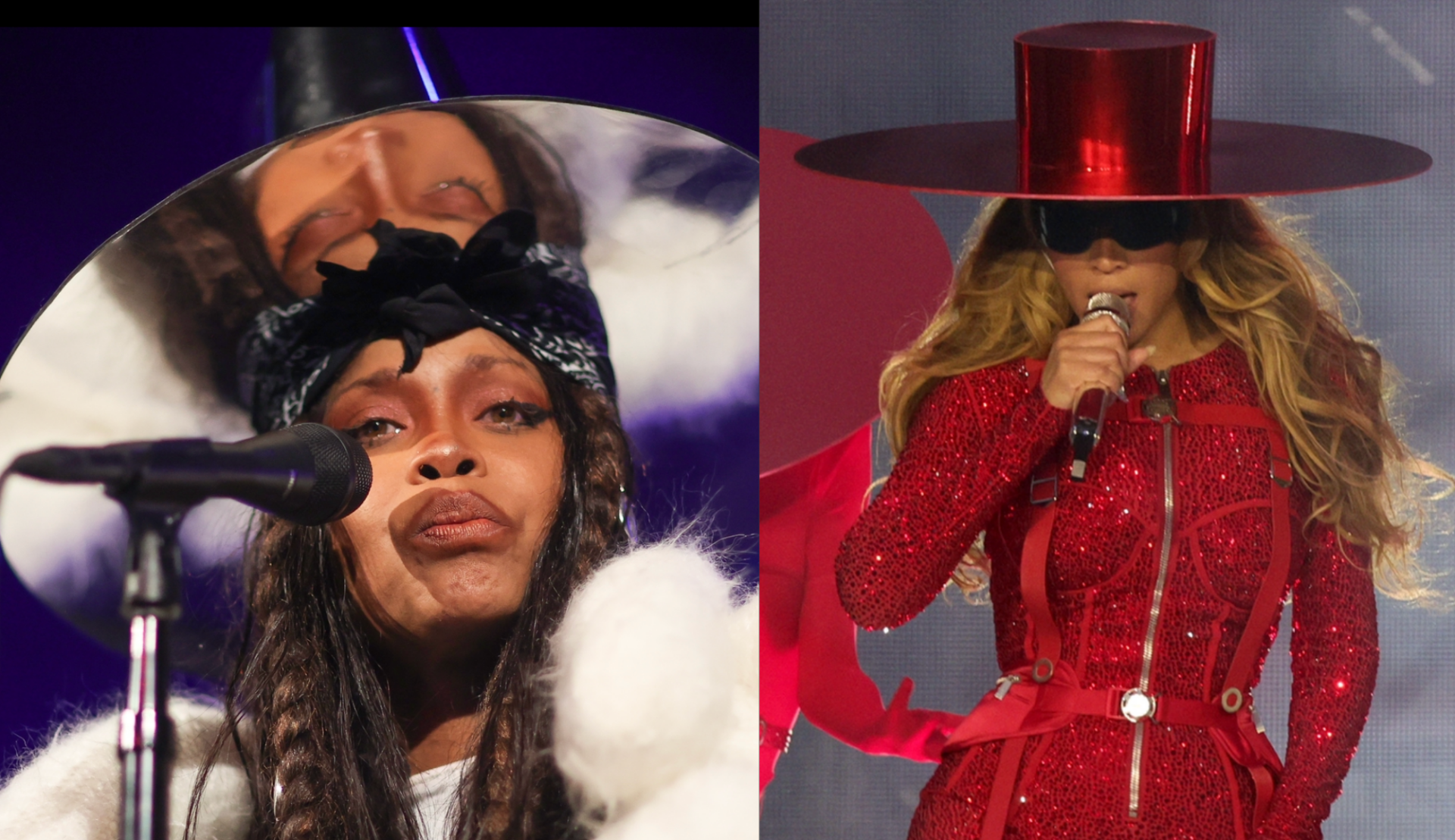
Did Erykah Badu Shade Beyoncé For Biting Her Style With Renaissance Tour Outfit?
One of Beyoncé’s outfits during her recent Renaissance tour stop looked slightly familiar to another music icon, Ms. Badu herself.
Erykah Badu hopped on Instagram to comment on an outfit Queen Bey wore at MetLife Stadium in New Jersey, TMZ reports. Beyoncé sported a bedazzled jersey dress with a larger-than-life hat, something Badu is known for wearing. “I’m flattered,” she wrote in the comment section under the post. She continued to post the picture on her IG story with “Hmmm” written on the bottom.
She continued with another post of her wearing a similarly styled hat with the caption, “I guess I’m everybody’s stylist.”
Members of the Beyhive jumped to their Queen’s defense in the comments, stinging Badu with some pushback. “You know she’s been wearing this hat since the Formation tour. So technically……,” one fan wrote. Another credited super producer, Pharrell, as being the originator of the big hat club. “Nah it’s a Pharrell original… he was doing it long before Erykah,” they said.
There is room at the table for artists to wear similar hats as both Beyoncé and the “Window Seat” singer are credited for being pioneers in the industry for their music and wardrobe style. Beyoncés oldest daughter, Blue, rocked the same outfit as her superstar mom while she shared the stage with her.
Badu has been making headlines on her “Unfollow Me” tour with supporting act Yasiin Bey, formally known as Mos Def. She’s been giving flowers and recognition to several of today’s hottest artists during her tour stops, including rappers Trinidad James and Lil’ Baby and Teyana Taylor, who is working on production for Lil’ Baby’s sold-out shows. But most recently, her attention is on They Cloned Tyrone star John Boyega, who she defined as her crush at her Atlanta show, calling him to join her on stage.
More Black Men Turn To Therapy And Mindfulness To Channel Healing
Mental health has traditionally been frowned upon in Black households over the years, but recent studies show that that trend is slowing down, and more people are seeking therapy to deal with their issues.
According to Capitol B News, more Black men have been going to therapy and utilizing other means to cope with modern-day problems affecting their mental state. Studies show that Black men are four times more likely to commit suicide than Black women. That alone is one of the leading causes of death for young Black men. Another study reveals that based on what society expects of Black men, particularly regarding education and income, the risk of depression decreases for Black women and white people. Not so for Black men. Due to the expectations associated with that, Black men don’t typically reach out for help.
Recently, more Black men are going to professional therapists and taking better care of their mental health using tools like meditation, mindfulness, and massages, fighting against stereotypes and narratives that have afflicted Black men for many years. Approaching mental health issues is becoming part of coping with the Black community’s everyday struggles.
“It makes you build a wall subconsciously,” says Eric Warren Jr., a Los Angeles-based therapist. “For so long historically, we had to be extremely strong.”
Some men have started tapping into what is not considered “normal” for Black men, at least not until now. Activities like yoga, taking time for themselves (alone time), going to spas, and having talks with others to let off some steam is becoming a part of some Black men’s routines to cope with the daily issues faced, primarily when Black boys are taught to be tougher and not show any emotions, or they are deemed “soft.”
From Classroom to Boardroom, Gilead is Supporting Black Economic Advancement
For many Black people in the U.S., experiencing racial inequities in education, economic opportunity and access to resources is a fact of life. These inequities often have life-long impacts that become apparent early in life andpersistthrough adulthood and career.
Gilead Sciences, a California-based biopharmaceutical company, believes addressing inequities across all of these spheres is essential to improving health outcomes.The organization’s history of transformative work across HIV prevention and treatment means they are no strangers to supporting marginalized groups and disinvested communities – communities where resources like housing, healthcare facilities, schools and grocery stores have been intentionally withdrawn.Itsbusiness strategy, company leaders say, places the same emphasis on health equity as it does on scientific research and manufacturing.
Gilead doubled down on this strategy in 2020 with the creation of its Advancing Health & Black Equity function, which employs a team dedicated to shepherding the organization’s efforts to expand health access, eliminate barriers to care and combat inequities for marginalized and disinvested groups.The company has also made a specific commitment to Black equity, which itdefines as the attainment of social, economic and health justice for Black individuals and communities.
In service of this commitment, Gilead chairman and CEO Daniel O’Day and executive Vice President of Corporate Affairs and General Counsel Deborah H. Telmanrecently headlined a session during the Global Black Economic Forum’s Global Business Summit. Held in conjunction with the 2023 ESSENCEFestival of Culture, the summit brought together a global group of business executives and thought leaders – which included Vice President of the United States Kamala Harris and former President of Liberia Madame President Ellen Johnson Sirleaf – to discuss topics relevant to Black economic opportunity, mobility and advancement.
In a session titled “The Future of Healthcare, the Impact on Black Lives & the Role of Corporations in Advancing Economic Equality,” Telman and O’Day spoke with moderator and CNBC anchor Frank Holland about how Gilead’s work to build a diverse workforce and address health inequities is critical to their business success.
Telman kicked off the session by setting a definitive tone. Directly in the wake of the Supreme Court’s ruling to strike down affirmative action in college and university admissions which was announced the morning of the summit, she stated “we know there are many social determinants of health, and education is certainly one. We feel strongly as a science-based company that we need diverse team members. Broad swaths of people around the table to help us with our innovation. So, we did file an amicus brief with some other science and technology companies when the decision was announced.”
Gilead strongly asserts that innovation and health equity must be prioritized together. The diseases Gilead seeks to treat, and one day cure, O’Day explained to the audience, disproportionately affect Black communities.Both he and Telman cited statistics highlighting the extent of racial healthinequities across HIV and cancer. These include the alarming fact that Black people represent 42 percent of new HIV diagnoses despite making up only 14 percent of the U.S. population and that Black women have a lower incidence rate of breast cancer than White women, but a 40 percent higher breast cancer death rate.That data, O’Day said, makes it clear health equity is a business imperative for the pharma company.
The CEO also spoke about how a diverse workforce enables the organization to meet its business objectives. In particular, he highlighted Gilead’s Advancing Black Leadership Strategy, a multi-year initiative to recruit, retain, and advance Black employees– which the company says is the largest private sector program of its kind. He also mentioned Gilead’s role as a founding member of OneTen, a coalition of business leaders aiming to hire, promote, and advanceone million Black individuals who do not have a four-year degree into family-sustaining careers over the course of ten years.
“We rely on a diverse workforce to come up with the types of cures that we work on every day,” O’Day said.
“What Gilead is doing is scientifically attacking society’s most intractable problems. You can’t do that with a group of like-minded people sitting in a room.Diversity is fundamental and core to how we come up with medicines and equally important to how we develop strategies for breaking down stigma and discrimination.”
Tony Mitchell, director, State Government Affairs, Southern Region at Gilead was proud to see O’Day and Telman amplifying Gilead’s health equity commitments in front of an audience of prominent global leaders.
“As a company, Gilead understands our responsibility to patients extends far past the pharmacy counter,” he said.
“We recognize the need to create a landscape where disparities areminimized, and access is maximized.For example, by amplifying the need for policy change and educating our lawmakers, we have the unique opportunity to change stigmatic narratives around people living with HIV. These are essential elements to chipping away at the structural barriers that perpetuate the HIV epidemic.”
President and CEO of Global Black Economic Forum Alphonso David also noted the importance of Gilead’s leadership in addressing factors, like stigma, that contribute to health inequities. Citing a Deloitte report that estimates the cost of unaddressed health inequitiesin the U.S. will eclipse $1 trillion by 2040, he emphasized the critical need for other Fortune 100 companies to follow Gilead’s lead and leverage their resources to address the root causes of inequity.
“Advancing health equity begins with interrogating and addressing social determinants of health,” David said.
“As we consider the future of healthcare and the impact on marginalized communities, it will be essential fororganizations like Gilead to lean into addressing root causes that exacerbate inequality in order to improve global public health outcomes.”
Education is certainly one of those root causes. According to a report from the National Academies of Sciences, an extensive body of research shows a clear link between the level of education a person has achieved and health indicators such as life expectancy and access to health services.To address this critical connection, Gilead created a workstream specifically aimed to advance health equity through academic and community partnerships. These partnerships have two main goals: to diversify the healthcare workforce, particularly within Gilead’s primary therapeutic areas, and to expand the company’s health equity footprint by developing programs that connect Gilead with students, faculty, and communities who can advocate for a more equitable system of health.
The partnerships also build on a wealth of support Gilead has provided to HBCUs and minority-serving institutions over the past several years. Following the murder of George Floyd in 2020, Gilead launched the Racial Equity Community Impact Fund (RECIF) to support organizations working to tackle racial inequities affecting Black communities across the U.S. The fund provided 20 organizations, including six HBCUs, with $10 million in grants.Additionally, the Gilead Foundation announced the creation of the $20 million Creating Possible Fundin 2022 to support creative and high-impact strategies that advance health through education equity, with a main focus on building a pipeline of Black health leaders.”
As a testament to the organization’s commitment to addressing inequities in education, following the Global Black Economic Forum Summit, Gilead leadership spent the afternoon at Xavier University of Louisiana, an inaugural Creating Possible Fund grantee and a partner in a three-year, $4.5 million collaboration to address the inequities of HIV care for Black communities in the Southern United States. The visit gave Gilead leaders the opportunity to learn more about the University’s work to advance equity as partners of Gilead and the Gilead Foundation. In return, Xavier students, faculty, and staff heard from Gilead about the importance of diversifying STEM fields and increasing the number of Black leaders in those fields.
“We appreciate the investment and partnership of Gilead Sciences,” said Dr. Reynold Verret, president of Xavier University of Louisiana. “Their commitment to developing the next generation of diverse scientists allows us to continue to address the disparities in healthcare that must be resolved so all people receive the care they deserve.”
Mitchell, who also attended the session at Xavier, sees Gilead’s work with HBCUs and other academic partners as a natural extension of the company’s equity and access work, and is excited to see what comes next. “Our work is so important to ‘creating possible’ for those who never knew it existed. Not only are these strategic partnerships important as we elevate communities, they provide a unique opportunity to build future champions for the work we have ahead.”
Cardi B Now Suspect In Battery Following Mic Throwing Incident In Las Vegas
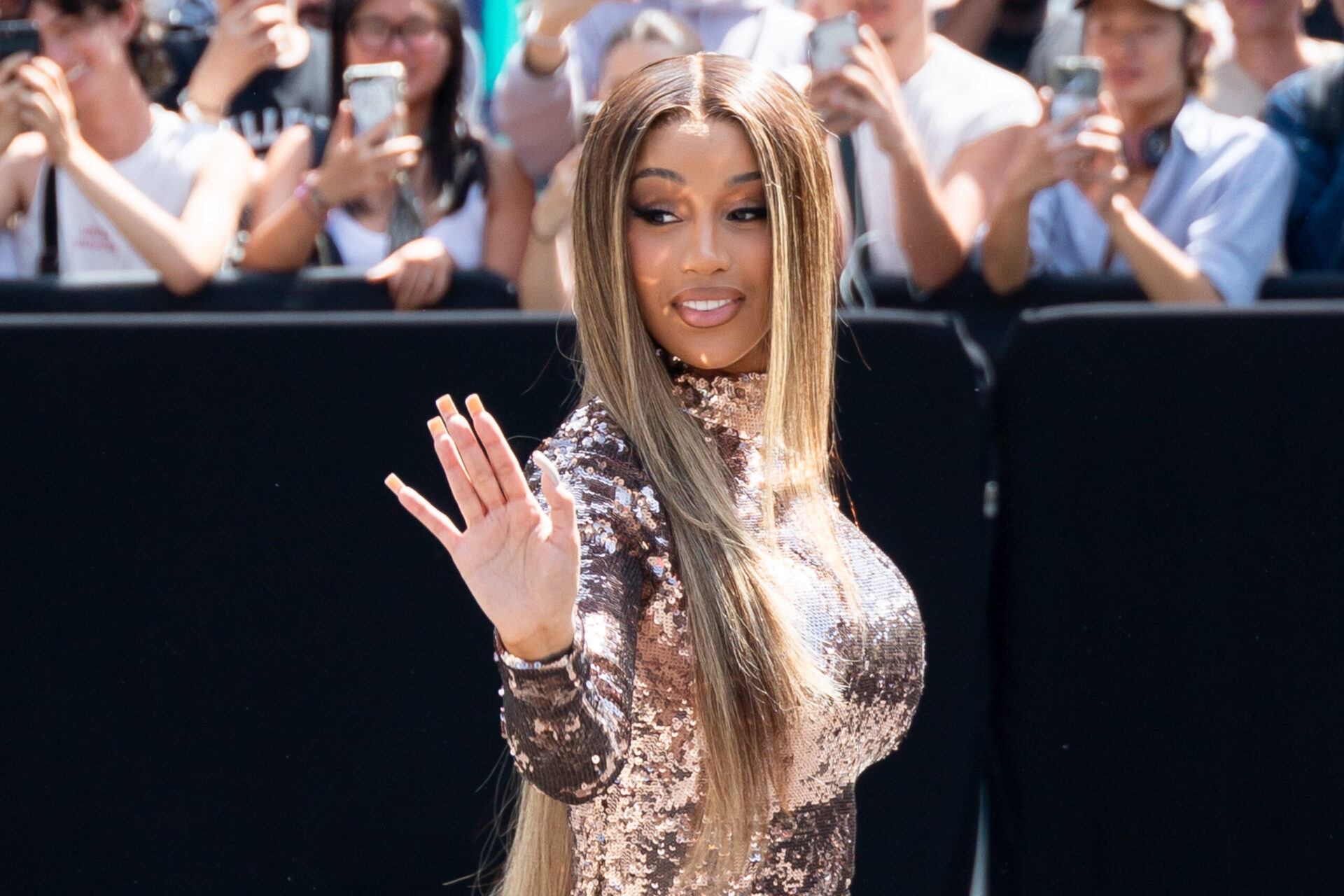
Cardi B became the latest musician to have an item thrown at them onstage during a performance. The 30-year-old “WAP” singer performed at Las Vegas hotspot Drais on Saturday, July 29, and was stunned when an audience member threw a liquid onto the stage, drenching her outfit and hair; she quickly retaliated by throwing her microphone at the concertgoer.
Now, the Bronx-born rapper may have to answer for her actions.
According to TMZ, the woman who was struck by the microphone reported the incident to the Las Vegas Metro Police Department, and now Cardi B may have a battery charge on her hands. In a viral video, the mother-of-two is seen hurling the microphone into the audience; however, with a growing list of celebrities who have had flying objects injuring them during their live shows, many fans and commenters understood her swift actions.
The growing trend is dangerous and frowned upon by entertainers and concertgoers alike.
Other rappers have also had recent run-ins with unexpected items aimed at them from the audience. During his, It’s All A Blur tour, the Toronto-born superstar Drake has been met with everything from women’s underwear to a purse with a fan’s personal items inside, including her identification. “You didn’t think this through,” he said while inspecting the handbag. “Put It On Da Floor” rapper Latto was also seen threatening to enter the crowd after an item was thrown at her during a performance at the Rolling Loud Festival in Germany on July 9. After the object is seen flying toward her, the 24-year-old tells the fan, “I will beat your a**” before continuing her performance.
It’s unclear what venues plan to do to crack down on the throwing of objects at performers. With heightened security around the size of bags and other requirements, there seems to be a need for even more precautions.
Here’s How Black Banks Are Tapping Into Banking Giant To Make A Difference
For many decades, Black Americans have not obtained much help in gaining access to financial services. But some minority depository institutions, or MDIs, are stepping up to help change that crisis with an investment and financial backing of the nation’s largest bank.
Take Citizens Trust Bank, which deployed over $93 million last year, of which 72% supported low-to-moderate income (LMI) communities it serves. The extra funding allowed the bank to broaden its reach, amplify the type of products and services it offered, and expand into other markets serving minority areas.
Another MDI, Carver State Bank, reports 91% of its loans in 2022 were dispersed into minority communities, including 71% in LMI communities. The bank says 27% of its lending went to affordable housing projects in communities that need them, while 21% went to local minority-owned small firms. Citizens Trust and Carver State are based in Atlanta and Savannah in Georgia, respectively.
They are among more than 15 MDIs. JPMorgan Chase states the bank has invested more than $100 million over the last two years, more than doubling its original pledge. All told, those MDIs serve about 90 communities in 19 states and the District of Columbia.
While MDIs play a critical role in providing underserved areas financial services, a reported 25% have vanished over a decade. Forces like mergers and acquisitions, access to capital needed to scale, high expenses, and consolidation or insolvency have contributed to the decline.
Chase recently held a roundtable discussion attended by all the MDIs at its New York City headquarters to focus on the problem. MDIs’ role in the financial ecosystem, the support they need to grow, and the impact the work has created to help MDIs better serve customers and communities were discussed.
Gatherings like the roundtable are vital in helping show how MDIs are providing resources to underserved communities and strategizing ways to beef up such actions.
Teaming with MDIs is a key part of JPMorgan Chase’s $30 billion pledge to drive inclusive growth and help erase the racial wealth gap. Chase reports its relationship with MDIs has allowed them to expand, compete, and increase its community impact. Some of the firm’s efforts included providing equity investments, onboarding MDIs as clients, and creating a money market fund to allow MDIs to generate new fee income.
Economist William Michael Cunningham, founder of MinorityBank.com, says JPMorgan Chase’s commitment shows increased attention to MDIs as part of a renewed focus on needs in the Black community. However, he says, the real test comes when the bank approaches the complex issues in the Black community like Black maternal mortality. “We see an opportunity for JPMorgan Chase to make loans to companies and nonprofits that are working on that issue.”
Tied to the discussion, Chase provided dialog from some bankers in attendance.
Matt Sable, head of the Financial Institutions Group at J.P. Morgan Commercial Banking, stated, “We’re really focused on the outcomes. It’s not perfect in terms of measurement, but we’re looking at returns, employee growth, and helping to upscale MDIs to further their work in our communities.”
Robert James, the National Bankers Association chairman and president & CEO of Carver Financial Corp., reflected, “JPMorgan is interested in creating holistic relationships that help our institutions. They are dedicating resources to us, helping us solve problems and they’re helping us to tweak our own individual business models.”
James Sills, CEO of M&F Bank, added, “JPMorgan Chase has allowed us to scale up and generate more loans to deepen our impact. Because we have additional fee income from our partnership with JPMorgan Chase, it allows us to be able to do things we never would have been able to do.”
And Citizens Trust Bank CFO Samuel Cox commented, “JPMorgan has helped us with the expansion—we’re taking products to additional underserved communities and our relationship is helping us do that.”
Check out the initial announcements here and here, providing more details about JPMorgan’s investments in financial institutions.
Ajike ‘AJ’ Owens’ Family Wants DOJ To Consider Hate Crime Charge Against White Woman Who Shot Her
Ajike “AJ” Owens’s family is calling on the Department of Justice and Florida Attorney General Ashley Moody to consider her murder a hate crime, ABC News reports.
Owens, a Black mother of four, was fatally shot through a closed door by her white neighbor, Susan Lorincz, on June 2 in Ocala, Florida. Lorincz is facing multiple charges, including first-degree manslaughter, culpable negligence, battery, and two counts of assault. However, Owens’ family is pushing for an upgrade from manslaughter to murder. Owens’ mother, Pamela Dias, says her grandchildren are asking how long their ex-neighbor will be in jail as Lorincz faces 30 years if convicted. “Thirty years, that’s not sufficient, because this is a lifetime of trauma that these children are going to have to deal with,” Dias said.
“One single person has truly changed our lives—the kids’ lives forever. Forever. So it’s a lot of grief, a lot of sadness over here.”
According to the Marion County Sheriff’s Office, Lorincz is being held on a $150,000 bond and remains in custody. Her pretrial hearing is scheduled for Nov. 2, with jury selection projected to begin on Nov. 13.
Police reports and body camera footage tell the long history between the former neighbors. Between February 2022 and April 2023, Lorincz called the authorities seven times to complain about the children in her neighborhood, including the Owens kids. Lorincz can be heard on camera referring to the children with “the n-word” and another neighbor accusing her of being racist.
The Owens’ family attorney, Anthony Thomas, says the family is “devastated” and “disappointed” by the charges and hopes they are changed, according to ABC 11; however, Florida State Attorney William “Bill” Gladson said there isn’t enough evidence to prove a case for the charges the family wants. “As deplorable as the defendant’s actions were in this case, there is insufficient evidence to prove this specific and required element of second-degree murder,” Gladson said. “Depraved mind requires evidence of hatred, spite, ill will or evil intent toward the victim at the time of the killing.”
New Jersey Hails Beyoncé ‘The Queen Honey-Bey Of The Garden State’ During Renaissance Tour Stop
Beyoncé received an extremely warm welcome from the state of New Jersey ahead of her Renaissance tour stop in the Garden State this weekend.
Queen Bey has been performing on her world tour since May and just so happened to be scheduled at New Jersey’s Met Life Stadium on the one-year anniversary of her “Renaissance” album.
To celebrate and honor the decorated Grammy winner, New Jersey’s Governor Phil Murphy shared a video on Twitter that let everyone know about his membership to the Bey Hive.
“Hey New Jersey, did you know Beyoncé is performing at MetLife Stadium?” Murphy said in the video. “No it’s not deja vu, the Queen Bey herself will actually be coming to New Jersey.”
“In honor of her two performances this weekend, I have officially proclaimed Beyoncé the Queen Bey of the Garden State.”
He continued with more Beyoncé song references, saying “Queen Bey — New Jersey would have a problem if you didn’t perform at MetLife for your Renaissance tour. Your New Jersey BeyHive will always be crazy in love with you. We are all heated to know we will be living cozy in your presence this weekend.”
“XO, Governor Murphy,” he concluded.
In honor of @Beyonce blessing New Jersey with her presence this weekend, I hereby proclaim the Irreplaceable lyrical genius “Queen Honey-Bey” of the Garden State.
The Bey Hive swarmed to Met Life Stadium in East Rutherford, New Jersey on both nights of Beyoncé’s Renaissance tour. Fans sang her songs outside even during a brief rain shower.
“Even in the rain, our souls will not be broken,” one fan told Pix 11.
“Beyonce shows us we can break the barriers. As a Black woman, you can do whatever you want,” another said. “I love you. Go Beyoncé. We love you.”
The Renaissance tour is Beyoncé’s first solo tour since 2016. She kicked off the European leg of the tour in May and is now touring the States. Forbes estimates the tour will earn the “Halo” singer around $2.1 billion.
Ciara Imani May Creates Plant-Based Hair Bundles To Avoid Use Of Toxic Synthetic Extensions
A Black-owned hair extension brand is making the environment safer one bundle at a time.
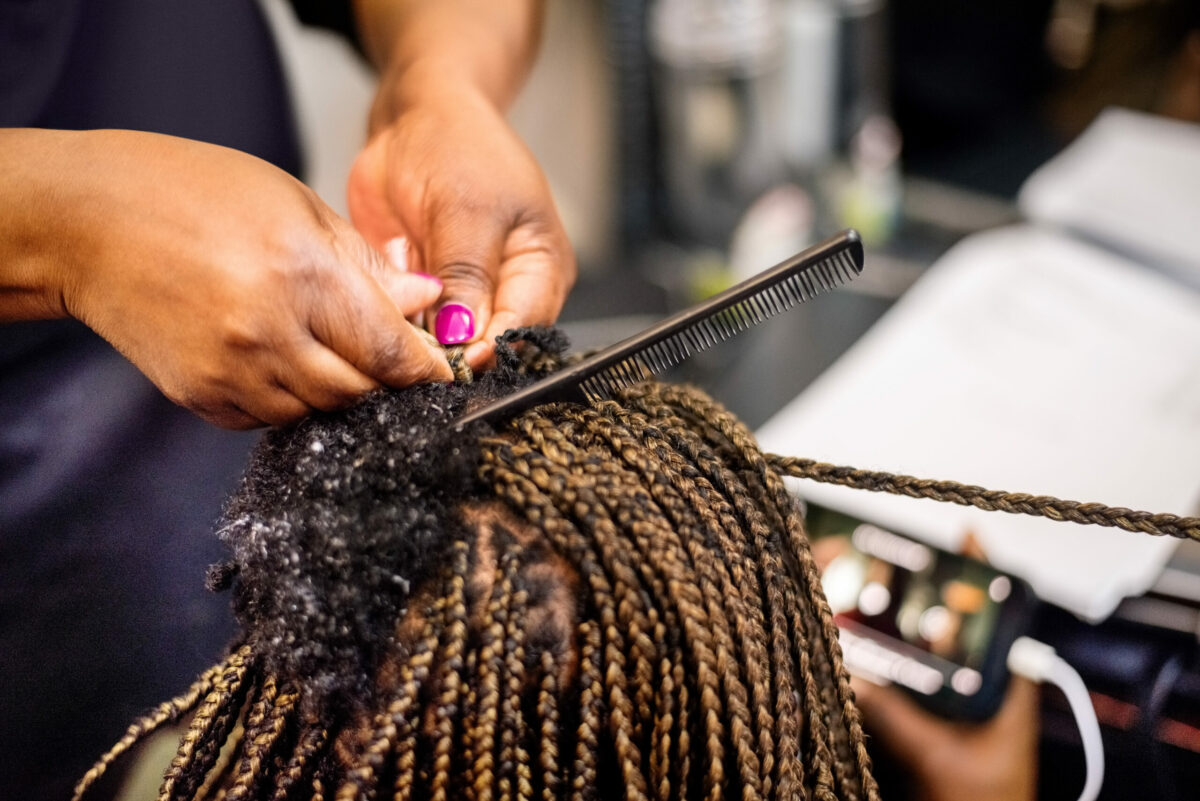
Ciara Imani May, the owner of Rebundle, is done with toxicity. The Root reported that the entrepreneur’s plant-based hair extensions are safer for Black women’s health and the environment than synthetic extensions.
Several pats on the head and sticking bobby pins through hair wefts can temporarily relieve the scalp from itchiness. But May knows how real scalp irritation can get with hair extensions. She told The Root her experience with synthetic hair led her to start Rebundle. “The idea came from my own experience wearing hair extensions and going through scalp irritation and rashes.”
Toxicity is not the vibe, and that includes toxic hair extensions. The plant-based hair bundles are free from harmful plastic toxins used in synthetic hair. May explained to The Root, “We’re constantly in research and development to get the bundles as hairlike as possible and maintain certain values that we hold true, like non-toxicity.”
The company is doing a whole lot of good for the environment too. The entrepreneur knows switching to plant-based hair extensions might be a big commitment for some. Rebundle offers a hair recycling program for wearers stuck on synthetic hair. May said, “We want to help maintain accountability for the waste that’s already in existence in the ecosystem. But it’s also a way for our community to choose sustainability, even if they’re not ready to make the switch to plant-based hair. They still have the opportunity to do some good for the environment.”
The hair extension creator added, “I think we’re pretty hell-bent on having a significant impact on the health and environmental impact that hair extensions are having on us. But we also want to change the way we experience buying and disposing of our extensions and who’s involved,” she said.
Rebundle offers texture samples for $20.00, according to its website. Hair bundles are priced at $45.00.
Paul Pierce Addresses Infamous Social Media Video That Cost Him His ESPN Job
NBA Hall of Famer Paul Pierce was terminated as an ESPN sportscaster in 2021. Yet, he is still rehashing the episode that led to the sports network getting rid of him.
The Boston Celtics legend spoke about the incident that led to his firing with Lance Armstong. The conversation occurred on a taping for the upcoming episode of the Fox television show Stars on Mars.” Pierce was sharing the happenings with Armstrong. He told the former cyclist he was playing poker with friends at a birthday party that incorporated strippers in the celebration. He stated that there was “a lot of alcohol” involved, and the video was posted to Instagram Live.
He told Armstrong there were “girls shaking their asses,” which Armstong didn’t initially understand to mean strippers. As Pierce continued to speak about the incident, Armstrong questioned how the video appeared on social media. Pierce admitted that he posted the video to his Instagram account.
“I accidentally did, my dumb ass.”
While discussing it, Pierce calls singer Tinashe to help him tell the story. She comes over and tries to downplay the video as not being that bad, but she laughs about the situation as Pierce explains that he lost his job due to that video being posted.
After they all laugh at the experience, Pierce sees something good coming out of it as it relates to his appearance on the Fox show.
“Maybe I wouldn’t be on Mars if that didn’t happen. See? Everything happens for a reason.”
“Stars on Mars” features Armstrong and guests, including Super Bowl champion Marshawn Lynch, UFC fighter Ronda Rousey, Real Housewives of Atlanta star Porsha Williams, comedian Natasha Leggero, Superbad star Christopher Mintz-Plasse (a.k.a. “McLovin”), Olympic figure skater Adam Rippon, football player Richard Sherman, singer and songwriter Tinashe, Vanderpump Rules star Tom Schwartz, actress Tallulah Willis, and former Modern Family star Ariel Winter.
Taking The Conversation To Work: Let’s Talk About Black Mental Health
When we talk about mental health, we can’t ignore the places where we spend most of our time—our workplaces. In the spirit of Minority Mental Health Awareness Month, let’s bring into focus the unique hurdles Black workers face every day. These challenges, deep-seated within our society, significantly impact mental health. Today’s fast-paced work culture adds to these struggles.
Just look at the Twitter chat kicked off last month by Tryfe Tejada. He pointed out a simple but powerful truth: making friends at work and hanging out with colleagues outside the office isn’t the same experience for everyone. For Black people, it can often be a very different story. His tweet has been viewed approximately 650,000 times, and the discussions that ensued in response to this tweet highlighted a common theme among Black professionals: the mental toll of enduring racial microaggressions and systemic racism in the workplace.
I realized this. But most yt people make friends at work and are generally very social with coworkers outside of the office. This, of course, is VERY different for Black people.
In many workplaces, Black employees deal with the added stress of feeling alone and facing subtle, sometimes not-so-subtle, racial bias every day. This daily navigation through a web of racism and prejudice takes a heavy toll on their mental health. It’s like walking on eggshells, fearing that any misstep could be used against them, leading to an unhealthy amount of stress and anxiety.
The recent policy shake-ups, like doing away with affirmative action and attacks on diversity efforts, have made things worse. These changes have sent a chilling reminder to Black employees—their experiences and challenges do not matter as much to those holding power.
Here’s the thing: the pandemic and the shift to work-from-home provided some relief for many Black workers. Away from the direct racial tensions and office politics, they found a safer space to be themselves. But with talk of returning to the office, the thought of stepping back into potentially hostile work environments is causing a lot of worry.
Research from Slack Technologies found that only 3% of Black professional workers were accepting of returning to the office full-time, compared to 21% of white professionals.
“We all know the workplace can be stressful for Black people. These stresses not only impact mental health but can lead to chronic illness or exacerbate existing conditions that already plague the Black community like hypertension, diabetes, and heart disease,” said Dr. Brandon Gillespie, a therapist and media professional.
This Minority Mental Health Awareness Month, it’s crucial to shine a light on the racial struggles Black professionals deal with regularly. These aren’t one-off incidents. They’re part of a bigger systemic problem that we need to tackle head-on.
Dr. Gillespie continued, “Several of my clients have quit their jobs to start their own businesses because of their toxic workplaces. People are now moving away from places that cause them stress and pain.”
To truly impact Black mental health, organizations need to foster an environment that actively combats microaggressions and discrimination, promotes understanding, diversity, and provides support for mental health.
“It’s more than just improving diversity numbers—it’s about breaking down the barriers of systemic racism and creating a culture of respect and equality,” added Timeka Muhammad, EDs, LPC-S, founder of The Courage to Cope Counseling and Wellness in Atlanta.
“Workplace racism and stress cause trauma, depression, and many other mental health concerns,” Muhammad concluded.
As we celebrate Minority Mental Health Awareness Month, it’s a wake-up call for all of us. Companies need to prioritize mental health, take a hard look at these systemic issues, and foster a culture that genuinely supports everyone in their organization. Because when it comes to mental health, every conversation, every action, matters.