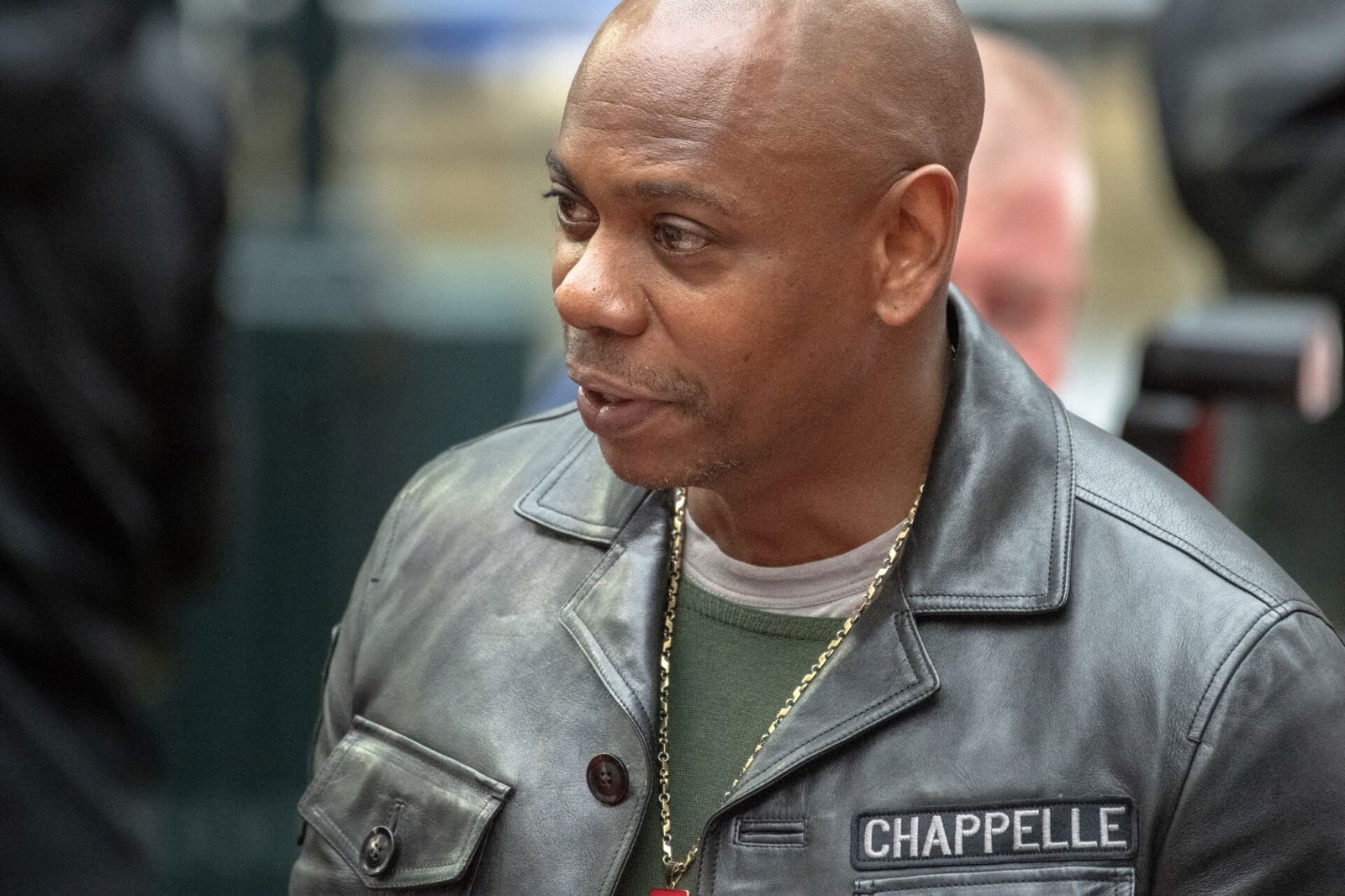
After leaving his own sketch comedy show, Chappelle’s Show, over 20 years ago, comedian Dave Chappelle recently revealed to the Associated Press that he’d consider bringing it back.
“If you’d asked me that question a year ago, I’d have told you absolutely not,” Chappelle said. “But in the last few weeks, it’s come up a lot, and I’m considering it.”
Chappelle was in Yellow Springs, Ohio, joining residents at a ribbon-cutting ceremony for a restoration of the Union Schoolhouse. The comedian financed the redevelopment of the building, which also houses the small-town radio station WYSO, which includes a new broadcast facility.
The Union Schoolhouse was built in 1872, but was vacant for years until Chappelle’s real estate company, Iron Table Holdings, purchased the building in 2020.
WYSO will occupy the building’s lower floors, while Chappelle’s offices will be on the top floor.
“If you have the opportunity, like I did, to invest in your community, then it’s one of the greatest investments I’ve ever made,” he told the Associated Press. “In some ways, it feels dutiful. Other times I feel proud. … but ultimately, I’m doing it because I want to, not because I have to.”
Although the comedian grew up in Maryland, he spent summers in the town, where his late father, William David Chappelle III, was the dean of students at Antioch College.
Chappelle lives with his wife and three children on a 39-acre farm in Yellow Springs. He has invested in local properties and has opened a comedy club downtown.
“One of the best sovereignties that a person can enjoy is the sovereignty of their mind,” he said, according to the Associated Press. “Just the idea of knowing where you land and the rest of the world begins.”
How VC Math Works: A Founder’s Guide To The Power Law And Outsized Returns
Success in venture capital isn’t just about access. It’s about understanding the system well enough to work within it.
Written By Antonia Dean
A question I’m often asked is: “How do you actually get VCs to invest in your company?” As a Partner at an early-stage venture capital fund, most people expect my answer to be about access, networking, or finding the right firm. It’s not. The real edge is far more fundamental and has everything to do with understanding the math involved.
Venture capital isn’t just about spotting great ideas or charismatic founders; it’s a tightly structured financial model with clear incentives and defined outcomes. Once you understand how the money flows, you understand how decisions get made, what gets funded, what gets passed over, and what it actually takes to win. If you’re a tech founder, having that clarity is the difference between guessing and playing the game with intention.
Few people are ever taught to dig into the nitty-gritty of the math involved in venture capital. And that knowledge gap in understanding is a major disadvantage. Below are five core tenets to familiarize yourself with so you can break into and navigate VC with clarity instead.
What is Venture Capital? Understanding the LP and GP Relationship
Photo by Peter Dazeley/Getty Images
At its core, venture capital is a subset of private equity. VC firms raise money from large institutions and wealthy individuals. Think pension funds, university endowments, and family offices. These investors are called Limited Partners, or LPs, and they are the financial backbone of the entire ecosystem.
LPs don’t just hand over money for the sake of innovation; they’re looking for outsized returns. Their portfolios are typically diversified across safer, more predictable assets like public equities and bonds. Venture capital sits on the opposite end of that spectrum: high risk, high reward. It’s where LPs take calculated risks in pursuit of outsized returns that can meaningfully boost overall portfolio performance.
The goal is simple in theory: outperform the market. In industry terms, that’s called generating “alpha” returns that exceed standard benchmarks. The path to that alpha is anything but straightforward.
Why Most VC Bets Fail
If you’re new to raising venture capital, here’s the first uncomfortable truth: most VC-backed companies fail. Founders need to understand that this isn’t a reflection of talent or effort; it’s the model. Venture capital is built on the expectation that many companies will fail, a few will return modest outcomes, and only one or two will drive the majority of returns. That reality shapes how investors behave: why they push for aggressive growth, why they prioritize massive market opportunities, and why they make decisions that can feel misaligned with the goal of building a steady, sustainable business. Understanding this dynamic helps founders see the game they’re stepping into and decide how to play it on their own terms.
That requires a different kind of mindset. Great investors aren’t trying to be right every time. They’re trying to be right in a way that matters. They understand that failure isn’t just inevitable, it’s necessary to the model.
A typical VC portfolio might include 10 companies. Of those, it’s expected that six will fail completely. Another two or three might return the original investment, but not much more. The entire fund’s success often hinges on one or, at best, two companies delivering extraordinary returns. This is known as the Power Law. In venture capital, outcomes aren’t evenly distributed. One breakout company can generate more value than the rest of the portfolio combined.
It’s All About Outsized Returns
In popular culture, venture capital is often associated with “unicorns,” startups valued at $1 billion or more, or even “decacorns” at $10 billion+. But internally, success is defined more precisely. VCs are judged by their ability to return capital to their LPs, typically at a multiple of the original investment. Today, that benchmark is often 3–5x.
That requirement fundamentally changes how investors think. It’s not just “Is this a good business?” It’s “If this works, can it return the entire fund?” For example, if a VC firm manages a $25 million fund, it may need to generate $75 million to $125 million in returns to meet expectations. That means each investment must have the potential, at least on paper, to contribute meaningfully toward that goal.
This is why venture capital tends to favor businesses with massive market opportunities and the ability to scale quickly. Smaller, profitable companies may be great businesses, but they’re often not “venture-backable” because they can’t deliver Power Law outcomes.
How VCs Actually Make Money
The venture capital model is built around what’s commonly known as “2 and 20.” First, the “2” references the management fee, which is typically 2% of the fund’s assets under management annually. This fee covers the cost of running the firm: salaries, legal expenses, due diligence, travel, and operations. For a $25 million fund, that’s about $500,000 per year.
While that may sound substantial, it doesn’t go as far when you consider the costs of sourcing and closing deals. Legal fees alone for a single investment can exceed six figures. This is why many VC firms operate with lean teams.
The “20” is where the real upside is, in the form of “carry,” or carried interest. This is the share of profits that the VC firm keeps after returning the original capital to LPs. Here’s how it works: let’s say that a $25 million fund ultimately returns $100 million. The first $25 million goes back to LPs to repay their initial investment. The remaining $75 million is profit.
That profit is typically split 80/20, with 80% to LPs and 20% to the VC firm. In this case, the firm earns $15 million in carry, in addition to the management fees collected over the life of the fund.
That’s the economic engine of venture capital. But it comes with a catch: those profits can take a long time to materialize.
Remember, VC Is A Long Game
Unlike public markets, where investments can be bought and sold quickly, venture capital is illiquid. Returns are realized only when a company exits, either through an acquisition or an initial public offering (IPO). Both outcomes can be lucrative, but they’re far from immediate. Even a “fast” exit typically takes five to seven years. More commonly, venture investments play out over a 10 to 12-year horizon.
This long timeline is another reason why understanding VC math matters. Investors aren’t just betting on what a company can do today; they’re projecting what it could become a decade from now.Whether you’re an aspiring investor, a founder raising capital, or simply someone trying to understand how innovation gets funded, venture capital can feel opaque. But it’s not magic, it’s math.
Once you see these mechanics clearly, the industry becomes more predictable. You start to understand why VCs push for rapid scale over slow and steady growth, why they pass on good businesses that aren’t big enough, and why timing matters as much as execution.
And perhaps most importantly, you see that success in venture capital isn’t just about access. It’s about understanding the system well enough to work within it, or to challenge it.
Frequently Asked Questions about VC Math
What is the Power Law in venture capital? The Power Law is a financial principle where a small number of investments (1 or 2 out of 10) generate the vast majority of a fund’s total returns, often outperforming the rest of the portfolio combined.
What does “2 and 20” mean? “2 and 20” refers to the standard fee structure for VC funds: a 2% annual management fee to cover operating expenses and a 20% carried interest (profit-sharing) earned after the original capital is returned to investors.
Antonia Dean is a partner at Black Operator Ventures (Black Ops VC), an early-stage VC firm.
Photo by cottonbro studio from Pexels: https://www.pexels.com/photo/a-woman-in-plaid-long-sleeves-sitting-on-the-chair-while-listening-to-music-6864507/
Suno CEO Reveals How ‘Comfortable’ The Music Industry Is Becoming With AI-Generated Content
The CEO of a leading AI music platform says a “market shift” is underway, with more artists and producers using AI to shape their sound.
What began as skepticism and criticism of AI’s growing role in music is now giving way to a noticeable “market shift” toward broader acceptance, industry insiders say.
Mikey Shulman, CEO and co-founder of Suno, a leader in AI music generation, says he’s already seeing more artists and industry figures embrace AI in music creation—marking a shift that has accelerated in just the past few months compared to the end of last year.
“I don’t meet a lot of producers and songwriters who aren’t using Suno at least a little bit in their workflows,” Shulman told the Hollywood Reporter. “I think people are starting to be a little more comfortable being public and upfront about their use, and most importantly, I think a bit more optimistic about the future. It’s not everyone, but there’s definitely a market shift.”
The shift follows early industry backlash that led to lawsuits from major labels accusing platforms like Suno and Udio of using music catalogs without permission to train AI models. Some cases have since been settled, with companies like Universal Music Group and Warner Music Group striking deals to allow only authorized content.
Suno has also worked to build trust by hosting initiatives such as a Grammy Week songwriting camp in Hollywood, which brought together artists, executives, and songwriters to demonstrate how AI can support the creative process.
“We were there and are there to listen a lot and learn and also show,” Shulman said of the camp.
Led by Grammy-winning producer Om’Mas Keith, the writers used Suno to generate fully produced tracks from simple prompts within minutes, then added live instrumentation for a human touch. Shulman said the process shows how AI enhances, not replaces, talented musicians’ creativity.
“You hang around for one hour, it’s very apparent that the best creatives in the world make better sh-t with these things than us mere mortals do,” Shulman said.
Now, creativity is playing out among everyday users on platforms like TikTok, where people regularly remix, speed up, and rework songs. He says it highlights a simple truth: “Everybody is creative. Everybody has the drive to make something.”
“In the future, people will be creating a lot more, and that means interacting with music in new ways,” he said. “And of course, that means interacting with the music of their favorite artists in new ways.”
Tatiana Cirisano, a music industry analyst at Midia Research, said she’s “pleasantly surprised” by how the industry has handled AI so far, adding that music may be better prepared than film and TV, since AI is largely accelerating challenges it has already faced for years.
Still, some remain skeptical. Songwriter Autumn Rowe, who has worked with artists like Jon Batiste, Dua Lipa, and Ava Max, has seen peers use Suno to create demos that later land with artists. She’s begun experimenting with it herself by remixing older, unreleased songs, but worries the process could dilute the authenticity of songwriting.
“I’ve got concerns with AI, I worry about younger writers who use Suno before they’ve spent the many, many hours crafting songs,” Rowe said. “But I do think AI in music will keep getting more prominent, and I think it could help writers get more leverage if they can do a lot of that production early themselves.”
An issue with his visa forced him to return to the States
After resuming his professional basketball career by signing with the Chinese Basketball Association, hip-hop recording artist J. Cole announced that he would no longer play in the league after appearing in one game.
The Born Sinner lyricist wrote to his fans on his personal blog, The Algorithm, and explained why his sports stint had swiftly ended. He said he had visa issues that curtailed his time with the Nanjing Monkey Kings. He did get the chance to play in one game before he had to leave China. Cole was initially scheduled to play in at least three games for the basketball team.
He acknowledged that he played for eight minutes but was unable to make a shot.
“I want to say thank you to the Nanjing club and to the CBA for allowing me to have that incredible experience. Also, to my teammates who were mad cool, and who really wanted me to get a bucket! I got to play 8 minutes in one of the top leagues in the world, got a few good looks, but wasn’t able to hit one.”
In the blog post, he expressed amazement that the basketball fans came to the game with his album so he could sign it for them.
“I also didn’t realize there were so many people in China that rocked with my music! Thank you to everybody who showed up and brought an album to sign. I was blown away.”
This was Cole’s third time playing professional basketball in another country.
Cole, who played on his high school team in North Carolina, played in the Basketball Africa League in 2021 for the Rwanda Patriots. The next year, the 2014 Forest Hills Drive rapper signed to play for the Scarborough Shooting Stars in the Canadian Elite Basketball League.
The artist recently released his latest album, The Fall-Off, on his label, Dreamville, distributed by Interscope Records, Feb. 26.
(Image: Wikimedia Commons / LBJ Library / Jay Godwin) Longtime civil rights leaders Dolores Huerta and Andrew Young discuss their social justice efforts at The Summit on Race in America at the LBJ Presidential Library on Monday, April 8, 2019. Huerta, a Presidential Medal of Freedom recipient, co-founded the United Farm Workers of America with Cesar Chavez in the 1960s and has spent decades advocating for laborers, women, and children. Young, a key lieutenant to Martin Luther King, Jr. in the civil rights movement of the 1960s, has served as mayor of Atlanta, U.S. congressman from Georgia, and U.S. Ambassador to the United Nations. Moderating the discussion is Mark K. Updegrove, LBJ Foundation president and CEO...The Summit on Race in America runs from April 8-April 10 at the LBJ Library...04/08/2019.
Andrew Young Foundation Wants $100M Peace Center In Atlanta To Honor City’s Famed Mayor
The peace center would host the famed former mayor's personal collection of papers, awards, and more.
The Andrew Young Foundation is exploring a $100 million peace center in one Atlanta neighborhood to honor its famed mayor.
The foundation pitched the development idea to break ground in Vine City, a historic area surrounding the west side of the city. According to Axios, the global peace institute would reside amid Atlanta’s storied HBCU campuses and sports stadiums.
To commemorate the city’s civil rights history and Young’s legacy, the foundation has suggested an 80,000-square-foot neoclassical building. Inside, the center would host art galleries, educational spaces, a theater, and a research library.
Young, a former U.N. ambassador who turned 94 in March, was an early pioneer of the Civil Rights Movement. Before his appointment as the mayor of Atlanta in 1982, he became the first Black man elected to Congress from Georgia since the Reconstruction era. Throughout his political career, he remained a lauded public figure for his upliftment of Atlanta and marginalized communities.
Young’s personal collection of papers, awards, and art would also be on display throughout the space. The peace center would also include a domed rotunda, overlooking the historically Black neighborhood that housed legendary Atlanta natives such as Martin Luther King Jr.
To bring this idea to fruition, the organization has asked for a $2 million public investment from Invest Atlanta. The money will remove sewer pipes from underneath its desired project site, a 2.77-acre city-owned lot overlooking Rodney Cook Sr. Park. Atlanta has offered the Andrew Young Foundation a lease rate of $1 per year for a five-year term, with the option to extend for 100 years.
City leaders have welcomed the idea, but want its entire funding secured by 2032. City documents detailed that the project stands a better chance of securing philanthropic grants once construction can begin.
As the foundation continues to secure financial backing, supporters have emphasized the peace center’s mission to amplify Atlanta’s history as a place of justice and equity.
“We want to make sure that the message of inclusion, of brotherly love, friendship, all that the movement represents, continues to be reflected in that particular location,” council member Michael Julian Bond told Axios.
If approved, construction could begin as early as mid-2028, with potential completion before the end of the decade. Invest Atlanta may consider the foundation’s request at its next meeting April 16.
Karen S. Carter Named Dow CEO; Number Of Black Women Running Fortune 500 Companies Now At 2
The HBCU grad, receiving her Bachelor’s degree from Howard University, joins a small group of women running Fortune 500 companies as the new Dow CEO and an even smaller group of Black women who lead them.
Dow announced some changes to its leadership on the board of directors, promoting Chief Operating Officer Karen S. Carter to Chief Executive Officer (CEO). She will replace Jim Fitterling.
The move becomes effective July 1.
“She is a disciplined, highly respected leader with a deep understanding of Dow’s businesses and customers,” Richard Davis, Dow’s independent lead director, said in a statement. “This appointment reflects our confidence in her ability to lead Dow forward into its next chapter of growth and value creation for customers, employees and shareholders.”
The appointment makes Carter the first Black woman to lead a major U.S. chemical company, according to Chemical & Engineering News. Carter has more than 30 years of experience at Dow.
During her tenure as COO, she oversaw business and operational performance across company lines. while strengthening customer engagement and accelerating innovation.
Carter said she is “deeply honored” to sit in this role and excited to lead “into our next chapter.”
“Dow has extraordinary people, world-class assets and leading positions in the markets we serve,” Carter added. “Our focus remains unwavering: delivering reliable and innovative solutions for our customers, and long-term value for our employees and our shareholders, while accelerating our transformation to set a new competitive standard for best-in-class performance.
“I look forward to continuing my partnership with Jim in his new role as Executive Chair, and to working with the Board and all of Team Dow to advance our strategy and deliver on our priorities.”
Previously, Carter served as president of Dow’s Packaging & Specialty Plastics, the company’s largest operating segment.
Carter, who received her bachelor’s degree from Howard University, joins a small group of women running Fortune 500 companies—and an even smaller group of Black women who lead them. A record-high 55 women hold CEO roles, but only two are Black women.
New Medicaid Rules Require At Least 1 Month Of Work; Some States Demanding More
The changes are expected to begin on January 1, 2027.
For the millions of people who apply for or receive Medicaid, they must prove they are working, attending school, or volunteering for at least a month to either gain or retain their health insurance. President Donald Trump signed the changes to the government health program into law as part of the One Big Beautiful Bill Act.
However, as CBS News reports, some lawmakers believe the changes don’t go far enough, so they’re upping the ante.
In Indiana, for example, lawmakers are leading this charge. Governor Mike Braun signed a new bill into law on March 4 that requires applicants to prove they’ve worked or participated in work or volunteer programs for three consecutive months to be eligible for benefits. Indiana is now the first state to set the Medicaid work requirements at three months. It’s the longest period allowed under federal law.
Meanwhile, in Idaho, Republican lawmakers are also requiring a three-month requirement. Governor Brad Little signed the bill into law on April 10.
More States Consider Longer Requirements
It likely won’t end there. State lawmakers are reportedly considering similar laws, including those in Arizona, Missouri, and Kentucky. As a part of Trump’s bill, states can decide whether to require one, two, or three months of work history.
“Normally, you would not see state legislators weighing in on these decisions,” Lucy Dagneau, a senior official with the American Society’s advocacy arm, told CBS News.
The Congressional Budget Office estimates that nearly 19 million adults will be affected by the new Medicaid rules, which will be enforced in 42 states and the District of Columbia. The changes are expected to begin on January 1, 2027. In general, the rules do not apply to children, people 65 years of age or older, people with disabilities, and individuals with serious health issues.
According to KFF, nearly two-thirds of adults ages 19 to 64 on Medicaid are already working.
Though the Rock and Roll Hall of Fame may have missed the mark, New Edition is proving that a legacy is measured by ownership, not just accolades.
New Edition has not only demonstrated its enduring stage presence—”The New Edition Way Tour” just wrapped a 30-city run—but the members have had success in business ventures away from the stage. Having overcome incredible financial strife in their early years, New Edition’s members are getting to the bag.
What Does New Edition Do Offstage?
Michael Bivins
Photo credit:Trish Badge
Sporty Rich Enterprises is a lifestyle brand Bivins’ created to deliver fashion and entertainment products alongside community programs. Through Biv 10 Records, Bivins established his talent development cred by launching Boyz II Men, Another Bad Creation, and 702. Bivins extended his reach into media and philanthropy through Biv Entertainment and the Bivfam Foundation. The Harlem Festival of Culture benefited from Bivins’ strategic advisory role in cultural preservation in 2022, strengthening his impact outside of music.
Ronnie DeVoe
Photo credit: Trish Badge
Ronnie DeVoe established DeVoe Real Estate and DeVoe Broker Associates to work in Atlanta’s housing market, where he focuses on residential and commercial transactions. In 2021, DeVoe joined eXp Realty to grow his platform and promote generational wealth and boost Black homeownership rates. DeVoe directs community programs such as Bikes & Backpacks while supporting relationship-focused initiatives through Married4LifeWalk.
Bobby Brown
Courtesy of TreMedia
Bobby Brown is growing his brand with consumer products and media ventures. Bobby Brown Foods started with sauces, seasonings, and marinades before a specialty coffee line was added. Brown retains ownership of his master recordings and creates content through projects such as his docuseries, Bobby Brown: Every Little Step. New Edition Entertainment handles production support and brand management functions.
Through Reach Media, Ralph Tresvant hosts the nationally syndicated Love and R&B show, and has broadcasting and entrepreneurial ventures. He uses his radio platform to generate income from his voice and brand. Noss’TAP LLC, operated by Tresvant, oversees music distribution along with business management and entertainment collaboration.
Johnny Gill
Photo credit: BE
Johnny Gill is founder and CEO of J Skillz Records, the independent label that manages his brand and released his last music projects, Game Changer and Game Changer 2. The label partnered with SRG/ILS Group for distribution.
Grace Ladoja Makes History With Nike Air Max Design Rooted In African Culture
The Our Homecoming founder becomes the first African woman to design a Nike sneaker, bringing Lagos and the diaspora to the global stage.
Grace Ladoja has spent years building bridges between Africa and the diaspora. Now, she’s turning that vision into something you can wear.
The cultural entrepreneur and founder of the Our Homecoming Festival has partnered with Nike to design a new Air Max Plus sneaker—marking the first time an African woman has designed a shoe for the global brand.
The collaboration, created under the Our Homecoming banner, is bigger than a fashion moment. Ladoja’s offering, combined with its historical impact, represents a true cultural statement.
With an intentional approach to the design, Ladoja’s offering arrives in two colorways: “Pan-African,” featuring a black base with red, green, and white accents, and “African Sunrise,” a bold orange gradient inspired by the glow of West African mornings. Both versions include symbolic detailing, from detachable charms like the Nigerian eagle and cowrie shell to maps of Africa, grounding the shoe in heritage and identity.
For Ladoja, the Air Max Plus is a silhouette that’s particularly personal to her lived experience.
“I saved up my bus fare to buy the shoe when I was young,” Ladoja said in an interview with Hypebae, which revealed her connection to both the style and sneaker culture. “I walked to school for 60 days to buy this shoe, so it feels really special to have it be the first thing I’ve worked on with Nike.”
The design also communicates volumes about Ladoja’s dual British-Nigerian heritage.
“That shoe is about being from two places at the same time, thinking about where home is,” Ladoja told Business of Fashion. Home for me is London. But the fabrication of the shoe is really Lagos. It’s really Africa.”
The mesh used for the shoe is based on the African sponge, while Ladoja’s model also incorporates a waterproof toe for functionality, adjustments she says she made with Lagos in mind. The shoelaces are a callback to Ladoja’s upbringing in London, where lace style often reflected where you were from.
That full-circle moment mirrors the trajectory of her career. Born in the U.K. to Nigerian parents, Ladoja has become one of the most influential cultural curators shaping the global perception of African creativity. Through Our Homecoming, the Lagos-based festival she launched in 2018, she has created a platform that brings together music, fashion, art, and sport, attracting talent and audiences from across the diaspora.
The Nike collaboration builds on that foundation, translating the spirit of Homecoming into a global product. It also reflects a broader shift in how brands engage with culture, moving from inspiration to collaboration, and from collaboration to authorship.
On April 13, the Studio Museum in Harlem announced on Instagram that applications are now open for its coveted annual residency, offering an 11-month program for three artists of African descent from around the world working in any medium.
“The residency program offers artists an unparalleled opportunity to develop their practice from within the Museum’s walls,” the Museum shared in its caption. “Individuals selected for the residency receive institutional guidance, professional development, research support, studio space, and a stipend paid out over the course of the residency.”
The 2026–27 Artist-in-Residence program will run from Nov. 2, 2026, to Oct. 3, 2027, culminating in an in-house exhibition at the Studio Museum in Harlem. Since its founding in 1969, the program has supported more than 150 artists of African and Afro-Latinx descent, shaping generations of contemporary talent.
In the 1980s, then-director Mary Schmidt Campbell formalized the residency by standardizing its structure and cohort size. Selected artists receive studio space, a $37,500 stipend, and mentorship from museum staff and visiting arts professionals.
Since its inception, the program has helped fill a critical gap by supporting artists of color navigating financial and personal challenges while staying true to their creative vision. Alums of the program continue to widely recognize its importance across Harlem and the broader art world.
“One of my fondest memories of being in the program is the camaraderie that I had with the other two artists [Terry Boddie and Nicole Awai], feeling that we were all embarking on a new journey,” said Sanford Biggers, a cohort within the 1999 – 2000 program.
“The residency maintained the momentum I was building and offered me access to people, exhibitions, and most importantly, the opportunity to begin regularly showing public works outdoors,” said Chakaia Booker, a cohort within the 1995 – 1996 residency.
In February, the Studio Museum in Harlem named Derriann Pharr, Simonette Quamina, and Taylor Simmons as its 2026 Artists-in-Residence. They are the first cohort to work in the J. Bruce Llewellyn Artist in Residence Center at the Museum’s new home, which opened in November 2025 with an installation honoring past residents.